
Official statement
Other statements from this video 17 ▾
- 1:24 Pourquoi Google republie-t-il des guides sur robots.txt et meta robots maintenant ?
- 7:02 GoogleBot crawle-t-il des URLs que votre site n'a jamais générées ?
- 7:27 GoogleBot crawle-t-il vraiment des URLs que votre site n'a jamais générées ?
- 8:07 Pourquoi Search Console et Google Analytics affichent-ils des données différentes ?
- 8:51 Combien de temps Google met-il vraiment à reconnaître une correction de balise noindex ?
- 9:49 Pourquoi Google met-il autant de temps à reconnaître la suppression d'une balise noindex ?
- 11:11 L'encodage des caractères spéciaux dans le code source nuit-il vraiment au référencement ?
- 11:11 L'encodage des caractères spéciaux dans le code source pose-t-il un problème pour le SEO ?
- 11:47 Comment bloquer efficacement les PDF du crawl Google sans risquer l'indexation ?
- 11:51 Faut-il vraiment bloquer les PDF avec robots.txt ou utiliser noindex ?
- 14:14 Combien de temps Google met-il vraiment à afficher votre nouveau nom de site ?
- 14:14 Comment forcer Google à afficher le bon nom de votre site dans les SERP ?
- 14:59 Pourquoi Google pénalise-t-il les noms de marque trop similaires dans les SERP ?
- 15:14 Faut-il éviter les noms de marque similaires pour ne pas nuire à son référencement naturel ?
- 19:01 Pourquoi Google refuse-t-il de détailler ses critères de classification adulte ?
- 20:13 Un site 100% HTTPS sans version HTTP est-il pénalisé par Google ?
- 20:30 Un site HTTPS-only pose-t-il un problème SEO ?
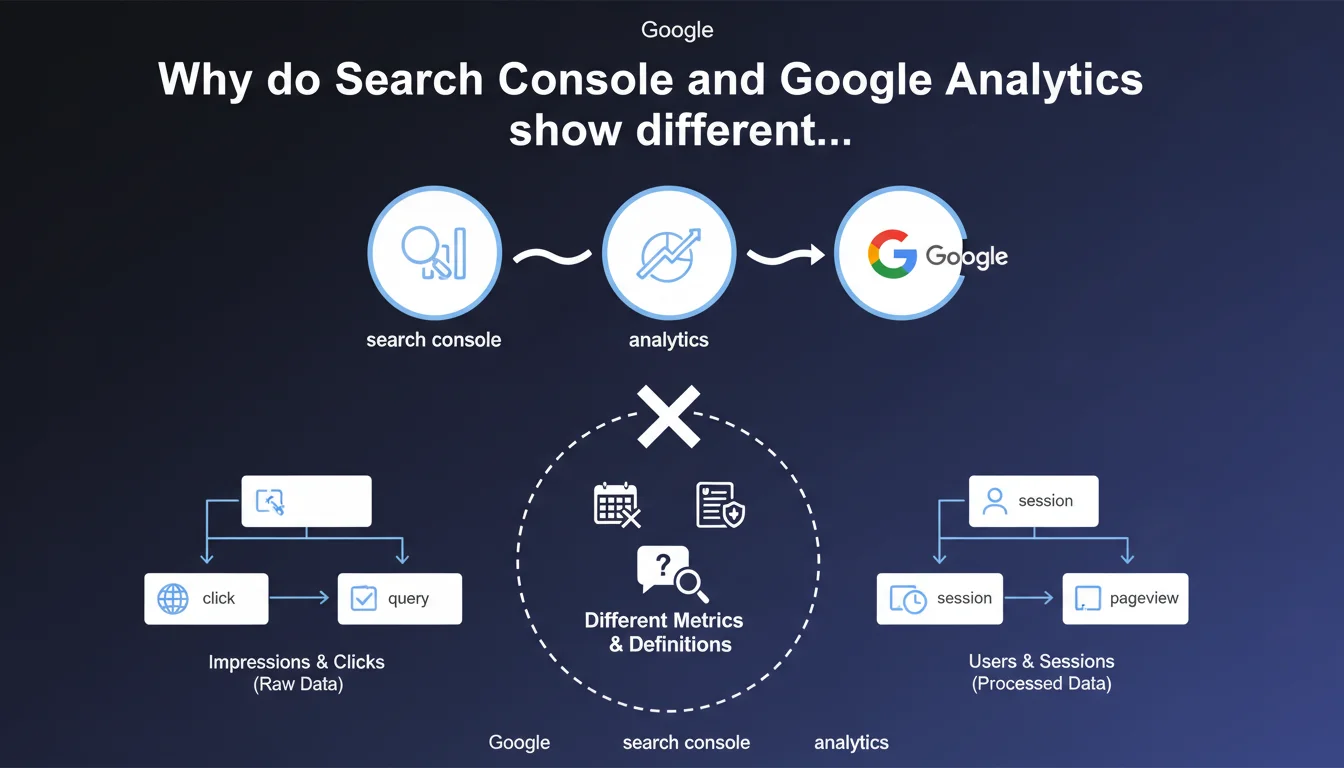
Search Console and Google Analytics use distinct metrics and definitions, which explains the discrepancies between the two tools. Google confirms that these differences are normal and refers you to its documentation to understand the reasons for these divergences. For an SEO professional, this means you need to understand the specifics of each tool before drawing hasty conclusions.
What you need to understand
Why can't these two tools align?
Search Console and Google Analytics collect data at different times and according to different protocols. Search Console records impressions and clicks on Google's side, even before the user reaches your site. Analytics, on the other hand, only counts actual sessions after the page loads and the tracking script executes.
This Google statement reminds us of a fundamental principle: each tool has its own scope. Search Console measures visibility in the SERPs, Analytics measures post-click behavior. Trying to make them match perfectly is like comparing apples and oranges.
What are the most common sources of discrepancies?
Differences stem from several technical factors. Data sampling, processing delays, filters applied in Analytics, or even script blockers on the user side naturally create divergences.
A click recorded in Search Console doesn't always become a session in Analytics. If the user leaves the page before the script fully loads, if an adblocker blocks tracking, or if the session timeout configuration differs, the numbers diverge mechanically.
How acceptable are these discrepancies?
Google provides no precise threshold — and that's telling. [To verify] because this lack of a benchmark makes it difficult to identify real anomalies. Is a 10% discrepancy normal? 30%? 50%? The ambiguity remains.
In practice, variations of 15 to 25% are commonly observed on well-configured sites. Beyond that, you need to investigate: tracking issues, poorly configured filters, untracked redirects, or suspicious traffic.
- Search Console measures on Google's side, before arriving at your site
- Analytics measures on-site, after the tracking script loads
- Ad blockers impact only Analytics
- The definitions of sessions and clicks are not identical
- Google doesn't provide a threshold for "acceptable" discrepancies
SEO Expert opinion
Is this statement an admission of technical helplessness?
Let's be honest: this announcement looks more like a disclaimer. Google refers you to its documentation without providing new insights. For a tool that claims to provide reliable data, the lack of transparency on normal discrepancy thresholds is problematic.
The issue is that without a clear benchmark, each professional interprets these discrepancies their own way. Some ignore them entirely, others spend hours tracking non-existent anomalies. This grey area benefits Google more than practitioners.
What nuances should be noted in practice?
Not all discrepancies are equal. A difference in total clicks vs sessions is expected. However, if Search Console shows 10,000 clicks on a specific URL and Analytics only sees 3,000, there's clearly a problem — likely related to tracking, redirects, or URL matching issues.
Experience shows that discrepancies widen particularly on sites with heavy JavaScript, SPA architectures, or complex multi-subdomain configurations. In these cases, each tool's measurement methodology amplifies natural divergences.
When is this explanation insufficient?
When discrepancies become erratic — for example, some pages show perfect consistency while others display absurd ratios — the simple methodological difference no longer holds. This often signals a specific configuration problem.
Similarly, if trends diverge (Search Console rising while Analytics falls, or vice versa), you need to dig deeper than the official explanation. Common causes: undocumented tracking changes, poorly executed technical migration, or bot traffic polluting one of the two tools. [To verify] systematically before concluding that discrepancies are normal.
Practical impact and recommendations
How do you correctly interpret data from both tools?
First rule: never use Search Console and Analytics to measure the same thing. Search Console is for evaluating your SERP performance (rankings, CTR, impression-generating queries). Analytics is for analyzing post-click behavior (bounce rate, session duration, conversions).
Practically speaking? Use Search Console to identify keyword opportunities, optimize CTR, and detect visibility drops. Switch to Analytics to understand what happens once the user arrives: which pages convert, what content engages, where visitors drop off.
What mistakes should you avoid in cross-analysis?
The classic mistake: trying to reconcile absolute numbers. "I have 5,000 clicks in Search Console but only 4,200 organic sessions in Analytics — where did the 800 go?" This question makes no sense — the two tools don't measure the same thing at the same time.
Another common trap: ignoring time window differences. Search Console may display data with a few days' delay, especially for recent impressions. Analytics is nearly real-time. Comparing identical date ranges doesn't guarantee you're comparing the same events.
What should you verify to minimize abnormal discrepancies?
Beyond normal methodological discrepancies, certain configurations unnecessarily amplify divergences. Start by auditing your tracking configuration: is the Analytics tag properly deployed on all pages? Are redirects correctly tracked? Are subdomains configured with cross-domain tracking if necessary?
Next, check the Analytics filters that can exclude traffic (geographic filters, internal IP exclusions, URL filters). These filters don't exist in Search Console, mechanically creating discrepancies. Document each filter so you know exactly what you're comparing.
- Use Search Console for SERP performance analysis and Analytics for user behavior analysis
- Don't try to match absolute numbers between the two tools
- Verify that the Analytics tag is deployed on 100% of indexed pages
- Audit Analytics filters that can exclude organic traffic
- Test tracking across different browsers and devices
- Document observed discrepancies to identify abnormal trends
- Monitor sudden variations rather than absolute values
- If discrepancies exceed 30%, launch a complete technical audit
❓ Frequently Asked Questions
Quel écart entre Search Console et Analytics est considéré comme normal ?
Pourquoi Search Console affiche-t-il plus de clics qu'Analytics de sessions organiques ?
Dois-je me fier davantage à Search Console ou à Analytics pour mesurer mon trafic SEO ?
Les bloqueurs de publicité peuvent-ils expliquer tous les écarts observés ?
Comment savoir si mes écarts sont dus à un problème technique ou simplement méthodologiques ?
🎥 From the same video 17
Other SEO insights extracted from this same Google Search Central video · published on 27/03/2025
🎥 Watch the full video on YouTube →
💬 Comments (0)
Be the first to comment.