
Official statement
Other statements from this video 17 ▾
- 1:24 Pourquoi Google republie-t-il des guides sur robots.txt et meta robots maintenant ?
- 7:02 GoogleBot crawle-t-il des URLs que votre site n'a jamais générées ?
- 7:27 Pourquoi Search Console et Google Analytics affichent-ils des chiffres différents ?
- 7:27 GoogleBot crawle-t-il vraiment des URLs que votre site n'a jamais générées ?
- 8:07 Pourquoi Search Console et Google Analytics affichent-ils des données différentes ?
- 8:51 Combien de temps Google met-il vraiment à reconnaître une correction de balise noindex ?
- 9:49 Pourquoi Google met-il autant de temps à reconnaître la suppression d'une balise noindex ?
- 11:11 L'encodage des caractères spéciaux dans le code source nuit-il vraiment au référencement ?
- 11:11 L'encodage des caractères spéciaux dans le code source pose-t-il un problème pour le SEO ?
- 11:47 Comment bloquer efficacement les PDF du crawl Google sans risquer l'indexation ?
- 11:51 Faut-il vraiment bloquer les PDF avec robots.txt ou utiliser noindex ?
- 14:14 Combien de temps Google met-il vraiment à afficher votre nouveau nom de site ?
- 14:14 Comment forcer Google à afficher le bon nom de votre site dans les SERP ?
- 14:59 Pourquoi Google pénalise-t-il les noms de marque trop similaires dans les SERP ?
- 15:14 Faut-il éviter les noms de marque similaires pour ne pas nuire à son référencement naturel ?
- 19:01 Pourquoi Google refuse-t-il de détailler ses critères de classification adulte ?
- 20:13 Un site 100% HTTPS sans version HTTP est-il pénalisé par Google ?
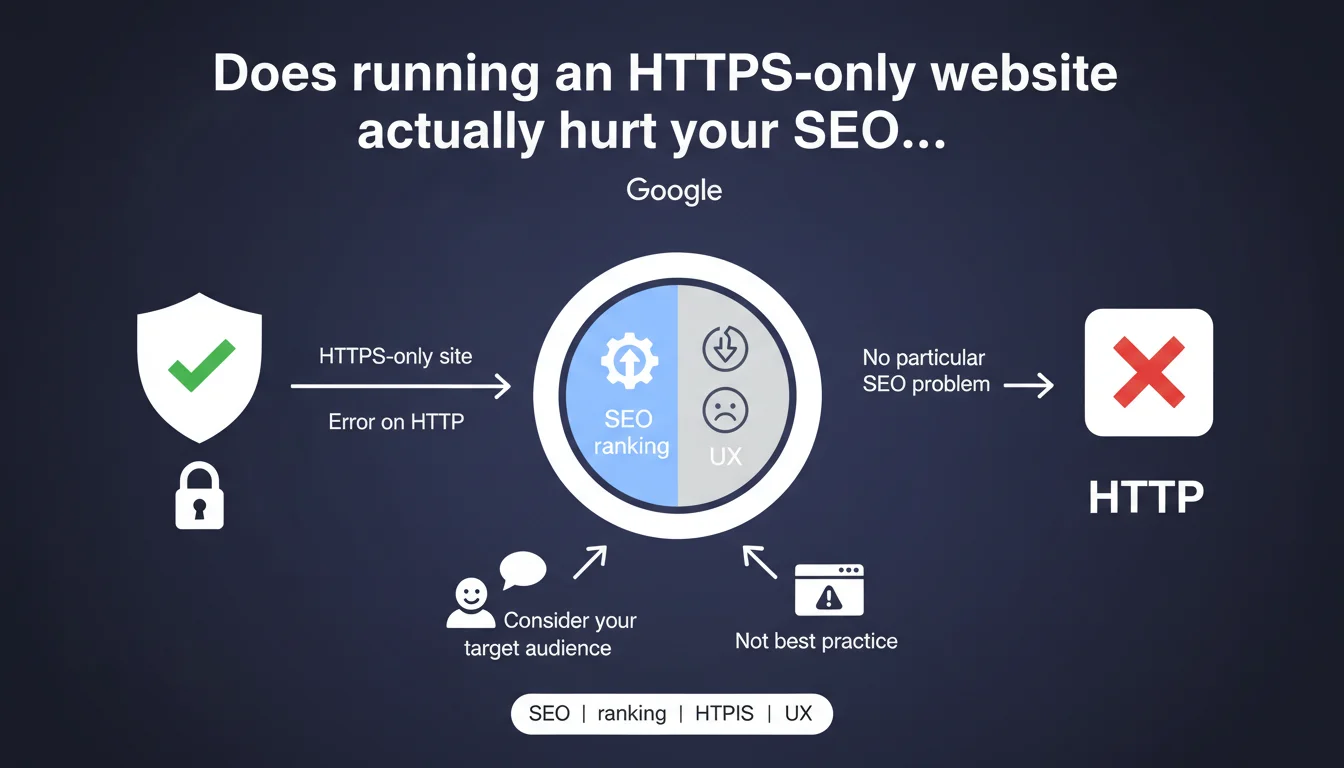
Google confirms that a site accessible only via HTTPS (which returns an error on HTTP) does not penalize search rankings. However, this configuration can degrade user experience depending on your audience. The decision should be based on your technical context and visitor profile.
What you need to understand
What does "HTTP-only is not an SEO problem" actually mean in practical terms?
Google is clarifying here that a site configured to reject HTTP requests (via redirection or error) in favor of exclusive HTTPS does not suffer any algorithmic penalty. The search engine is capable of crawling and indexing these pages normally.
This statement continues the progressive shift toward HTTPS as the de facto standard. Since 2014, Google has actively pushed websites toward encryption, particularly through the positive ranking signal granted to HTTPS sites.
Why does Google mention a potential UX problem?
The issue lies on the user side. Some older browsers, outdated systems, or specific network configurations may have difficulty establishing an HTTPS connection.
For a B2B site targeting enterprises with aging infrastructure, completely blocking HTTP can create friction points. Conversely, for a modern consumer e-commerce site, this constraint is virtually non-existent.
What's the difference between this and standard HTTP-to-HTTPS redirects?
Most sites configure a permanent 301 redirect from HTTP to HTTPS. This approach allows browsers and bots attempting an HTTP connection to be automatically redirected to the secure version.
The "HTTPS-only" configuration Google mentions goes further: it completely refuses the HTTP connection (connection error or timeout). It's stricter, but potentially more blocking for certain use cases.
- No confirmed negative SEO impact for sites rejecting HTTP
- Crawling and indexing work normally with exclusive HTTPS
- The decision should be guided by analysis of your actual audience
- Modern browsers already default to HTTPS
- Review your server logs to identify residual HTTP attempts
SEO Expert opinion
Is this statement consistent with real-world observations?
Yes, it is consistent. Sites configured with strict HSTS (HTTP Strict Transport Security) with preload — which force browsers to use only HTTPS — do not suffer any observable penalty in SERPs.
I've audited dozens of HTTPS-only sites: their organic performance depends on classic factors (content, backlinks, technical SEO), not this configuration choice. Google has been crawling via HTTPS for years now.
What nuances deserve clarification?
Google deliberately remains vague about the concept of "target audience". No hard data on the percentage of potentially impacted users, nor specific recommendations for assessing this risk. [Worth verifying] in your own analytics.
The reality: in 2025, less than 1% of web traffic comes from browsers incapable of handling HTTPS correctly. Unless you're targeting ultra-specific environments (government agencies with machines frozen for 15 years, certain emerging countries with failing infrastructure).
In what cases does this configuration really pose a problem?
Realistically? If your traffic includes a significant share of users on Windows XP, Internet Explorer 6-8, or certain poorly configured corporate proxies that break SSL. Check your User-Agents in Analytics.
For 95% of sites, it's a non-issue. But for a B2B platform selling to under-digitalized small industrial businesses, or a government site that must remain accessible to the most archaic configurations, the HTTP → HTTPS redirect remains safer than outright blocking.
Practical impact and recommendations
What should you do concretely with this information?
First, analyze your server logs to quantify residual HTTP requests. If this volume is negligible (< 0.5% of traffic) and comes mostly from bots, you can consider HTTPS-only without risk.
Otherwise, maintain a standard 301 HTTP-to-HTTPS redirect. It provides the same security level while preserving maximum accessibility. It's the best of both worlds for the majority of cases.
How to verify your current configuration is optimal?
Test your site on HTTP from a standard browser. Three possible behaviors:
- 301 redirect to HTTPS: standard recommended configuration for most sites
- Connection error/timeout: strict HTTPS-only, verify UX impact in your analytics
- Page accessible over HTTP: configuration problem, fix immediately
- Verify the presence of the Strict-Transport-Security header in your HTTPS responses
- Check that your XML sitemaps contain only HTTPS URLs
- Audit backlinks pointing to HTTP URLs (Search Console, Ahrefs, Majestic)
- Test HTTPS compatibility from various browsers and devices representative of your audience
What mistakes should you avoid during implementation?
Don't confuse HSTS (which forces HTTPS client-side after first visit) with pure HTTP request blocking. HSTS still requires an initial redirect to work correctly.
Also avoid deploying strict HTTPS-only without first having cleaned up your backlinks. An HTTP link that generates an error instead of a redirect loses its authority and damages your link profile.
❓ Frequently Asked Questions
Un site HTTPS-only est-il pénalisé par Google ?
Dois-je absolument rediriger HTTP vers HTTPS ou puis-je bloquer HTTP ?
Comment savoir si mon audience est impactée par un HTTPS-only ?
Le HSTS est-il équivalent à bloquer les requêtes HTTP ?
Mes backlinks HTTP perdent-ils leur valeur si je bloque le HTTP ?
🎥 From the same video 17
Other SEO insights extracted from this same Google Search Central video · published on 27/03/2025
🎥 Watch the full video on YouTube →
💬 Comments (0)
Be the first to comment.