
Official statement
Other statements from this video 10 ▾
- □ Is Google's shift from Webmaster Guidelines to Search Essentials just a rebrand, or does it signal something bigger?
- □ Are Search Essentials really the non-negotiable foundation for ranking on Google?
- □ How is Google now displaying website names in search results?
- □ Is your favicon costing you clicks? Here's why Google wants you to check it now
- □ Are Panda and Penguin Still Relevant in Modern SEO?
- □ Does Google finally publish a complete history of its ranking updates?
- □ Why does Google document some ranking systems but keep others completely hidden?
- □ Is Google Really Being Transparent About Algorithm Updates, and What Does It Mean for Your SEO?
- □ Does Google really expect you to solve your traffic drops through a community forum instead of direct support?
- □ Should you really be sending feedback to Google about its SEO documentation gaps?
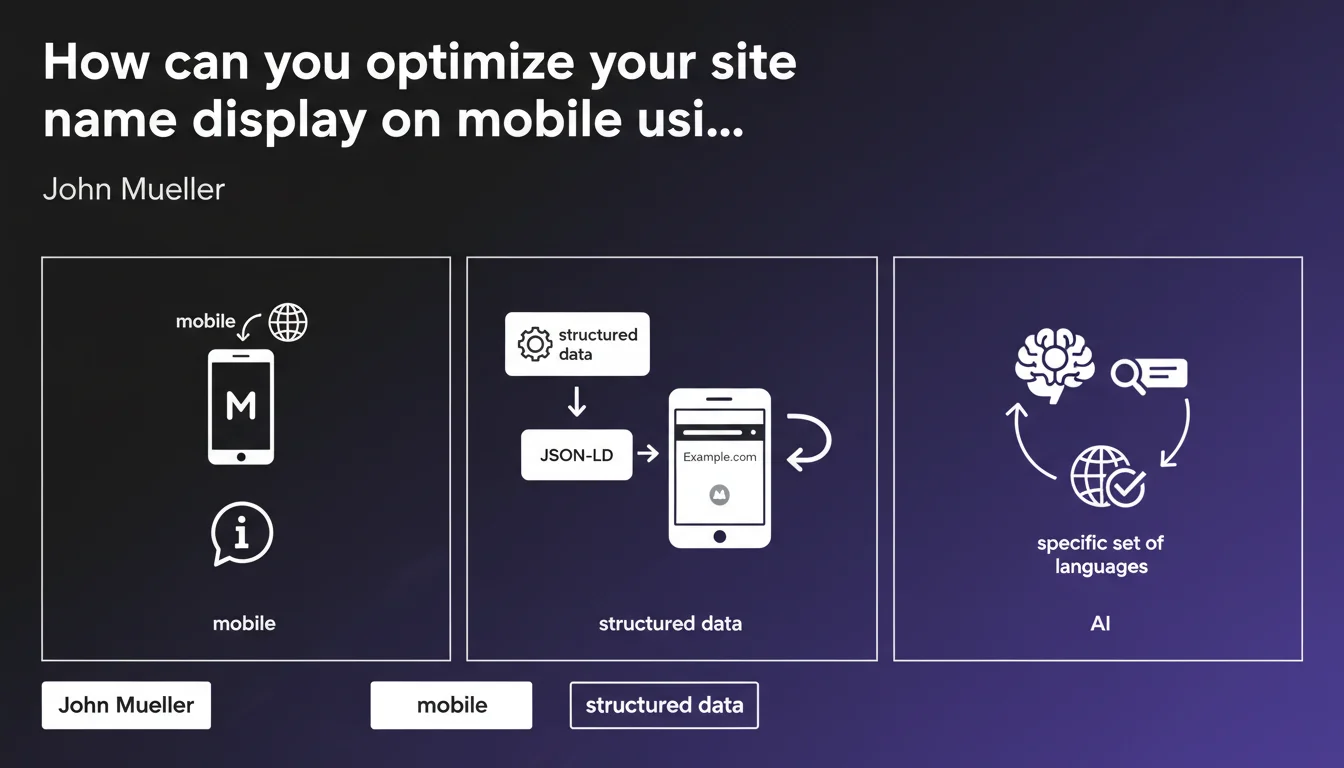
Google is rolling out the site name feature on mobile for a limited set of languages. Websites can influence their display through specific structured data. This feature is not yet universal and depends on precise linguistic criteria.
What you need to understand
What exactly is the site name feature?
This is an option that allows websites to control how their name appears in mobile search results. Rather than letting Google decide how to display your brand, you can now use structured data to specify exactly what should appear.
The rollout remains partial. Only certain languages are affected, which limits the immediate impact for many international or multilingual websites.
Why is Google limiting this feature to certain languages?
Google doesn't explain the reasons behind this linguistic restriction. It's reasonable to assume this is a gradual rollout designed to test system reliability before broader expansion.
Since the affected languages aren't listed in the announcement, there's no way to know if your market is eligible without testing directly. This is the kind of ambiguity that forces SEO professionals to do reverse engineering.
What structured data markup should you use?
Mueller mentions "appropriate structured data" without specifying exactly which markup. In practice, this refers to the WebSite markup with the name property in schema.org.
Google Search Central's official documentation details the exact syntax, but Mueller's statement remains deliberately vague on validation criteria.
- Feature limited to mobile only for now
- Availability restricted to an unspecified set of languages
- Use of WebSite structured data to influence display
- No guarantee that Google will systematically respect the provided name
- Gradual rollout with opaque exact criteria
SEO Expert opinion
Does this feature actually give you control over how your name displays?
Let's be honest: saying you "can use" structured data doesn't mean Google will systematically respect it. History shows that Mountain View always reserves the right to rewrite whatever it wants, even with perfect markup.
Real-world observations confirm that even with correct structured data, Google sometimes displays a brand name different from the one declared. The feature offers a suggestion, not a guarantee. [Needs verification] in your specific sector, as results vary enormously.
Why is this feature limited to mobile only?
Mobile-first indexing has been the standard for years, but limiting a display feature to mobile says a lot about Google's priorities. Desktop continues to exist for complex commercial searches — this asymmetry is problematic.
Concretely? Your desktop and mobile users could potentially see different brand names in the SERPs. For brand consistency, that's questionable.
Which languages are actually affected?
Mueller provides no list. Zero transparency. To find out if your French-speaking, German-speaking, or Spanish-speaking market is eligible, you need to test manually or wait for a third party to compile observations.
This systematic opacity forces professionals to do permanent reverse engineering instead of working on documented foundations. It's time-consuming and delays adoption of features that are actually simple to implement on the code side.
Practical impact and recommendations
How do you correctly implement WebSite structured data?
Add a WebSite JSON-LD type on your homepage with the name and url properties. The name should match exactly how you want your brand to appear in mobile results.
Validate the markup using Google's Rich Results Test. Keep in mind — technical validation doesn't guarantee Google will adopt it in the SERPs. The time it takes to apply varies from a few days to several weeks.
What mistakes should you avoid when setting this up?
Don't put multiple variations of your brand name on different pages. Google interprets conflicting signals poorly and may ignore your structured data completely.
Avoid overly long names or keyword-stuffed ones. Google may view that as spam and rewrite your name its own way. Keep it simple: authentic brand name, no keyword stuffing.
How can you verify that your name displays correctly on mobile?
Test with actual mobile search, not just a desktop emulator. Desktop previews don't accurately reflect what a mobile user sees.
Search for branded queries about your brand from a smartphone. If the displayed name doesn't match your structured data after 2-3 weeks, it's either because your language isn't covered or Google has decided to ignore it.
- Implement WebSite JSON-LD with name property on your homepage
- Validate markup with Rich Results Test and Search Console
- Test actual mobile display on branded search queries
- Check for conflicting signals on other pages
- Monitor changes over 2-4 weeks before drawing conclusions
- Document whether your language is part of the initial rollout
❓ Frequently Asked Questions
Quelles langues sont actuellement supportées pour les noms de sites ?
Les données structurées WebSite garantissent-elles l'affichage du nom choisi ?
Pourquoi cette fonctionnalité est-elle limitée au mobile ?
Combien de temps faut-il pour que le nom s'affiche dans les résultats ?
Faut-il mettre le JSON-LD WebSite sur toutes les pages du site ?
🎥 From the same video 10
Other SEO insights extracted from this same Google Search Central video · published on 21/12/2022
🎥 Watch the full video on YouTube →
💬 Comments (0)
Be the first to comment.