
Official statement
Other statements from this video 10 ▾
- □ Is Google's shift from Webmaster Guidelines to Search Essentials just a rebrand, or does it signal something bigger?
- □ Are Search Essentials really the non-negotiable foundation for ranking on Google?
- □ How is Google now displaying website names in search results?
- □ How can you optimize your site name display on mobile using structured data?
- □ Is your favicon costing you clicks? Here's why Google wants you to check it now
- □ Are Panda and Penguin Still Relevant in Modern SEO?
- □ Does Google finally publish a complete history of its ranking updates?
- □ Why does Google document some ranking systems but keep others completely hidden?
- □ Does Google really expect you to solve your traffic drops through a community forum instead of direct support?
- □ Should you really be sending feedback to Google about its SEO documentation gaps?
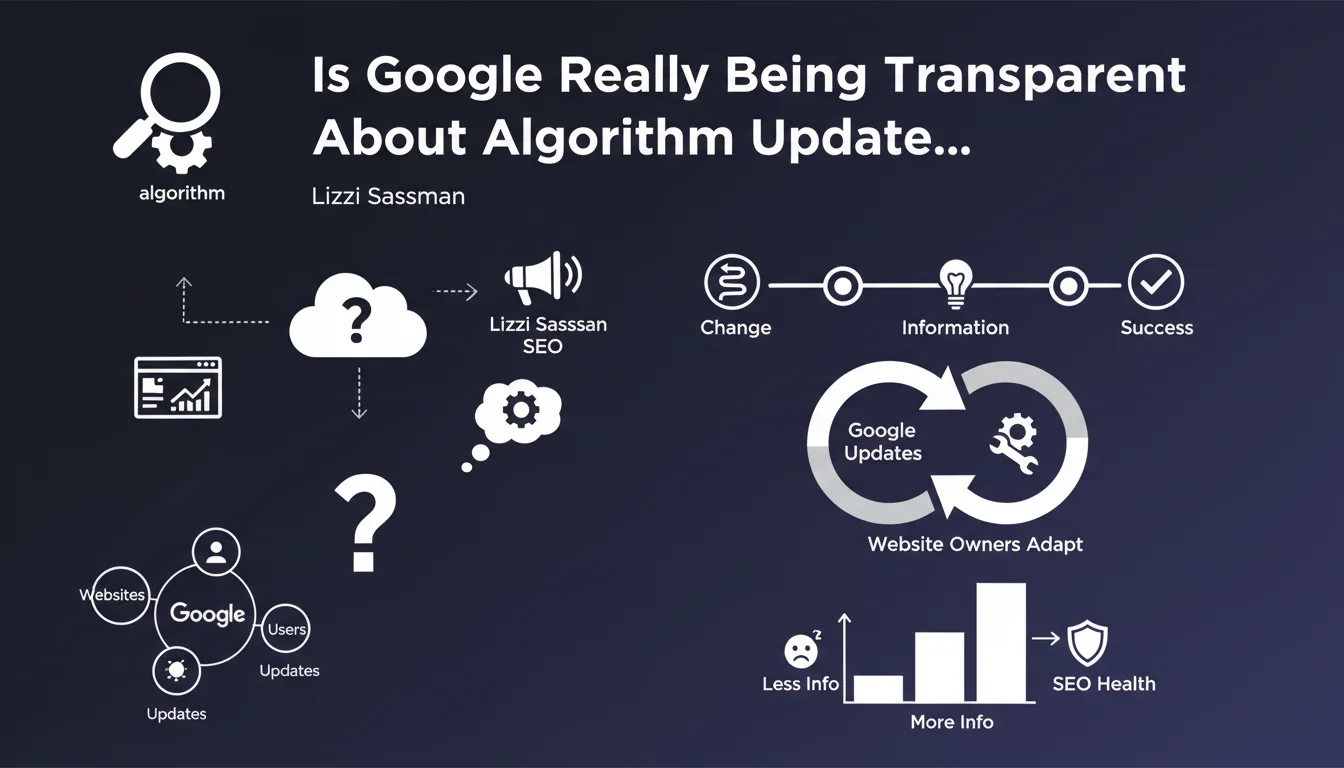
Google claims to do its best to inform website owners about algorithmic updates, acknowledging that change is difficult. Lizzi Sassman emphasizes the importance of providing webmasters with the necessary information to succeed with Google Search. A statement that raises the question of what truly constitutes "doing your best" when it comes to communication.
What you need to understand
What is Google Really Trying to Achieve With This Statement?
This statement from Lizzi Sassman, head of Search documentation at Google, comes at a time when webmasters regularly criticize the search engine for its lack of transparency regarding updates. The statement explicitly acknowledges that "change is difficult" — an admission that resonates particularly after multiple Core Updates that have caused dramatic traffic drops.
The phrase "doing its best" is interesting. It suggests that Google is aware of the limitations of its current communication, while preemptively absolving itself: we're doing what we can, you understand.
What Is the Concrete Promise Behind This Announcement?
Google commits to providing "the information necessary to succeed with Google Search." What "necessary" means remains to be defined. Does this refer to update announcements on the Search Status Dashboard? General guidelines in the documentation? Detailed explanations about ranking criteria?
The wording remains deliberately vague. No mention of timelines, level of detail, or guarantees about communication frequency. This is about intention, not measurable commitment.
What Are the Key Takeaways?
- Google officially acknowledges that algorithmic changes are difficult for website owners to manage
- Communication about updates is presented as a priority, without specifying concrete methods
- The stated objective is to give webmasters the means to "succeed" — a formulation that leaves considerable room for interpretation
- This statement echoes recurring criticism about Google's lack of transparency concerning its algorithms
- No KPI or quantified commitment accompanies this intention
SEO Expert opinion
Is This Communication Consistent With What SEO Professionals Actually Observe?
Let's be honest: there's a glaring gap between this declaration of intent and the daily reality of SEO professionals. Yes, Google has improved with the Search Status Dashboard and more regular Core Update announcements. But "doing its best"? Debatable.
SEO practitioners regularly observe unexplained fluctuations that don't correspond to any official update. Sites lose 50% of their traffic overnight without any communication explaining the cause. The time between update rollout and public announcement remains unpredictable.
And that's where it falls short. [To be verified] : Google claims to communicate "the necessary information," but systematically refuses to detail the precise ranking criteria or algorithmic weightings. How can this communication be considered sufficient?
What Are the Limitations of This "Benevolent" Approach?
The phrase "change is difficult" implies that Google understands the pain of webmasters. Fair enough. But this displayed empathy doesn't translate into concrete actions to facilitate the transition.
Take the Helpful Content Updates: Google claims to want to favor useful content, but the criteria remain fuzzy. What exactly is "people-first" content? How do I measure whether my content meets the standards? General guidelines aren't enough when a site loses 70% of its traffic.
In Which Cases Does This Announced Transparency Not Apply?
There are gray areas where Google remains systematically silent. Manual penalties are documented via Search Console, admittedly. But algorithmic actions? No notification, no individualized explanation.
The E-E-A-T criteria also remain shrouded in mystery. Google communicates their importance but refuses to provide precise metrics. How do you evaluate an author's expertise? What weight for domain authority? A mystery. This opacity allows Google to maintain complete control — and it's probably intentional.
Practical impact and recommendations
What Should You Concretely Do in Response to Google's Communication?
First rule: don't rely solely on Google's official announcements to drive your SEO strategy. The algorithmic reality goes far beyond what's publicly communicated. You need to cross-reference multiple information sources.
Monitor the Search Status Dashboard regularly, but supplement with active monitoring: SEO forums, sectoral fluctuation analysis, monitoring tools like SEMrush or Ahrefs that detect SERP volatility. Unannounced changes are sometimes more impactful than official Core Updates.
How Can I Ensure My Site Stays Aligned Despite the Uncertainty?
Rather than trying to decode every update, focus on the documented fundamentals: content quality, user experience, Core Web Vitals, clean technical architecture. These pillars remain valid regardless of algorithmic evolution.
Adopt a data-driven approach: analyze correlations between your performance and periods of volatility. A site that drops during a Helpful Content Update likely has an editorial quality issue — even if Google doesn't say so explicitly.
What Mistakes Should You Avoid in This Context of Partial Information?
- Don't panic at every ranking fluctuation — not all are tied to an update
- Avoid over-optimizing in reaction to vague announcements (e.g., artificially stuffing your site with E-E-A-T signals)
- Don't ignore Search Console signals under the pretext that no update was announced
- Refuse to bet everything on a single traffic source — diversification remains the best protection
- Don't treat Google's guidelines as exhaustive: they provide direction, not a complete checklist
- Avoid blindly copying what works for competitors — each site has its own context
❓ Frequently Asked Questions
Google annonce-t-il toutes ses mises à jour algorithmiques ?
Comment savoir si une baisse de trafic est liée à une mise à jour Google ?
Les communications de Google donnent-elles des pistes actionnables pour récupérer du trafic perdu ?
Peut-on contester ou demander des explications à Google après une perte de classement suite à une mise à jour ?
Faut-il modifier son site immédiatement après l'annonce d'une mise à jour ?
🎥 From the same video 10
Other SEO insights extracted from this same Google Search Central video · published on 21/12/2022
🎥 Watch the full video on YouTube →
💬 Comments (0)
Be the first to comment.