
Official statement
Other statements from this video 10 ▾
- □ Is Google's shift from Webmaster Guidelines to Search Essentials just a rebrand, or does it signal something bigger?
- □ Are Search Essentials really the non-negotiable foundation for ranking on Google?
- □ How is Google now displaying website names in search results?
- □ How can you optimize your site name display on mobile using structured data?
- □ Is your favicon costing you clicks? Here's why Google wants you to check it now
- □ Are Panda and Penguin Still Relevant in Modern SEO?
- □ Does Google finally publish a complete history of its ranking updates?
- □ Why does Google document some ranking systems but keep others completely hidden?
- □ Is Google Really Being Transparent About Algorithm Updates, and What Does It Mean for Your SEO?
- □ Does Google really expect you to solve your traffic drops through a community forum instead of direct support?
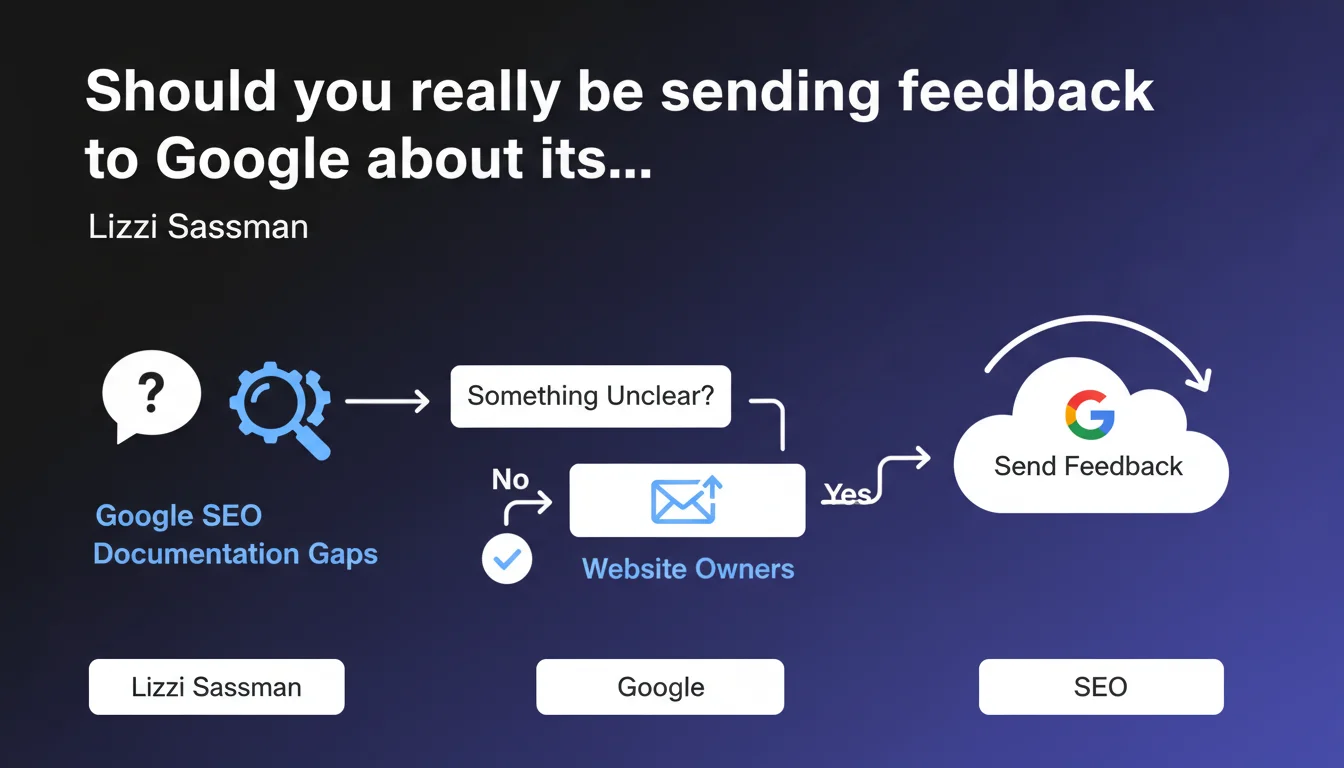
Google actively encourages website owners to flag gaps and unclear areas in its official documentation. This open invitation reveals that even the search engine itself acknowledges blind spots or ambiguities in its own resources. For SEO practitioners, it's an opportunity to influence the clarity of future guidelines.
What you need to understand
What does this Google invitation actually mean in practice?
Google admits that its official documentation can be incomplete, ambiguous, or poorly worded. Lizzi Sassman calls on website owners to report these shortcomings directly. This isn't mere formality: Google is trying to identify gray areas that generate conflicting interpretations within the SEO community.
In practice, this means that a professional who stumbles on a vague or contradictory instruction shouldn't simply speculate. They can — and should — flag the problem to potentially obtain an official clarification.
Why is this approach relevant for an SEO professional?
Google documentation (Search Central, Search Console support, Office Hours videos) serves as normative reference for any SEO strategy. When it's vague, you end up testing blind or relying on case studies that aren't necessarily generalizable.
Getting an official clarification through this channel can settle internal debates, justify technical choices to a client or developer, or prevent costly errors based on misinterpretation.
How do you send feedback to Google?
Each Search Central page has a feedback button at the bottom. Google encourages you to be specific: which section is problematic, which wording creates confusion, what information is missing. The more detailed and specific your feedback, the better the chances it will be addressed.
- Google acknowledges gaps in its own SEO documentation
- Direct feedback can influence the clarification of future guidelines
- This can prevent costly misinterpretations that waste time and traffic
- The feedback channel is accessible on Search Central, at the bottom of each page
SEO Expert opinion
Does Google actually take this feedback seriously?
We know Google processes certain feedback — we've seen documentation updates following community reports. But the actual response rate? [To verify]: Google shares no metrics on the volume of feedback processed, average response time, or prioritization criteria.
It's likely that massive feedback or reports from high-authority sites are processed faster. A small site flagging an inconsistency may never receive a direct response — but contributes to a critical mass that can trigger a revision.
When is this invitation really useful?
Let's be honest: sending feedback on every unclear detail is time-consuming and has low ROI. Real value concentrates on situations where a documentation ambiguity blocks a major strategic decision or exposes you to penalty risk.
For example: a contradictory instruction between English and French docs, a technical rule mentioned in Office Hours but undocumented, or a complete absence of guidance on an emerging format (e.g., short videos, AI carousels).
Does this channel replace field testing?
No. Google documentation reflects what the company wants to communicate, not necessarily what the algorithm actually does. Feedback can clarify an official instruction, but will never reveal undocumented patterns that only large-scale testing can detect.
Seasoned practitioners know that a significant portion of ranking behavior exists in the gray zone between what Google says and what Google does. Feedback improves the former; tests help map the latter.
Practical impact and recommendations
When should you send feedback to Google?
Prioritize cases where documentation ambiguity directly impacts your decisions. For example: you're torn between two technical architectures because the docs are unclear on cross-domain canonical treatment. Or you're facing contradictory guidance between two official pages.
Don't waste time on cosmetic details or imperfect wording with no practical consequence. Save this channel for real blockers.
How do you formulate effective feedback?
Be precise and factual. Indicate the exact section, quote the problematic sentence, explain why it creates confusion. If possible, suggest a rewording or flag an inconsistency with another official page.
Avoid vague feedback like "the docs aren't clear." Google probably receives hundreds of generic submissions that get buried. Actionable feedback has a better chance of being processed.
- Identify documentation gray areas that block strategic decisions
- Use the feedback button at the bottom of Search Central pages
- Formulate precise feedback: page, section, sentence, nature of the issue
- Don't count on quick turnaround — document your decision internally
- Always cross-check with field testing: the docs don't tell the whole story
- Monitor documentation updates to see if your feedback was incorporated
❓ Frequently Asked Questions
Où envoyer un retour sur la documentation Google ?
Google répond-il systématiquement aux retours envoyés ?
Faut-il envoyer un retour pour chaque imprécision trouvée ?
Le feedback peut-il accélérer une clarification officielle ?
Ce canal remplace-t-il les tests SEO terrain ?
🎥 From the same video 10
Other SEO insights extracted from this same Google Search Central video · published on 21/12/2022
🎥 Watch the full video on YouTube →
💬 Comments (0)
Be the first to comment.