
Official statement
Other statements from this video 10 ▾
- □ Are Search Essentials really the non-negotiable foundation for ranking on Google?
- □ How is Google now displaying website names in search results?
- □ How can you optimize your site name display on mobile using structured data?
- □ Is your favicon costing you clicks? Here's why Google wants you to check it now
- □ Are Panda and Penguin Still Relevant in Modern SEO?
- □ Does Google finally publish a complete history of its ranking updates?
- □ Why does Google document some ranking systems but keep others completely hidden?
- □ Is Google Really Being Transparent About Algorithm Updates, and What Does It Mean for Your SEO?
- □ Does Google really expect you to solve your traffic drops through a community forum instead of direct support?
- □ Should you really be sending feedback to Google about its SEO documentation gaps?
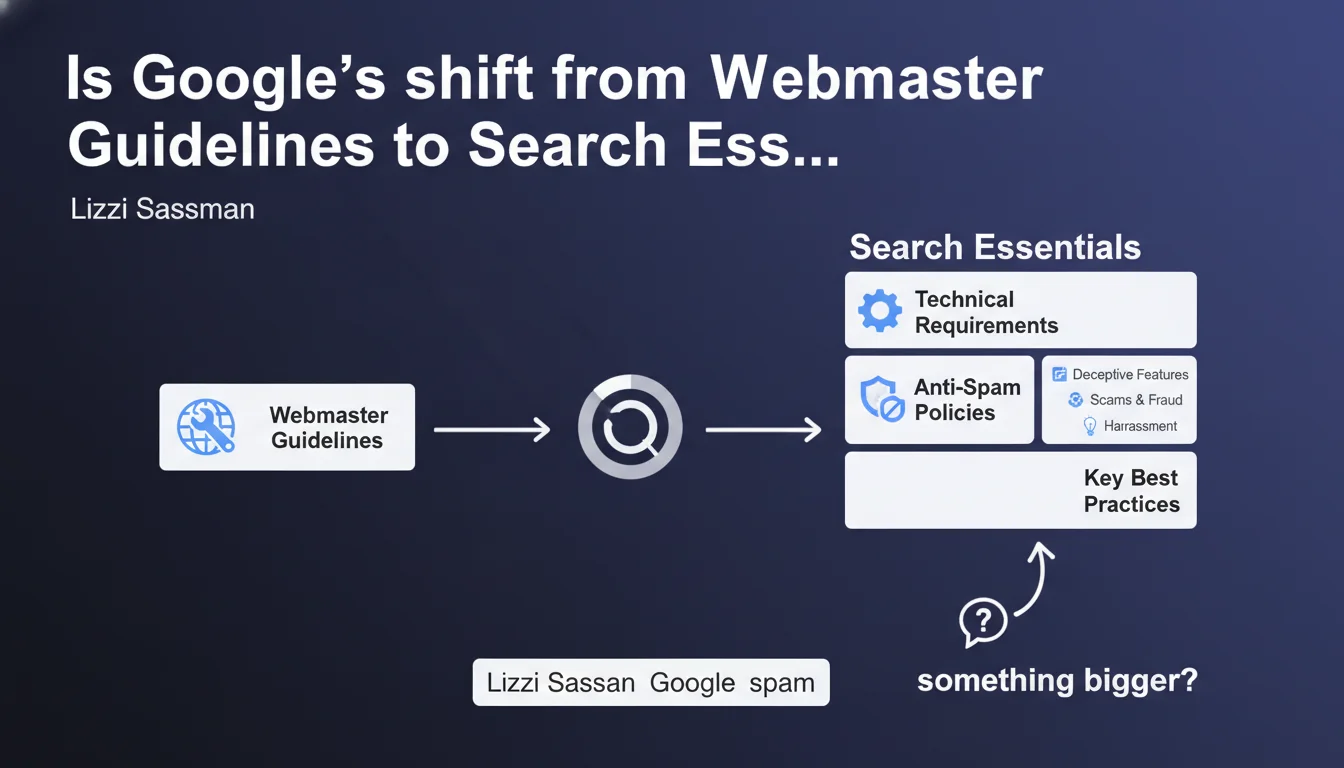
Google is rebranding its Webmaster Guidelines to Search Essentials and restructuring directives around three pillars: minimum technical requirements, expanded anti-spam policies (with new sections on deceptive practices, scams, fraud, copyright, and harassment), and key best practices. This rebranding comes with a refocus on what matters most and clearer rule definitions.
What you need to understand
Is this name change purely cosmetic, or does it signal a deeper strategic shift?
Google is moving from Webmaster Guidelines to Search Essentials. Beyond the more modern vocabulary (nobody has called themselves a "webmaster" for over a decade), this overhaul marks a strategic refocus. The old guidelines mixed everything together: technical recommendations, anti-spam policies, SEO best practices, quality advice...
Now, Google clearly structures three tiers: minimum technical requirements (the bare minimum to be indexed), anti-spam policies (what can get you penalized), and a focused set of best practices. This hierarchy forces Google to make explicit what counts as mandatory versus recommended.
What are these newly added anti-spam sections?
Google is expanding its anti-spam policies with previously unseen sections: deceptive practices, scams, fraud, copyright, and harassment. These additions reflect recent web problems: sites mimicking official services, financial scams, large-scale content theft, and negative SEO smear campaigns.
Practically speaking, Google now has an explicit framework to demote or deindex these contents without operating in a gray area. For SEO practitioners, this is also a signal: these practices risk manual penalties on top of algorithmic action.
What exactly does Google mean by a "focused set of best practices"?
Google doesn't precisely define this narrower scope in their announcement. We can reasonably assume it concentrates on what actually moves the needle for rankings: clean technical structure, original and useful content, decent user experience.
Gone are the long laundry lists of one-size-fits-all recommendations mixing essential and secondary advice. This simplification could help beginners — but heads up: what's not in the "essentials" isn't necessarily negligible. Internal linking, page depth, and crawl efficiency remain critical.
- Three pillars: technical requirements, anti-spam, key best practices
- New anti-spam sections covering scams, fraud, copyright, and harassment
- Clear distinction between mandatory requirements and recommendations
- Rebranding from "Webmaster" terminology to more current language
- Scope of "best practices" narrowed to essentials — full details to come
SEO Expert opinion
Does this overhaul actually change the game, or is it just new packaging?
Substance-wise, there's nothing revolutionary here. Technical requirements (indexability, robots.txt, sitemaps...) have existed forever. Anti-spam policies too. What's changing is the presentation and hierarchy. Google is making explicit what was previously implicit: here's the absolute minimum, here's what gets you sanctioned, here's what we recommend.
For an experienced SEO professional, immediate impact is minimal. But this clarity becomes a powerful talking point with clients or leadership who downplay certain technical aspects. "Google classifies this as a minimum requirement, not a best practice" — that's a useful rhetorical tool.
Are these new anti-spam sections aligned with what Google actually penalizes?
Partially. Google already penalizes scams, stolen content, and fraudulent sites — but often opaquely and with significant delays. Formalizing these rules in Search Essentials pushes Google toward greater transparency on deindexation criteria.
However, the harassment section raises questions. Will Google penalize aggressive negative SEO campaigns? Coordinated fake review bombs targeting a brand? [To verify]: we'll need to watch how these policies translate into concrete actions. Historically, Google has been reluctant to take broad manual intervention at scale.
Should we expect algorithm updates following this restructuring?
Unlikely in the short term. This rebranding is primarily an editorial clarification, not a technical overhaul. Google's algorithms don't get rewritten just because documentation is renamed.
However, this restructuring may foreshadow more targeted manual deindexing campaigns focused on these new anti-spam categories. If Google is formalizing rules on scams and fraud, it's probably to justify forthcoming action. Watch your Search Console reports for activity in these areas.
Practical impact and recommendations
What should you audit first following this announcement?
Start by verifying your site meets the minimum technical requirements. Clean robots.txt, updated sitemap, working HTTPS, indexable pages with no unnecessary blocks. This seems basic, but it's what Google is now highlighting as non-negotiable foundation.
Next, review the new anti-spam sections. Does your site have features that could be flagged as deceptive? Sneaky download buttons, forms redirecting to unsolicited offers, aggressive pop-ups? If yes, clean it up. Google now has explicit grounds to penalize you.
How do you verify none of your pages violate the new anti-spam policies?
Crawl your site with Screaming Frog or Oncrawl. Identify pages with suspicious redirects, massive duplicate content, or deceptive schema markup (fake reviews, false pricing). Also audit affiliate pages: some previously tolerated tactics may now fall under the new scam and fraud rules.
If you host user-generated content (UGC), audit it for potentially fraudulent, defamatory, or copyright-infringing material. Google can now hold you accountable if you host such content without moderation.
What mistakes should you avoid now that these rules are formalized?
Don't play with deceptive practices. This covers fake download buttons, ads disguised as editorial content, and interstitials blocking main content access. Google has always hated this, but now it's explicitly in Search Essentials.
Also avoid monetizing your site with borderline scam offers: crypto pyramids, miracle products, fake emergency services. Even if it converts, you risk manual deindexation.
- Audit your robots.txt file and XML sitemap
- Verify key page indexability (no accidental noindex tags)
- Eliminate deceptive features: fake buttons, aggressive interstitials
- Review affiliate and monetized content for borderline practices
- Moderate user-generated content to prevent fraudulent, defamatory, or stolen material
- Check for suspicious or unjustified redirects
- Verify schema markup isn't deceiving users (fake reviews, false prices)
❓ Frequently Asked Questions
Les anciennes Webmaster Guidelines sont-elles encore valables ?
Dois-je m'attendre à une pénalité si mon site ne suit pas les bonnes pratiques clés ?
Qu'est-ce qu'une fonctionnalité trompeuse selon Google ?
Cette refonte impacte-t-elle les sites e-commerce différemment ?
Faut-il revoir mes contenus existants suite à cette annonce ?
🎥 From the same video 10
Other SEO insights extracted from this same Google Search Central video · published on 21/12/2022
🎥 Watch the full video on YouTube →
💬 Comments (0)
Be the first to comment.