
Official statement
Other statements from this video 10 ▾
- □ Pourquoi Google transforme-t-il ses Webmaster Guidelines en Search Essentials ?
- □ Les Search Essentials sont-elles vraiment essentielles pour ranker sur Google ?
- □ Comment Google affiche-t-il désormais les noms de sites dans les résultats de recherche ?
- □ Comment optimiser l'affichage de votre nom de site sur mobile avec les données structurées ?
- □ Pourquoi Google recommande-t-il de vérifier votre favicon suite au changement d'affichage des noms de sites ?
- □ Faut-il encore se soucier de Panda et Penguin en SEO ?
- □ Pourquoi Google documente-t-il certains systèmes de classement et pas d'autres ?
- □ Pourquoi Google communique-t-il sur ses mises à jour et qu'est-ce que ça change pour les SEO ?
- □ Pourquoi Google renvoie-t-il vers la Search Central Help Community pour comprendre les changements de trafic ?
- □ Pourquoi Google demande-t-il des retours sur sa documentation SEO ?
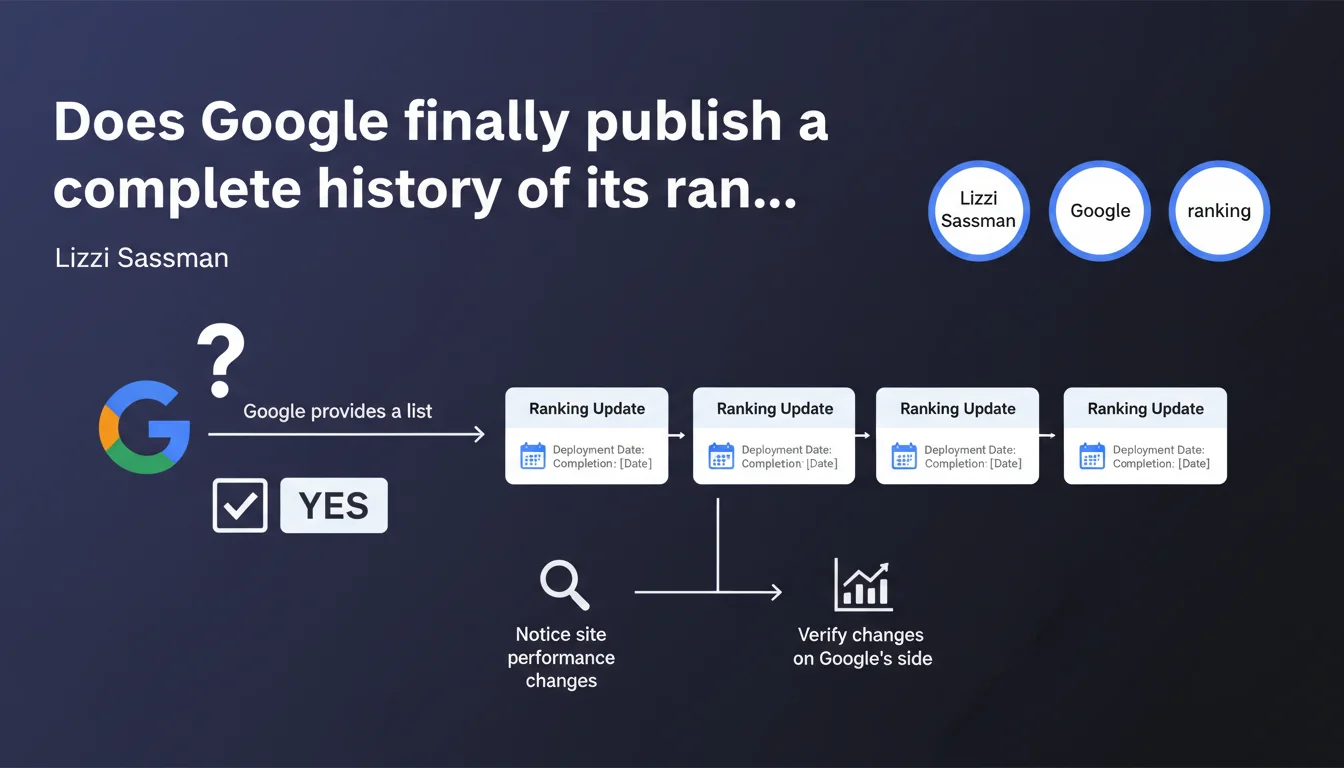
Google provides an official list of ranking updates with their deployment and completion dates. This resource enables SEO professionals to correlate traffic fluctuations with documented Google interventions, finally offering a reliable reference point for diagnosing sudden drops or spikes in visibility.
What you need to understand
Why does this list change the game for SEO professionals?
Until now, identifying the cause of a traffic fluctuation was often a guessing game. Practitioners scanned forums, third-party tools, and tried to piece together weak signals. Google now centralizes the official deployment dates of its updates, which removes a significant degree of uncertainty.
This transparency facilitates retrospective analysis. If your site loses 30% of traffic between March 12 and 18, you can verify whether a Core Update or thematic update rolled out during that period. Diagnosis becomes less time-consuming.
Which updates are actually listed?
The list covers major algorithm updates: Core Updates, Helpful Content, Product Reviews, Spam Updates, and others. Google indicates the start and end of the rollout, which allows you to distinguish between a gradual impact and a sudden shock.
However, not all daily micro-adjustments appear in this repository. Google makes thousands of minor modifications each year — this list only records significant interventions likely to cause measurable variations.
How do you use this resource in practice?
The primary value lies in temporal correlation. When you observe an anomaly in your Analytics or Search Console curves, start by cross-referencing the dates with those on this list. If an update coincides, you know the issue likely stems from your alignment with quality criteria targeted by that update.
This approach also helps avoid false leads. If no update matches the decline period, look toward your infrastructure, a technical error, or competitive changes.
- The list formalizes the start and end dates of each major update
- It covers Core Updates, Helpful Content, Product Reviews, Spam Updates, and other documented interventions
- It does not record daily adjustments or localized tests
- Its primary use: diagnose traffic fluctuations by correlating dates and impact magnitude
- It provides a reliable reference to distinguish algorithmic issues from technical problems
SEO Expert opinion
Is this transparency as complete as it appears?
Let's be honest: this list represents progress, but it remains partial. Google only documents updates it chooses to discuss publicly. Yet, massive fluctuations regularly occur without any official announcement accompanying them.
Some late rollouts or post-deployment adjustments don't always appear in this timeline. [To verify]: Is the announced temporal granularity (start/end) always accurate, or does Google sometimes round dates to simplify communication?
Does the list truly solve the diagnosis problem?
Not entirely. Even knowing that a Core Update rolled out between March 10 and 25, you won't know which specific signal penalized your site. Google never details the weighting of hundreds of criteria evaluated during an update.
In practice? This list tells you when something changed, but rarely why your site suffered. You'll always need to conduct in-depth qualitative analysis: content, backlinks, UX, EEAT signals, etc.
In which cases is this resource insufficient?
Some sectors experience constant fluctuations with no direct link to documented updates. YMYL niches, for example, are subject to frequent, unannounced algorithmic adjustments. If your site covers finance or health topics, this list captures only a fraction of actual interventions.
Similarly, multilingual sites or those targeting multiple geographic regions may see staggered impacts across regions. Google sometimes deploys updates in progressive, localized manner, complicating strict correlation between dates and observed effects.
Practical impact and recommendations
What should you concretely do with this list?
Integrate this resource into your monthly monitoring routine. The moment an unusual fluctuation appears in your metrics (organic traffic, rankings, CTR), immediately consult the list to check if an update coincides.
If so, export your most impacted pages from Search Console and audit them according to the quality criteria targeted by the relevant update. For a Core Update, scrutinize content depth, EEAT, and user satisfaction. For a Helpful Content Update, track signs of engine-generated content.
What errors should you avoid when interpreting?
Don't fall into the over-interpretation trap. Just because an update rolled out from April 5-20 doesn't mean every traffic variation during that period comes from this update. Other factors — seasonality, competition, technical modifications — can play simultaneously.
Also avoid reacting too quickly. An update's effects can take several weeks to stabilize. If you drastically modify your site on day 3 of the rollout, you risk correcting a non-problem, or worsening the situation.
How do you verify your site aligns with targeted criteria?
For each documented update, Google typically publishes an explanatory article on its official blog. Read it carefully, then cross-reference with Quality Rater Guidelines recommendations if the update affects content quality.
Next, conduct a targeted audit: if it's a Product Reviews Update, thoroughly review your product sheets and verify the presence of genuine tests, original photos, and factual comparisons. If it's a Spam Update, track toxic backlinks and artificial link schemes.
- Consult the list as soon as a traffic fluctuation occurs
- Cross-reference dates with your Search Console and Analytics data
- Identify the most impacted pages and audit them according to the relevant update's criteria
- Read the official Google article accompanying each major update
- Don't react immediately: wait for rollout stabilization (often 2-3 weeks)
- Document each impact to detect patterns during future updates
- Avoid drastically modifying your site before confirming the actual cause of the fluctuation
❓ Frequently Asked Questions
Cette liste inclut-elle toutes les mises à jour de Google ?
Puis-je me fier aux dates indiquées pour diagnostiquer une chute de trafic ?
Que faire si mon trafic chute sans qu'aucune mise à jour ne soit listée ?
Cette liste remplace-t-elle les outils de suivi des fluctuations SERP ?
Google explique-t-il pourquoi mon site a été impacté par une mise à jour ?
🎥 From the same video 10
Other SEO insights extracted from this same Google Search Central video · published on 21/12/2022
🎥 Watch the full video on YouTube →
💬 Comments (0)
Be the first to comment.