
Official statement
Other statements from this video 10 ▾
- □ Pourquoi Google transforme-t-il ses Webmaster Guidelines en Search Essentials ?
- □ Comment Google affiche-t-il désormais les noms de sites dans les résultats de recherche ?
- □ Comment optimiser l'affichage de votre nom de site sur mobile avec les données structurées ?
- □ Pourquoi Google recommande-t-il de vérifier votre favicon suite au changement d'affichage des noms de sites ?
- □ Faut-il encore se soucier de Panda et Penguin en SEO ?
- □ Google publie-t-il enfin un historique complet de ses mises à jour de classement ?
- □ Pourquoi Google documente-t-il certains systèmes de classement et pas d'autres ?
- □ Pourquoi Google communique-t-il sur ses mises à jour et qu'est-ce que ça change pour les SEO ?
- □ Pourquoi Google renvoie-t-il vers la Search Central Help Community pour comprendre les changements de trafic ?
- □ Pourquoi Google demande-t-il des retours sur sa documentation SEO ?
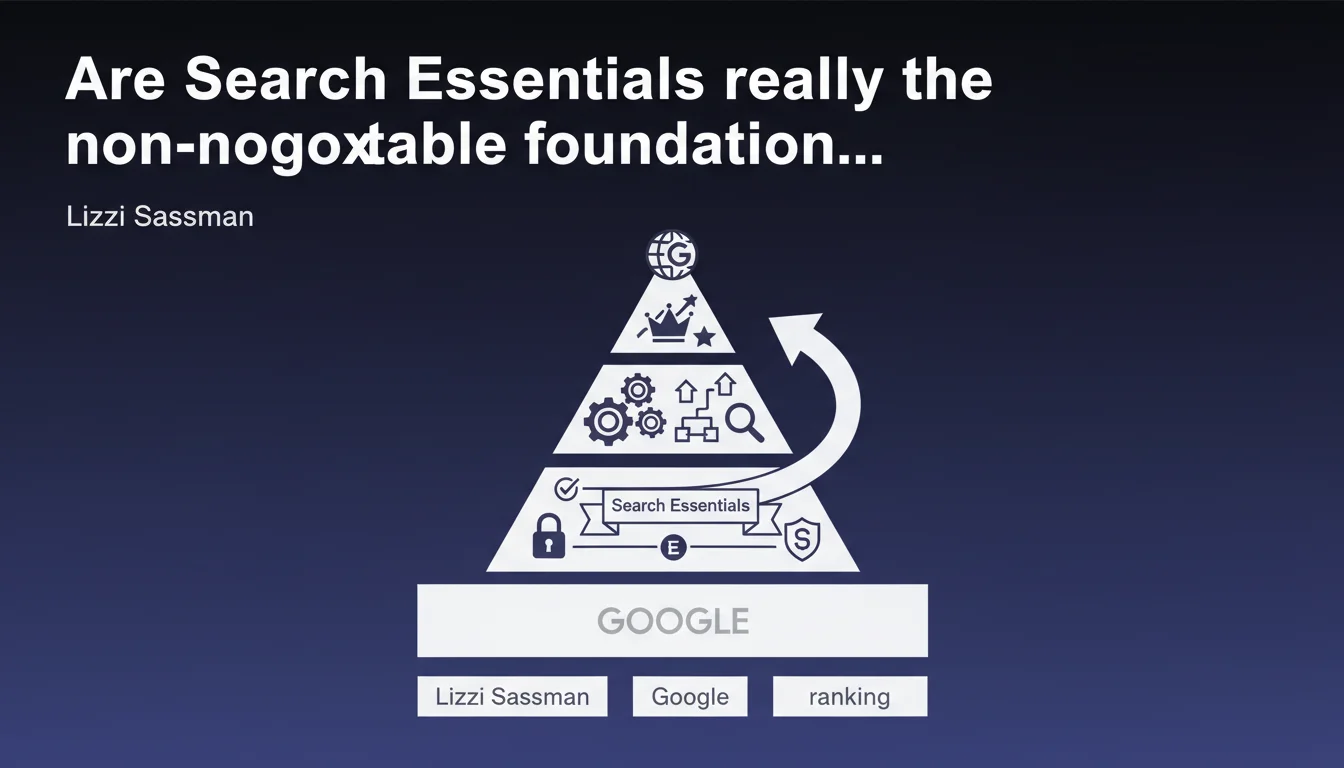
Google reminds us that Search Essentials form the non-negotiable foundation for being indexed and ranked in its search results. These technical and qualitative guidelines define the bare minimum threshold — not a competitive advantage, but a prerequisite. Without them, your site risks being outright ignored by the search engine.
What you need to understand
Why does Google place so much emphasis on these Search Essentials?
The Search Essentials (formerly Google Webmaster Guidelines) are the social contract between Google and website publishers. They define the minimum technical and quality criteria for a site to be eligible for indexation. Google presents them not as optional recommendations, but as baseline requirements.
This communication from Lizzi Sassman — head of Search documentation at Google — aims to clarify a frequent misunderstanding: complying with these guidelines doesn't guarantee good rankings, but failing to comply effectively excludes your site from the race. It's the entry threshold, not the finish line.
What exactly do these Search Essentials cover?
Search Essentials break down into three pillars: technical requirements (content accessibility to bots, absence of critical blocks), quality requirements (useful content, people-first creation), and prohibited practices (spam, cloaking, link manipulation).
The crucial point — Google doesn't always clarify where the boundary lies between "acceptable technique" and "manipulation". Gray areas exist, especially around auto-generated content or link strategies.
- Technical accessibility: Googlebot must be able to crawl, index, and understand your content without major obstacles
- Editorial quality: Content must deliver real value, not be created solely to manipulate rankings
- Formal prohibitions: Cloaking, link spam, deceptive redirects, massive duplicate content, hidden text
- Applicable sanctions: From simple non-indexation to manual penalties with notification in Search Console
Do all indexed sites really comply with these guidelines?
No. And that's where it gets tricky.
In reality, you find sites that violate certain rules and still rank — because enforcement isn't uniform. Google's algorithms don't detect all violations, and manual review teams can only audit a fraction of the billions of indexed pages. Some sites slip through the cracks for months or even years.
This doesn't mean the guidelines are optional. It means the risk exists, and it's asymmetrical: losing 80% of your organic traffic overnight due to a manual action or algorithm update is never a good business model.
SEO Expert opinion
Is this statement consistent with what we observe in the field?
Partially. Google claims Search Essentials are "essential" — and for the majority of legitimate sites, that's true. Following these rules eliminates major risks and lays the foundation for sustainable SEO strategy.
But — and that's a big but — we regularly observe sites that violate certain guidelines and continue to perform well. Sites with heavy content duplication, disguised link farms, abuse of auto-generation scripts. These cases are the exception, not the norm, but they exist. [To verify]: Google never communicates precise statistics on violation detection rates or average sanctions enforcement timelines.
What nuances should we add to this official message?
First nuance: "essential" doesn't mean "sufficient". Strictly following Search Essentials is only a necessary condition, not a guarantee of visibility. Thousands of technically flawless sites stagnate on page 3 because they offer nothing better than what already exists.
Second nuance: some areas remain unclear. Take AI-generated content. The guidelines say "create useful content for humans". OK. But where's the line between an AI-assisted article and automated spam? Google doesn't say clearly, and teams on the ground are experimenting in the fog.
In which cases doesn't this rule really apply?
Let's be honest: in no legitimate case. If you're playing the long game, Search Essentials always apply.
The only exceptions involve deliberate blackhat strategies: ephemeral sites designed to exploit loopholes for a few weeks before getting banned. These tactics exist, they can be profitable short-term, but they're not professional SEO — they're organized spam. No serious client should accept this kind of risk.
Practical impact and recommendations
What should you do concretely to comply with these guidelines?
Start with a complete technical audit: crawlability (robots.txt, meta robots, XML sitemap), indexability (HTTP status codes, redirects, canonicalization), HTML structure (title tags, meta descriptions, coherent heading hierarchy). Use Google Search Console to identify crawl errors and coverage issues.
Next, evaluate editorial quality. Every page should have a clear objective, a differentiating angle, and measurable added value compared to competing content. If you can't explain in one sentence why your page deserves position 1, it probably doesn't.
Finally, eliminate high-risk practices: purchased links untagged with nofollow/sponsored, cloaking, deceptive redirects, massive duplicate content without proper canonicalization. If you're unsure about a technique, apply the common sense test: if Google found out, would they consider it manipulation? If yes, don't do it.
- Verify complete site accessibility for Googlebot (no critical robots.txt blocks, properly rendered JS)
- Validate indexation: are all strategic pages properly indexed? (site: operator, GSC)
- Audit content: does each page deliver unique, measurable value?
- Identify and fix duplicate content (canonicalization, URL parameter management)
- Clean your link profile: identify and disavow toxic or spammy backlinks
- Meet Core Web Vitals (LCP, INP, CLS) — part of Search Essentials since 2021
- Monitor Search Console for any manual actions or security issues
- Document technical and editorial decisions to justify arbitrages if audited
What mistakes should you avoid at all costs?
Mistake #1: believing "it works" because it always has. Algorithms evolve, tolerances too. A site that ranked by violating certain rules can get decimated overnight during a spam update.
Mistake #2: copying tactics observed from competitors without understanding their context. That competitor abusing keyword stuffing may have domain authority that compensates — or they're in Google's crosshairs and don't know it yet.
Mistake #3: neglecting monitoring. Search Essentials aren't frozen. Google regularly adds clarifications, especially after each public controversy (AI content, product reviews, link spam). Failing to follow these developments risks finding yourself sidelined without knowing why.
How can you verify your site is compliant?
Use the official tools trio: Google Search Console (coverage, mobile usability, Core Web Vitals, manual actions), PageSpeed Insights (performance and CWV), and the mobile-friendliness test. These tools detect most critical technical issues.
For quality and spam aspects, it's more subjective. Put every major section of your site through the naive reader test: does someone arriving on this page without context quickly find what they're looking for? Is the content clear, useful, well-structured? Or does it look like a keyword aggregate designed for a robot?
Finally, compare your site against Google's official guidelines (Search Essentials, Quality Rater Guidelines, documentation on ranking systems). If a point seems ambiguous, always favor the conservative approach: when in doubt, play it safe.
❓ Frequently Asked Questions
Les Search Essentials sont-elles les mêmes que les anciennes Webmaster Guidelines ?
Est-ce que respecter les Search Essentials garantit un bon classement ?
Que se passe-t-il si mon site viole une Search Essential ?
Les Core Web Vitals font-elles partie des Search Essentials ?
Où puis-je consulter la version officielle et à jour des Search Essentials ?
🎥 From the same video 10
Other SEO insights extracted from this same Google Search Central video · published on 21/12/2022
🎥 Watch the full video on YouTube →
💬 Comments (0)
Be the first to comment.