
Official statement
Other statements from this video 10 ▾
- □ Is Google's shift from Webmaster Guidelines to Search Essentials just a rebrand, or does it signal something bigger?
- □ Are Search Essentials really the non-negotiable foundation for ranking on Google?
- □ How is Google now displaying website names in search results?
- □ How can you optimize your site name display on mobile using structured data?
- □ Is your favicon costing you clicks? Here's why Google wants you to check it now
- □ Are Panda and Penguin Still Relevant in Modern SEO?
- □ Does Google finally publish a complete history of its ranking updates?
- □ Why does Google document some ranking systems but keep others completely hidden?
- □ Is Google Really Being Transparent About Algorithm Updates, and What Does It Mean for Your SEO?
- □ Should you really be sending feedback to Google about its SEO documentation gaps?
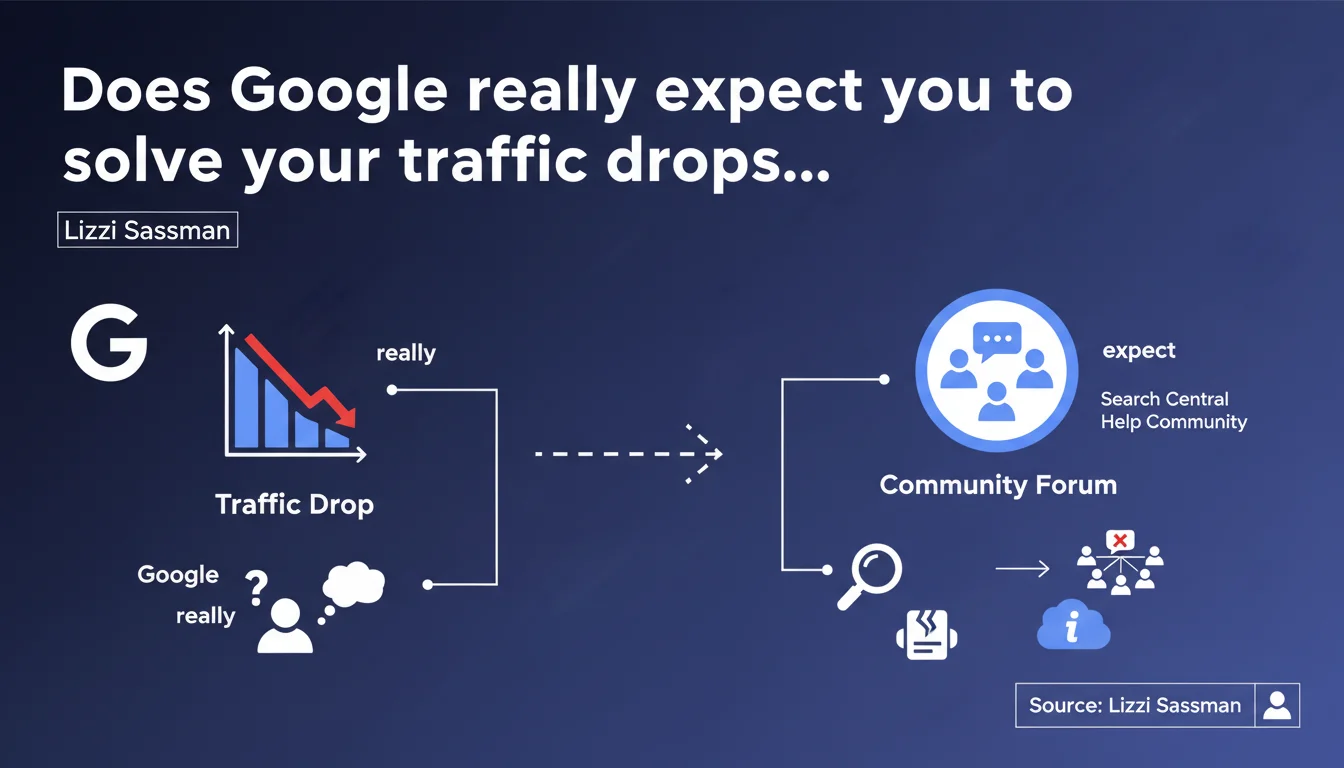
Google officially recommends using the Search Central Help Community to get information about traffic variations and changes affecting your site. This statement suggests a partial transfer of technical support to a community-driven instance. In practical terms, Google delegates part of the explanation for algorithmic fluctuations to a peer-to-peer mutual aid platform.
What you need to understand
What does this Google recommendation actually mean?
Google indicates that the Search Central Help Community constitutes a legitimate source of information for understanding changes impacting your site. This community brings together Product Experts, certified contributors, and SEO professionals who answer questions.
The wording is deliberately vague — Google doesn't specify which types of changes are involved. Are we talking about major algorithm updates, daily fluctuations, manual penalties, or simple ranking variations? This ambiguity leaves room for interpretation.
Why doesn't Google provide this information directly?
Delegation to a community suggests two things: either Google lacks resources to provide individualized support to millions of sites, or this approach aims to decentralize explanations to avoid multiplying binding official statements.
In practice, the Search Central Help Community allows Google to maintain distance from certain diagnoses. The answers given by the community don't legally bind Google — it's a convenient firewall.
What information can you actually get from this platform?
The community functions as a moderated forum where Product Experts answer recurring questions. You'll find generic diagnoses, links to official documentation, and sometimes confirmations of known bugs or technical issues.
For complex cases — unexplained traffic drops, suspected algorithmic penalties — answers often remain superficial. The community has no access to Google's internal data and cannot audit your site in depth.
- The Search Central Help Community is a peer-to-peer space supervised by Product Experts certified by Google
- Google uses this platform to outsource part of support without assuming direct responsibility
- Answers provided remain generic and do not replace thorough technical SEO audits
- This recommendation mentions no automated diagnostic tools or dedicated dashboard for traffic variations
- The statement doesn't clarify whether this community is the only recommended channel or a complement to other resources
SEO Expert opinion
Is this statement consistent with field observations?
Yes and no. The Search Central Help Community has existed for years and works well for basic questions — blocked indexing, Search Console errors, schema markup issues. For these cases, the community offers quick and documented answers.
However, for traffic drops following algorithmic updates, the community often proves powerless. Product Experts have no visibility into the ranking criteria applied to a given site. They redirect to official documentation — which amounts to going in circles. [To be verified]: no public data confirms that community diagnoses have actually resolved traffic drops linked to Core Updates.
Why doesn't Google offer direct, paid technical support?
This is a question many ask. Google Ads offers dedicated support for advertisers — why not for organic SEO? The likely answer: Google doesn't want to set a precedent where it's obligated to explain every ranking variation. SEO remains an area where Google maintains opaque control to preserve algorithm relevance.
Delegating to a community also filters requests. Only truly problematic cases escalate to internal teams through discrete escalations — but this remains exceptional.
What limitations should you keep in mind with this community approach?
First limitation: answer variability. Depending on which Product Expert responds, you can receive contradictory diagnoses. No mechanism guarantees consistency in advice given.
Second limitation: survivorship bias. Cases that find solutions through the community are overrepresented in testimonials, while sites left without answers disappear silently. This creates an illusion of effectiveness.
Practical impact and recommendations
What should you do concretely if your traffic drops?
Start by documenting the timeline: exact date of the drop, affected pages, impacted queries. Then check Search Console to rule out any technical issues — indexation errors, broken redirects, manual penalties.
If no obvious technical problem appears, post a structured question on the Search Central Help Community with the following elements: site URL, drop period, Search Console screenshots, description of recent changes. The more documented your request, the more relevant the answer will be.
What mistakes should you avoid when using this community?
Don't expect a detailed explanation of the algorithmic reasons for your drop. Product Experts cannot — and will not — tell you "your content is judged low-quality by Helpful Content System." They'll redirect you to generic guidelines.
Also avoid creating multiple threads on the same subject. This scatters answers and frustrates contributors. One well-documented thread is worth more than five fragmented questions.
How should you integrate this recommendation into your overall SEO strategy?
The Search Central Help Community should be a quick checkpoint, not a permanent crutch. Use it to validate technical hypotheses — for example, "is this FAQ markup format correct?" — but don't rely on it for strategic diagnostics.
For complex issues, the community can at best confirm you're not alone in observing a phenomenon. That's useful, but insufficient for taking action.
- Document any traffic drop with Search Console screenshots and precise timeline
- First check for obvious technical issues: 4xx/5xx errors, robots.txt files, broken canonicals
- Post a structured and documented question on the community — avoid "my traffic is dropping, help me"
- Don't expect detailed algorithmic diagnosis — Product Experts don't have access to this data
- Use the community for hypothesis validation, not as a substitute for complete SEO audits
- Cross-reference answers obtained with your own analysis — the community can be wrong
- If the drop exceeds 30% or persists for more than 6 weeks, invest in thorough technical and content audits
❓ Frequently Asked Questions
La Search Central Help Community peut-elle expliquer une baisse de trafic après une Core Update ?
Les réponses données sur cette communauté sont-elles officielles au nom de Google ?
Dois-je attendre une réponse sur la communauté avant d'agir sur mon site ?
Peut-on obtenir une escalade vers les équipes Google via la communauté ?
La communauté peut-elle diagnostiquer une pénalité algorithmique ?
🎥 From the same video 10
Other SEO insights extracted from this same Google Search Central video · published on 21/12/2022
🎥 Watch the full video on YouTube →
💬 Comments (0)
Be the first to comment.