
Official statement
Other statements from this video 10 ▾
- □ Is Google's shift from Webmaster Guidelines to Search Essentials just a rebrand, or does it signal something bigger?
- □ Are Search Essentials really the non-negotiable foundation for ranking on Google?
- □ How is Google now displaying website names in search results?
- □ How can you optimize your site name display on mobile using structured data?
- □ Is your favicon costing you clicks? Here's why Google wants you to check it now
- □ Are Panda and Penguin Still Relevant in Modern SEO?
- □ Does Google finally publish a complete history of its ranking updates?
- □ Is Google Really Being Transparent About Algorithm Updates, and What Does It Mean for Your SEO?
- □ Does Google really expect you to solve your traffic drops through a community forum instead of direct support?
- □ Should you really be sending feedback to Google about its SEO documentation gaps?
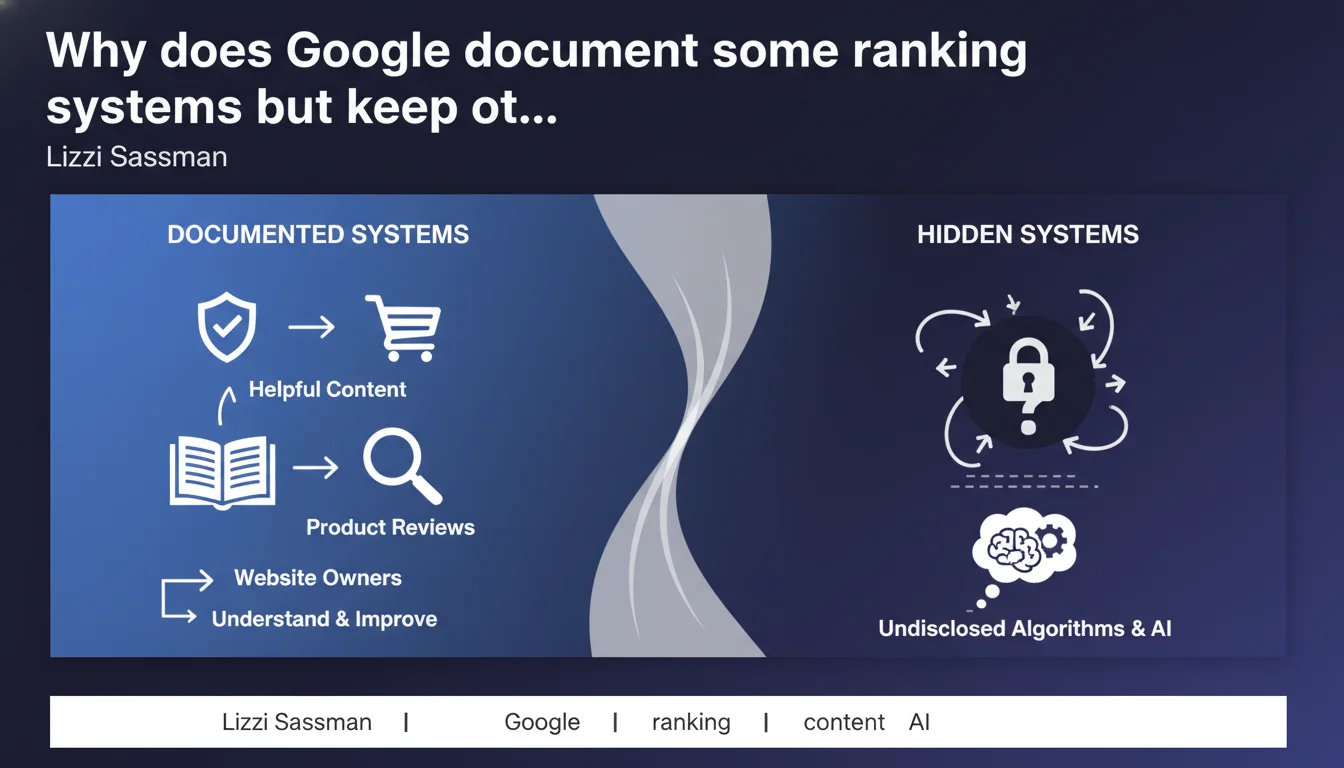
Google publishes detailed documentation only for certain recent ranking systems like Helpful Content and product reviews. The stated goal: help website owners understand these mechanisms. But this selectivity raises questions about what intentionally remains in the shadows.
What you need to understand
Which systems actually get official documentation?
Google concentrates its documentation efforts on two major systems: the Helpful Content System and the Product Reviews Update. Both mechanisms have been deployed progressively and have generated significant disruptions across the SERPs.
The first targets content created primarily for search engines rather than humans. The second evaluates product review quality using precise criteria — actual testing, original photos, in-depth comparisons. Both systems share the characteristic of being permanent algorithmic systems, integrated into core ranking.
Why does this documentation exist now?
Google's selective transparency responds to dual pressure. First, from the SEO industry that has demanded greater clarity on ranking factors for years. Second, from regulators — particularly European ones — demanding more traceability in algorithmic decisions.
But let's be honest: this documentation remains oriented toward website owners, not SEO professionals. The level of technical detail is limited. You get directional principles, rarely precise thresholds or metrics.
What do these resources actually contain?
Official documentation blends general recommendations with concrete examples. For Helpful Content, Google emphasizes expertise, firsthand experience, user satisfaction. For product reviews, you find explicit criteria: test duration, comparison elements, visual proof.
- Documentation targeted only at recent systems — no retrospective on Panda, Penguin, or others
- Variable level of detail: directional principles rather than quantifiable metrics
- Dominant qualitative approach with illustrative examples
- Complete absence of documentation for historical or technical systems (crawl budget, link equity, etc.)
- Irregular updates — some sections remain frozen despite algorithm evolution
SEO Expert opinion
Does this selective transparency hide something?
Google documents what suits it. Recent systems, visible ones, that directly impact content creators. But where is the documentation on link treatment? On topical authority signals? On content clustering mechanisms or internal cannibalization?
The silence is revealing. Google documents only what cannot be easily manipulated at scale. Helpful Content relies on behavioral and qualitative signals — difficult to game industrially. Product reviews require real work. Conversely, everything touching on exploitable technical signals remains deliberately vague.
Do field observations confirm these documentations?
Only partially. On Helpful Content, we do observe a correlation between engagement signals (time on page, pogo-sticking) and positive or negative impacts. But sites that scrupulously follow the guidelines sometimes get hammered. [To verify]: Google claims the system evaluates the entire site, yet certain domains seem penalized only on specific sections.
For product reviews, consistency is stronger. Sites investing in authentic content — original photos, detailed testing — have generally progressed. Those republishing manufacturer spec sheets stagnate or decline. Here, documentation and reality align more closely.
What strategy should you adopt facing this partial transparency?
Don't limit yourself to official documentation. It provides direction, not a complete roadmap. You must continue to test, measure, iterate on undocumented dimensions: technical structure, internal linking, semantic optimization, implicit E-E-A-T signals.
And remember that Google communicates to influence. When they pound home "create content for users," it's both advice and a deflection strategy. If your site drops, it's because your content wasn't useful enough — not because the algorithm misfired.
Practical impact and recommendations
How to leverage these documentations without falling into the trap?
First step: read these resources as a consistency filter, not as gospel. If your content directly contradicts stated principles, there's a problem. But following guidelines guarantees nothing.
Second step: audit your existing content through this lens. For Helpful Content, identify pages created solely to capture SEO traffic without real added value. For product reviews, verify if you're contributing genuine experience or just copying technical specs.
What concrete actions should you implement?
For the Helpful Content System, focus on engagement signals. Reduce click depth to your key content, improve readability, structure articles to facilitate scanning. Integrate elements of expertise proof: identified author, credentials, field experience.
For product reviews, the bar is high. You need original photos, comparative testing data, elements proving you've handled the product. No shortcuts possible — it's pure editorial work.
- Audit existing content with a Helpful Content grid: demonstrated expertise? Unique added value? Measurable user satisfaction?
- Identify purely SEO-driven pages without real user benefit — improve or deindex them
- For product reviews: invest in actual testing, original photos, factual comparisons with quantified data
- Set up tracking for engagement signals (time on page, scroll depth, qualified bounce rate)
- Structure content with identified experts — author bio, credentials, proven experience
- Document testing and verification processes — Google values methodological transparency
- Avoid "assembled" content sourced from third parties without personal contribution
❓ Frequently Asked Questions
Google documente-t-il tous ses systèmes de classement ?
Ces documentations contiennent-elles des seuils ou métriques précises ?
Respecter les guidelines garantit-il un bon classement ?
Peut-on se fier uniquement à ces documentations pour optimiser un site ?
Ces systèmes s'appliquent-ils uniformément à tous les secteurs ?
🎥 From the same video 10
Other SEO insights extracted from this same Google Search Central video · published on 21/12/2022
🎥 Watch the full video on YouTube →
💬 Comments (0)
Be the first to comment.