
Official statement
Other statements from this video 5 ▾
- □ Is Google finally offering the advanced SEO training that practitioners have been demanding?
- □ Will Google's Deep Dive SEO sessions finally replace superficial conference presentations?
- □ Should you trust local SEO experts over Google's official statements?
- □ Is Google really serious about hands-on learning with its new Deep Dive workshops?
- □ Is Google really using your feedback to shape its SEO events—or just making you think it does?
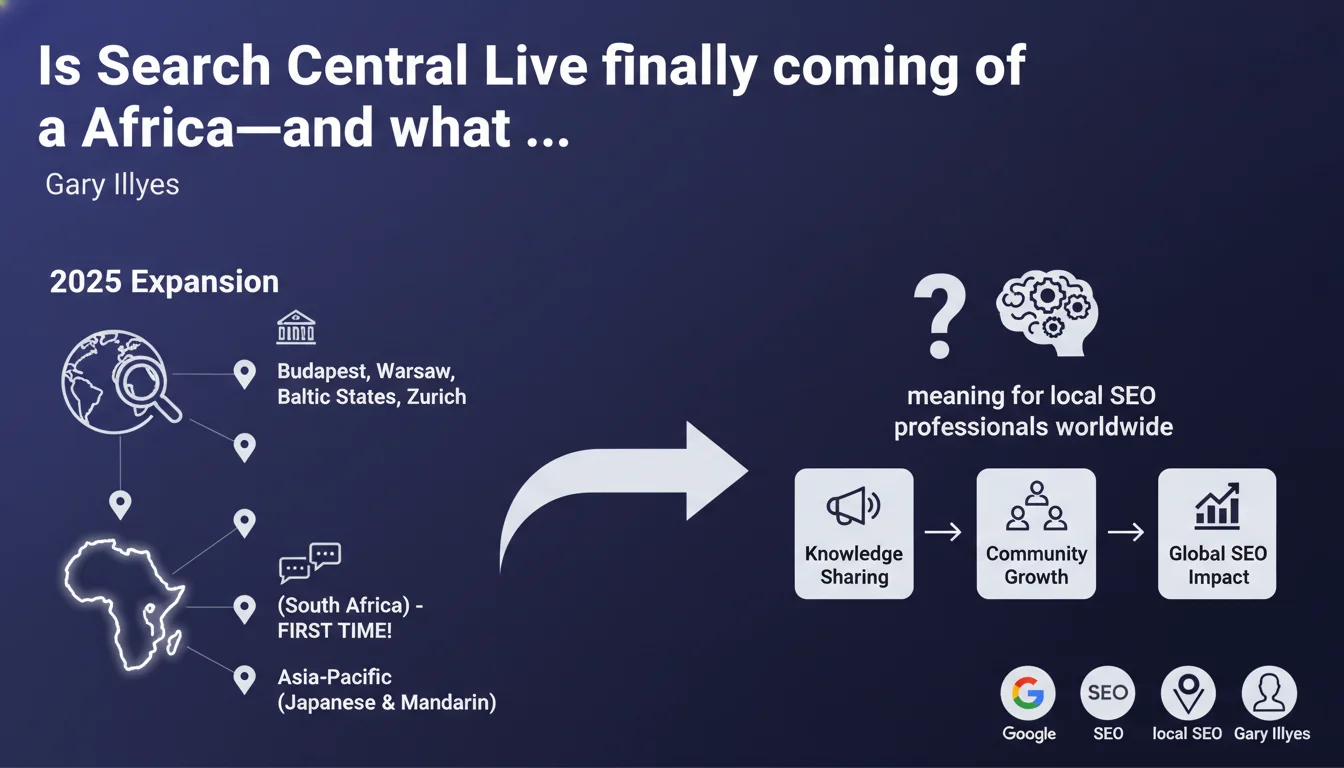
Google is expanding Search Central Live to new territories: Budapest, Warsaw, the Baltic States, Zurich, and for the first time in South Africa. Events are also being maintained in Asia-Pacific with Japanese and Mandarin sessions, confirming a regional proximity strategy. For SEO practitioners, this is an opportunity to capture localized insights and build direct relationships with Google teams.
What you need to understand
Why is Google multiplying Search Central Live events outside the USA?
Google is deploying a strategy of decentralizing its SEO communication. Rather than concentrating events in major English-speaking metropolises, the company is betting on physical presence in emerging or underrepresented markets: Eastern Europe, Africa, Asia-Pacific.
The objective? Create direct points of contact with local SEO communities, address region-specific challenges, and prevent official documentation from remaining too generic. An event in Warsaw won't cover the same use cases as an event in Tokyo.
What does the arrival of Search Central Live in South Africa signify?
This is a first on the African continent. Google is implicitly acknowledging that the African market now has enough structured SEO professionals to justify a dedicated event.
It also reflects a desire to capture on-the-ground signals from regions where mobile search dominates, where network infrastructure is heterogeneous, and where user behaviors differ radically from Western markets. The insights gathered at these events likely feed into Google Search's product priorities.
What topics are likely to be covered at these regional events?
Search Central Live sessions never limit themselves to generalities. Each edition addresses concrete cases: crawl issues on local infrastructure, multilingual site management, optimization for slow connections, indexing of content in regional languages.
In Eastern Europe and South Africa, expect sessions on Core Web Vitals in constrained mobile environments, managing multilingual sites with poorly documented dialects, or the peculiarities of local SEO in regions where Google Maps is less mature.
- Decentralization: Google is multiplying physical events outside traditional hubs
- African first: South Africa marks the continent's official entry into the Search Central Live circuit
- Regional approach: Each event targets specific local challenges
- Ground signals: These meetings allow Google to gather insights from underrepresented markets
SEO Expert opinion
Does this expansion reflect a shift in Google's product strategy?
Yes, and it's consistent with what we've observed over the past two years. Google is intensifying its physical presence in regions where English-language documentation is no longer sufficient. Emerging markets pose specific technical challenges: slow networks, budget devices, complex multilingual content.
By organizing local events, Google collects ground feedback it doesn't capture through usual channels. It's also a way to train local SEO communities on standards they often don't apply due to lack of information access.
Are the insights shared at these events truly unprecedented?
Let's be honest: some content will be rehashed. The basics (indexing, crawl, Core Web Vitals) are universal. But the value lies in the Q&A sessions at the end, where participants raise concrete cases Google has never publicly documented.
For example, at an Asia-Pacific event, questions about managing simplified vs. traditional hanzi forced Google to clarify points never addressed in Search Central documentation. These micro-clarifications are worth the trip. [To verify]: it remains to be seen whether Google will systematically publish verbatim records of these regional sessions.
Should you systematically attend these events?
It depends on your market. If you operate solely on French-language sites hosted in Western Europe, a Budapest event will bring you little immediate actionable value. However, if you manage multilingual sites covering Eastern Europe, or if you're exploring African markets, it's a unique opportunity to ask targeted questions to Googlers rarely accessible.
The real value is networking with local SEOs who share their ground feedback. These informal exchanges often outweigh official presentations.
Practical impact and recommendations
How can you benefit from these events if you don't attend physically?
Google typically publishes video recaps or written summaries after each Search Central Live. But the real value is found in Twitter/LinkedIn discussions right after the event. Participants often share screenshots of slides, verbatim responses given off-record, unprecedented clarifications.
Create a dedicated Twitter list grouping SEOs from the regions involved. Monitor official hashtags. Archive important threads. These micro-insights will never make it into official documentation.
What should you do if you operate in a market covered by these new events?
If you manage sites in South Africa, Poland, or the Baltic States, now is the time to prepare your sharpest questions. Google rarely opens such direct communication channels. Use it to clarify gray areas: hreflang management for regional dialects, Googlebot behavior on unstable network infrastructure, indexing of content in poorly documented languages.
Even if you don't attend, contact event participants after it concludes. The Googlers present on-site are often more accessible for post-event follow-ups.
What mistakes should you avoid at these regional events?
Don't monopolize Q&A time with generic questions already documented. The Googlers present know their subject, but they're not there to repeat what's in Search Central. Ask questions grounded in real cases, with URLs as examples if possible.
Also avoid treating these events as free debugging sessions. Google won't fix your indexing problems in public. However, a well-formulated question about a recurring pattern can lead to clarification useful to the entire community.
- Monitor official hashtags and ground-level feedback post-event
- Archive Twitter/LinkedIn threads containing Google response verbatims
- Prepare specific questions grounded in real cases if you attend
- Don't ask generic questions already documented in Search Central
- Contact participants after the event for first-hand insights
- Leverage these channels to clarify regional gray areas (hreflang, dialects, local infrastructure)
❓ Frequently Asked Questions
Les contenus présentés lors de Search Central Live diffèrent-ils selon les régions ?
Google publie-t-il systématiquement les verbatim de ces événements régionaux ?
Faut-il nécessairement assister physiquement pour en tirer de la valeur ?
Pourquoi Google organise-t-il pour la première fois un événement en Afrique ?
Ces événements annoncent-ils des nouveautés produit ?
🎥 From the same video 5
Other SEO insights extracted from this same Google Search Central video · published on 01/05/2025
🎥 Watch the full video on YouTube →
💬 Comments (0)
Be the first to comment.