
Official statement
Other statements from this video 5 ▾
- □ Google propose-t-il enfin une formation SEO avancée à la hauteur des attentes des praticiens ?
- □ Les Deep Dive SEO de Google vont-ils enfin remplacer les conférences superficielles ?
- □ Google mise-t-il vraiment sur la pratique avec ses nouveaux ateliers Deep Dive ?
- □ Comment Google utilise-t-il vraiment vos retours pour concevoir ses événements SEO ?
- □ Search Central Live débarque en Afrique : pourquoi cette expansion géographique change-t-elle la donne pour les SEO locaux ?
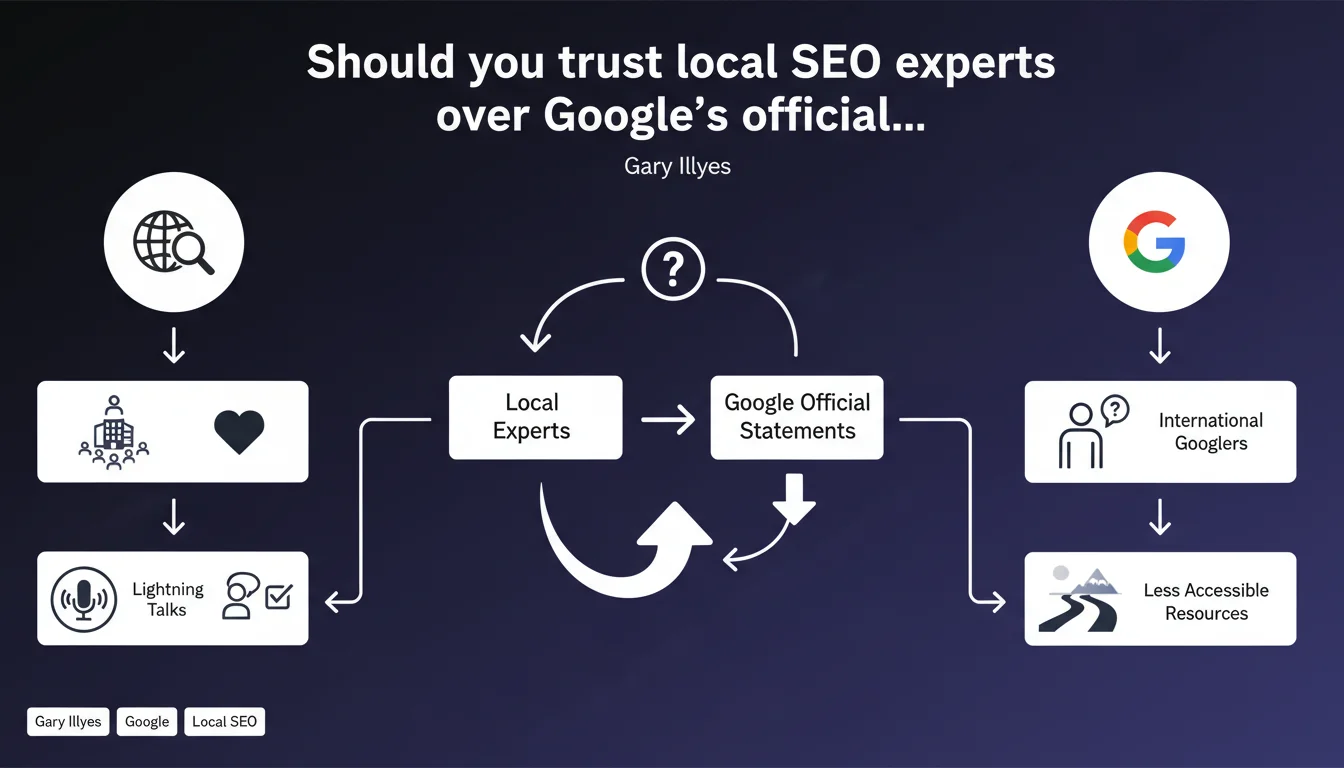
Google explicitly acknowledges that local experts identified through lightning talks are often more accessible and relevant than international Googlers. This official recognition validates what many suspected: geographic and cultural proximity matters in interpreting guidelines. Local communities become strategic information relays.
What you need to understand
This statement from Gary Illyes marks a turning point in Google's communication. The company openly acknowledges that its international representatives are not always the best source of information for local issues.
Why is Google suddenly valuing local communities?
The answer is pragmatic: Google cannot be everywhere. Linguistic nuances, regulatory specifics (GDPR, CNIL in France, for example) and search habits vary considerably from one country to another.
Lightning talks — these short presentations at events — serve as a filter. Google identifies who masters what, in which market. These experts then become unofficial information relays, more responsive than a Googler based in Mountain View or Dublin.
What does this concretely change for an SEO professional?
It legitimizes an already widespread practice: relying on recognized local experts rather than waiting for a generic response on Twitter. A French expert who understands the subtleties of .fr and the French market will often have a more actionable answer than an international statement.
This also means that Google is actively encouraging the decentralization of expertise. Local communities (SEO Camp in France, for example) are no longer just peer support groups — they become strategic hubs validated by Google.
- Local experts are recognized as reliable resources by Google itself
- Lightning talks serve as a tool for detecting and validating expertise
- Geographic and cultural proximity becomes an official relevance criterion
- Local communities gain in strategic legitimacy
SEO Expert opinion
Is this statement consistent with observed practices?
Yes, and it's even a belated confirmation. For years, SEO practitioners have known that Googlers' answers vary depending on the interlocutor and context. A local expert who speaks the language, knows the market and has already handled similar cases will always be more relevant.
The problem? Google provides no criteria to identify these "local experts". [To be verified] How do you know who is truly recognized by Google and who is self-proclaimed as an expert? Lightning talks are an indicator, but not all experts participate in these events.
What nuances should be added to this statement?
First nuance: accessible does not mean more competent. A local expert may be more responsive, but this does not guarantee that they have the correct information. Googlers remain the only ones with access to internal data and strategic decisions.
Second nuance: this recognition of local communities can create informal hierarchies. If Google values certain experts through lightning talks, this can marginalize other practitioners equally competent but less visible or less inclined to speak publicly.
In what cases does this approach not work?
On pointed technical questions affecting Google's infrastructure (advanced crawl budget, differential indexing, complex hreflang processing), a local expert will not have more information than an international Googler. Worse: they risk providing an answer based on unvalidated empirical observations.
Similarly, on strategic algorithmic questions (weighting of ranking signals, spam handling), Google shares nothing — neither with local experts, nor with public Googlers. Counting on a local community to get these answers is an illusion.
Practical impact and recommendations
What should you concretely do to benefit from this recognition?
First, identify recognized local experts in your market. Look for those who have participated in lightning talks at Google events (Search Central Live, Google I/O extended, etc.). Their visibility and legitimacy are usually public.
Then, actively participate in local communities. Forums, Slack, physical events — this is where the most relevant information circulates. Local experts often share nuances that they would never publish on Twitter.
What mistakes should you avoid with this new dynamic?
Do not replace dependence on Googlers with dependence on local experts. Both sources have their limitations. Always cross-reference information, test on your own sites, verify with your analytics data.
Also avoid blindly following a local expert without checking their references. Ask for proof: did they really participate in a lightning talk? Do they have documented case studies? A legitimate expert will have no problem justifying their expertise.
How should you structure your SEO monitoring in light of this statement?
Set up a hybrid monitoring system: follow Google's official statements (Search Central blog, Googlers' Twitter accounts), but systematically supplement with analyses from recognized local experts. The two levels of information complement each other.
Document your own observations. If a local expert claims something, test it on your sites. Build your own knowledge base validated by on-the-ground experience.
- Identify local experts who have participated in official lightning talks
- Join active local SEO communities (forums, Slack, events)
- Systematically cross-reference information: Googlers + local experts + field tests
- Check experts' references before following their recommendations
- Set up hybrid monitoring (official + local)
- Document your own tests to validate or refute statements
- Do not replace one dependency with another: remain critical
❓ Frequently Asked Questions
Comment savoir si un expert local est vraiment reconnu par Google ?
Un expert local a-t-il accès à plus d'informations qu'un Googler international ?
Faut-il arrêter de suivre les déclarations des Googlers internationaux ?
Les communautés SEO locales sont-elles obligatoires pour rester à jour ?
Un expert local peut-il se tromper ou donner de mauvais conseils ?
🎥 From the same video 5
Other SEO insights extracted from this same Google Search Central video · published on 01/05/2025
🎥 Watch the full video on YouTube →
💬 Comments (0)
Be the first to comment.