
Official statement
What you need to understand
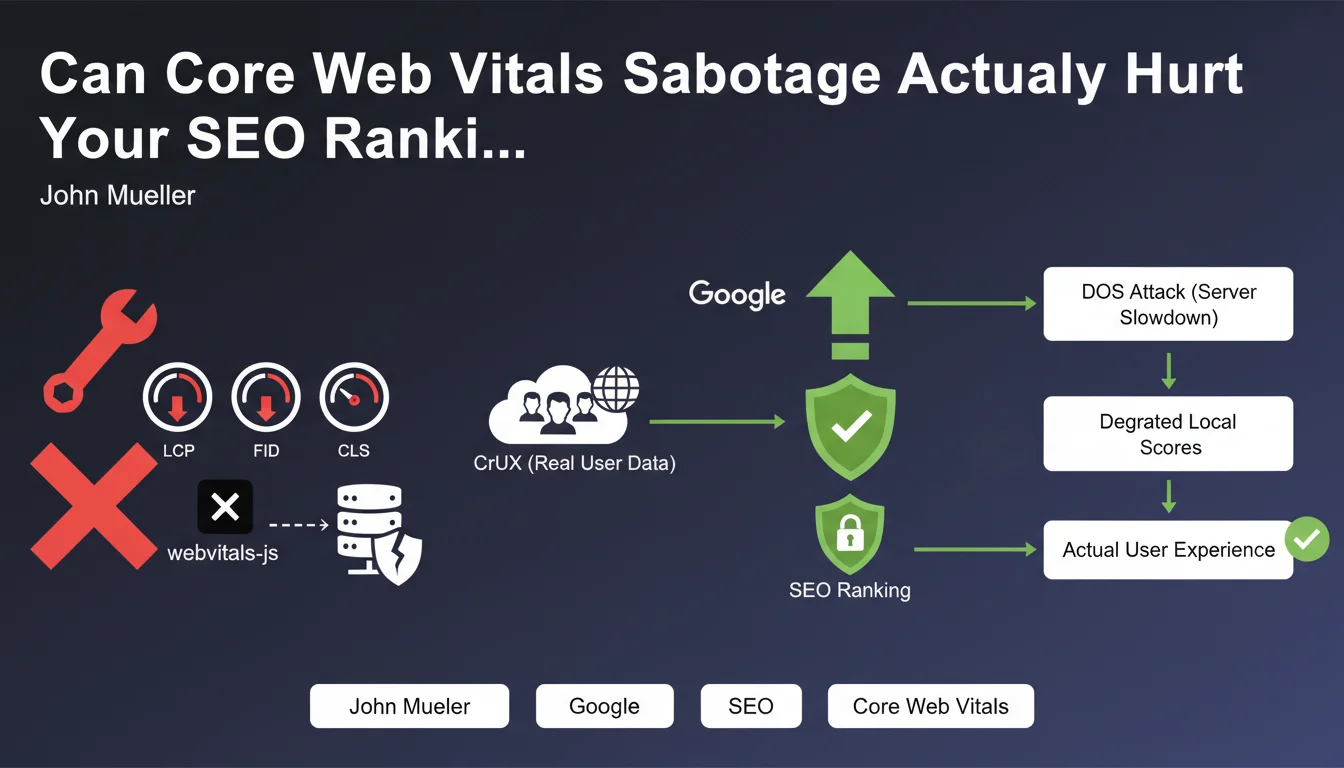
"Core Web Vitals poisoning" is an attack technique that aims to artificially degrade a website's performance metrics. The objective is to falsify indicators such as LCP (Largest Contentful Paint), FID (First Input Delay), and CLS (Cumulative Layout Shift).
This official statement from Google provides an important clarification: this type of sabotage does not directly affect rankings in search results. The reason is simple: Google does not rely on data from automated tests or internal tools to evaluate your Core Web Vitals.
The search engine exclusively uses CrUX (Chrome User Experience Report) data, which comes from real users browsing with Chrome. This data reflects the actual experience of users over a rolling 28-day period.
- Google ignores synthetic metrics: only real user data counts for rankings
- CrUX is the only official source: testing tools like Lighthouse or PageSpeed Insights are only used for diagnostics
- A local attack does not impact SEO: if your real users continue to have a good experience, your rankings are not threatened
- Security remains a priority: even without direct SEO impact, these attacks harm reputation and reliability
SEO Expert opinion
This position from Google is perfectly consistent with what we have observed since the rollout of the Page Experience Update. CrUX data is indeed the only metric taken into account for the ranking signal related to Core Web Vitals.
However, there is an important area of vigilance: if a DoS attack or sabotage actually slows down your server for an extended period, the experience of real Chrome users will be degraded. In this case, CrUX data will indeed deteriorate, and this will impact your rankings.
Furthermore, even without direct SEO impact, a perceived performance degradation by your users can increase bounce rate and reduce engagement. These behavioral signals, although not officially confirmed as ranking factors, can indirectly affect your visibility.
Practical impact and recommendations
- Regularly monitor your official CrUX data via Search Console and the CrUX report on PageSpeed Insights
- Don't panic over testing tool fluctuations: Lighthouse, GTmetrix, or other tools do not reflect what Google uses for rankings
- Implement server-side performance monitoring: response time, availability, CPU load to detect anomalies
- Strengthen your infrastructure security: anti-DoS protection, CDN with attack mitigation, monitoring of suspicious access
- Implement a robust caching solution: Cloudflare, Fastly, or Varnish to absorb malicious traffic spikes
- Configure alerts on critical metrics: server response time, 5xx error rate, service availability
- Analyze trends over 28 days: CrUX works on a rolling window, temporary degradation will not have immediate impact
- Prioritize real user experience: test your site as your visitors would, on different devices and connections
- Document and track incidents: in case of a confirmed attack, keep logs to understand the origin and nature of the threat
Optimizing Core Web Vitals and implementing an attack-resistant architecture constitute a complex set of technical skills. Between monitoring CrUX data, configuring secure infrastructure, performance optimization, and interpreting metrics, there are numerous parameters to master.
For companies looking to secure their positioning without mobilizing significant internal technical resources, collaborating with a specialized SEO agency can prove beneficial. Personalized support enables quick identification of vulnerabilities, implementation of best practices, and maintaining proactive monitoring of these critical performance aspects.
💬 Comments (0)
Be the first to comment.