
Official statement
Other statements from this video 4 ▾
- □ Should you really start your SEO audit with your browser and Search Console?
- □ Are Google Search Console's bubble charts really revolutionizing your SEO analysis?
- □ Why have image dimensions in HTML become essential for fixing CLS problems?
- □ Should you really delete problematic elements instead of fixing them for SEO?
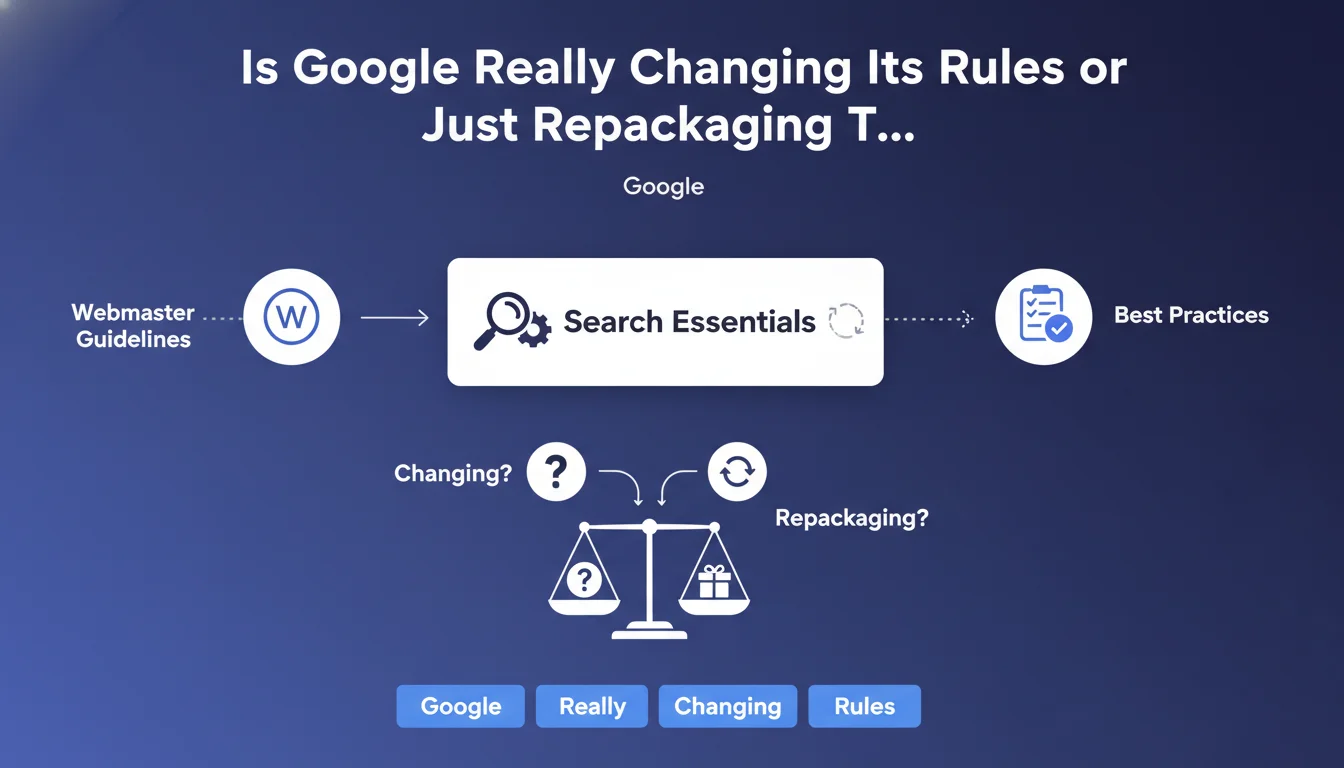
Google is rebranding its Webmaster Guidelines as 'Search Essentials' with a complete overhaul of the documentation. This isn't just cosmetic: the structure and tone are evolving to address a broader audience than just historical webmasters. The question remains whether the recommendations themselves will shift fundamentally or if this is primarily a marketing repositioning.
What you need to understand
Why Is Google Ditching the Term 'Webmaster Guidelines'?
The word webmaster comes from an era when managing a website meant getting your hands dirty with code. Today, the web landscape is far more diverse: developers, SEO professionals, content writers, marketers, and business owners running WordPress or Shopify sites.
Google is broadening its audience by adopting a more generic term. Search Essentials speaks to anyone who wants visibility in search results, not just technical profiles. It's also a signal that Google wants to simplify its messaging.
What Actually Changes in the Documentation?
The overhaul goes beyond just the name. Google has reorganized the documentation architecture to make it more accessible. Sections are restructured, technical jargon is reduced, and the focus shifts toward essential best practices rather than exhaustive technical details.
That said, [To be verified] — we still lack specifics on what disappears or appears in this new version compared to the old Guidelines. Some technical points risk being diluted in favor of more generalist advice.
Should We Expect New SEO Directives?
Not necessarily. Rebranding doesn't automatically mean substantive change. The fundamentals remain: quality content, crawlability, performance, and user experience.
What might evolve is how Google presents and prioritizes these principles. The overhaul could also be an opportunity to integrate recent elements like Core Web Vitals or generative AI into a unified framework.
- Google is targeting a wider audience than just web technicians
- The documentation is restructured for greater clarity and accessibility
- The change is primarily formal: SEO fundamentals aren't shifting radically
- Be cautious of nuances that might disappear in the simplification process
SEO Expert opinion
Does This Overhaul Really Change the Game for SEO Professionals?
Let's be honest: no. For an experienced SEO, the principles don't change. Whether Google calls it Guidelines or Essentials, the rules of the game stay the same. What might shift is the granularity of certain recommendations.
The risk is that Google waters down important technical nuances in favor of a broader audience message. For instance, the distinctions between crawl budget, JavaScript rendering budget, and indexation priority could be oversimplified. A professional needs precision, not excessive popularization.
Should We Anticipate Contradictions Between the Old and New Documentation?
Likely. Google has a habit of reformulating its recommendations over time, sometimes creating ambiguities. If the new documentation simplifies certain points, precise technical directives risk disappearing or being reworded more vaguely.
[To be verified] — you'll need to compare the old and new versions line by line to spot what's been removed. Some advanced practices might no longer be explicitly mentioned, which doesn't mean they become forbidden or ineffective.
Does This Evolution Reflect a Shift in Google's Strategy?
Yes, in positioning. Google wants to be perceived as accessible and inclusive, not as a black box reserved for insiders. This aligns with the rise of no-code tools and the democratization of the web.
But algorithmically speaking? Nothing changes. Ranking criteria, crawl management, quality assessment: all of that continues functioning as before. The rebranding is a communication move, not a technical revolution.
Practical impact and recommendations
What Should You Actually Do With This New Documentation?
First step: explore the new structure of Search Essentials. Identify reorganized sections, note any wording changes, and document what's been added or removed compared to the old Guidelines.
Second step: update your internal processes and checklists. If you have reference documents based on the Webmaster Guidelines, adapt them by incorporating the new phrasing — without abandoning the technical nuances that may have disappeared from the public-facing version.
- Compare old and new documentation to identify content gaps
- Update your checklists and quality processes with new references
- Keep a copy of the old Guidelines for historical reference
- Train your teams on the new terminology to standardize vocabulary
- Monitor future updates to the Search Essentials documentation
What Mistakes Should You Avoid During This Transition?
Don't assume a practice is obsolete just because it no longer appears in the new documentation. Google tends to simplify for the general public, which doesn't mean advanced techniques become useless.
Also avoid over-reacting by massively revamping your sites. If your current practices comply with the old Guidelines and your performance is stable, there's no urgent need to overhaul everything. The change is documentary, not algorithmic.
How Can You Ensure Your Strategy Stays Aligned With Google's Expectations?
Stay focused on fundamental principles: useful and relevant content, technical accessibility, solid user experience. These pillars run through every version of Google's documentation.
Follow official updates via Google Search Central and communication channels from John Mueller, Gary Illyes, and other Google spokespeople. Public statements typically remain more nuanced than generalist documentation.
❓ Frequently Asked Questions
Les anciennes Webmaster Guidelines sont-elles encore valables après ce changement ?
Faut-il modifier mon site suite à ce renommage ?
Google va-t-il publier de nouvelles recommandations techniques avec les Search Essentials ?
Le terme 'webmaster' disparaît-il complètement de l'univers Google ?
Cette simplification risque-t-elle de masquer des nuances importantes pour les SEO avancés ?
🎥 From the same video 4
Other SEO insights extracted from this same Google Search Central video · published on 16/02/2023
🎥 Watch the full video on YouTube →
💬 Comments (0)
Be the first to comment.