
Official statement
Other statements from this video 13 ▾
- □ Why aren't your product listings appearing in Google Shopping carousels?
- □ How does Google display price ranges in rich snippets using Schema.org markup?
- □ What's the best way to feed your products into Google Shopping to maximize visibility and sales?
- □ Should you take control of your product feed refresh frequency in Merchant Center?
- □ Does Google really refresh your Merchant Center product data multiple times per day?
- □ Will the Merchant Listing report in Search Console replace Merchant Center?
- □ Do you really need both schema.org AND Merchant Center to rank in Google Shopping?
- □ How do price and availability updates impact your product eligibility in Google Shopping results?
- □ Should you use schema.org or feed specification for Google Shopping? Here's why you actually need both
- □ Can Schema.org really manage product variants better than flat feeds?
- □ Is Google really hiding your products because prices don't match between your feed and website?
- □ Does Google's crawl budget really limit how fast your product prices update in Shopping results?
- □ Why is Google launching a dedicated impressions and clicks report for products in Merchant Center?
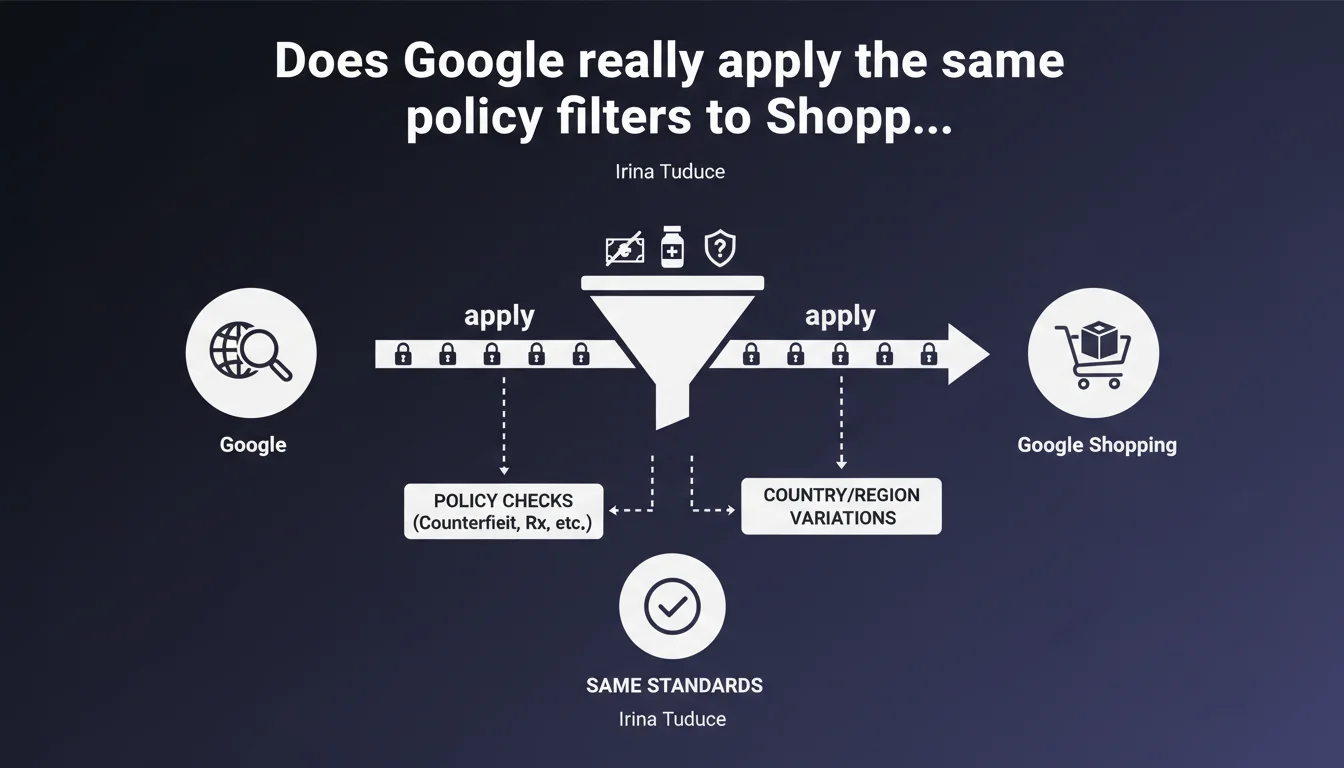
Google confirms that its Shopping infrastructure uses identical policy checks to web search — counterfeit goods, prescription medications, banned content. These rules vary by country and are publicly documented. For e-commerce businesses, this means a Shopping suspension can reflect a problem detected in organic search as well.
What you need to understand
What does this convergence between Shopping and web search really mean?
Google is progressively unifying its detection systems. The technical infrastructure that analyzes products in Google Shopping now relies on the same pipelines as those used for traditional web search.
Concretely? A site selling counterfeit products risks not only being excluded from Shopping, but also seeing its organic pages penalized. Both channels share the same policy databases.
Why do these policies vary depending on the region?
Local legislation imposes different rules. A dietary supplement authorized in the United States might be classified as an unapproved medication in Europe. Google adapts its filters country by country.
This statement reminds us that Google's public policies — often overlooked by SEOs — are the first level of filtering before any ranking algorithm. A product blocked for policy reasons will never be indexed, regardless of the quality of your technical SEO.
- System unification : Shopping and web search share the same detection infrastructure
- Documented policies : the rules are public, but scattered across different guides depending on the country
- Prioritization : policy compliance comes before any traditional SEO optimization
- Cross-channel impact : a violation detected on Shopping can contaminate your organic visibility
SEO Expert opinion
Is this statement consistent with field observations?
Yes, and it confirms a pattern observed over several quarters. E-commerce merchants have seen their Shopping listings disappear simultaneously with drops in organic visibility — without receiving clear notification explaining the link between the two.
The problem? Google doesn't explicitly document this interdependence. Irina Tuduce speaks of shared infrastructure, but the tools (Search Console vs Merchant Center) remain siloed. A merchant can have a site that appears "healthy" in Search Console while being banned from Shopping for policy violation. [To verify] : does this technical convergence come with a convergence of alert systems?
What nuances should be added to this statement?
The phrase "similar policy checks" remains vague. Similar doesn't mean identical. A product can pass in web search but be blocked in Shopping if its Merchant Center feed contains problematic attributes (misleading pricing, non-compliant images).
Another blind spot : timing. A violation detected in Shopping might take weeks to impact organic search, or vice versa. Google says nothing about the temporal synchronization between the two systems.
Practical impact and recommendations
What should you audit first on an e-commerce site?
Start by cross-referencing Shopping policies with your catalog. Google publishes lists by category (health, alcohol, weapons, regulated products), but they're scattered across different help centers depending on the country.
Next verify consistency between your product feeds and your web pages. A title optimized for SEO might contain wording forbidden in Shopping ("exact copy," "like the original"). If your feed automatically pulls these titles, you risk a double penalty.
How do you detect a policy violation before it impacts your performance?
Use the Merchant Center Diagnostics proactively, even if you haven't been flagged yet. Minor warnings (often ignored) can become indexing rejections if Google tightens its criteria.
On the Search Console side, monitor manual actions AND impression drops without notification. A sudden drop on transactional queries can indicate policy filtering, even without an alert message.
- Compare your catalog against Shopping policies country by country (especially health, beauty, supplements)
- Audit titles, descriptions and images to detect forbidden wording
- Verify consistency between Merchant Center feed and on-page content
- Enable alerts in Merchant Center to anticipate issues
- Cross-reference Search Console and Merchant Center data to spot inconsistencies
- Document policy variations by region if you operate internationally
❓ Frequently Asked Questions
Une sanction Shopping peut-elle affecter mon référencement organique ?
Où trouver la liste complète des politiques Shopping par pays ?
Un produit légal peut-il être refusé par Google Shopping ?
Comment savoir si mon site est impacté par un filtre de politique sans notification ?
Les politiques Shopping évoluent-elles fréquemment ?
🎥 From the same video 13
Other SEO insights extracted from this same Google Search Central video · published on 05/09/2024
🎥 Watch the full video on YouTube →
💬 Comments (0)
Be the first to comment.