
Official statement
Other statements from this video 13 ▾
- □ Why aren't your product listings appearing in Google Shopping carousels?
- □ How does Google display price ranges in rich snippets using Schema.org markup?
- □ What's the best way to feed your products into Google Shopping to maximize visibility and sales?
- □ Should you take control of your product feed refresh frequency in Merchant Center?
- □ Does Google really refresh your Merchant Center product data multiple times per day?
- □ Will the Merchant Listing report in Search Console replace Merchant Center?
- □ Do you really need both schema.org AND Merchant Center to rank in Google Shopping?
- □ How do price and availability updates impact your product eligibility in Google Shopping results?
- □ Can Schema.org really manage product variants better than flat feeds?
- □ Is Google really hiding your products because prices don't match between your feed and website?
- □ Does Google really apply the same policy filters to Shopping as it does to organic search?
- □ Does Google's crawl budget really limit how fast your product prices update in Shopping results?
- □ Why is Google launching a dedicated impressions and clicks report for products in Merchant Center?
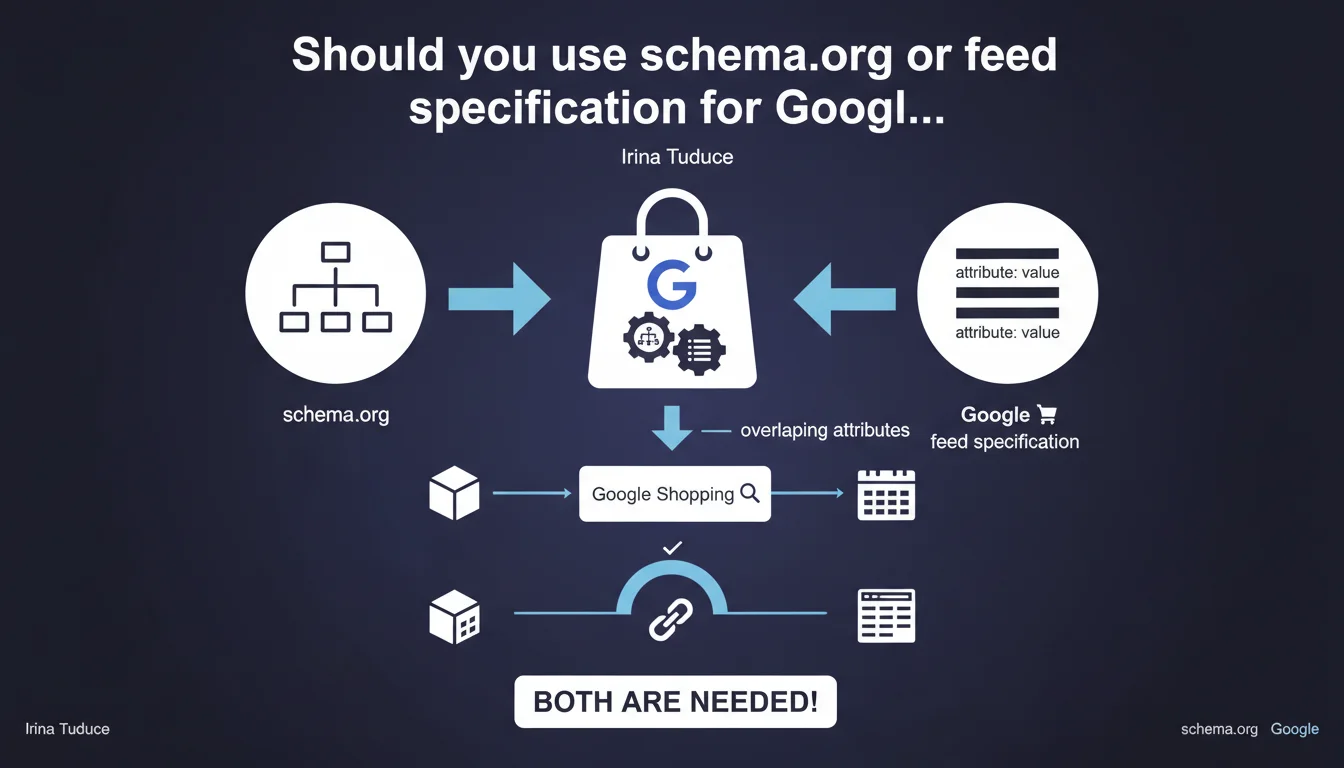
Google uses two distinct data formats for shopping: schema.org (open source hierarchical markup) and feed specification (Google's proprietary key-value flat structure format). These formats have largely overlapping attributes, but are not yet fully equivalent — forcing e-commerce businesses to juggle between both.
What you need to understand
Why does Google maintain two competing data formats?
Google manages two parallel systems to interpret product data: schema.org markup (integrated directly into HTML) and Merchant Center feeds (XML/CSV files sent via the Google interface).
The first is an open, hierarchical standard that integrates into the DOM. The second is a proprietary flat-structure format optimized for massive product catalog processing.
What does this "non-parity" actually change in practice?
The two formats share a large portion of their attributes (price, availability, SKU, images). But some fields are only available in one or the other — or are interpreted differently.
For example, certain product categories, shipping conditions, or promotional information may not be recognized the same way depending on which format you use.
Which format does Google actually prioritize?
Google doesn't say explicitly, but in practice, the Merchant Center feed is often prioritized for Shopping campaigns and commercial surfaces (Google Shopping, Shopping tab).
schema.org markup, meanwhile, mainly serves to enrich organic results (rich snippets, FAQ, breadcrumb) and feed other Google services (Assistant, Discover).
- Schema.org: on-page markup, hierarchical, open, multi-platform
- Feed specification: centralized format, flat, Google proprietary, optimized for commerce
- The two formats overlap but are not fully interchangeable
- Google does not guarantee that all attributes will be processed equivalently
- "Complete parity" between the two remains a future goal, not current reality
SEO Expert opinion
Is this statement really a surprise?
No. SEO and e-commerce practitioners have long known that Google maintains two separate data channels. What's interesting here is that Google officially owns it: there is no complete parity.
This means you need to stop believing that good schema.org markup alone is enough to be visible in Google Shopping — or that an optimized Merchant Center feed guarantees rich snippets in organic results.
What nuances should be added to this statement?
Google doesn't specify which attributes are missing from each format, or when this "complete parity" will be achieved. That's frustrating. [To be verified] based on field audits: some fields (like shippingDetails in schema.org) are not processed with the same level of detail as in feeds.
Another point: Google doesn't clearly state which format takes priority in case of conflict. If a price differs between on-page markup and the Merchant Center feed, which one displays? Radio silence.
In what cases does this logic become problematic?
For sites wanting to centralize their data management (one single feed, one single source of truth), this duality forces maintaining two systems in parallel. That's expensive in development and maintenance costs.
Worse: if Google modifies one format without synchronizing the other, errors can appear — and there is no cross-validation between the two systems.
Practical impact and recommendations
What should you do concretely to manage this duality?
First rule: don't choose. If you're an e-commerce business with ambitions on Google commercial surfaces (Shopping, paid campaigns), the Merchant Center feed is mandatory. If you want rich snippets in organic results, schema.org markup is essential.
Second rule: synchronize as much as possible. Common attributes (price, availability, images) must be identical between on-page markup and feed. Any divergence can create rejections or visual inconsistencies.
What mistakes should you absolutely avoid?
Don't update the Merchant Center feed thinking that schema.org markup will automatically follow. The two systems are completely independent.
Don't assume that an attribute present in one format will be interpreted in the other. Example: some detailed shipping information in the feed is not recognized in schema.org — and vice versa.
How can you verify that everything is properly configured?
Use Google Search Console to monitor schema.org markup errors ("Enhancements" section). In parallel, regularly audit Google Merchant Center for feed rejections or warnings.
Test your rich snippets with Google's Rich Results Test, and verify that your products appear correctly in the Shopping tab after feed validation.
- Implement both schema.org and a Merchant Center feed for maximum coverage
- Synchronize common attributes (price, stock, images) between the two formats
- Monitor updates to each format separately — they are not linked
- Test regularly with Google Search Console and Merchant Center
- Document attributes specific to each format to prevent oversights
- Never assume that a change in one format impacts the other
❓ Frequently Asked Questions
Est-ce que schema.org suffit pour être visible dans Google Shopping ?
Si un prix diffère entre mon balisage schema.org et mon feed Merchant Center, lequel Google affiche-t-il ?
Quels attributs ne sont pas encore à parité entre les deux formats ?
Dois-je mettre à jour les deux formats à chaque modification de produit ?
Est-ce que Google prévoit de fusionner les deux formats à terme ?
🎥 From the same video 13
Other SEO insights extracted from this same Google Search Central video · published on 05/09/2024
🎥 Watch the full video on YouTube →
💬 Comments (0)
Be the first to comment.