
Official statement
Other statements from this video 13 ▾
- □ Why aren't your product listings appearing in Google Shopping carousels?
- □ How does Google display price ranges in rich snippets using Schema.org markup?
- □ What's the best way to feed your products into Google Shopping to maximize visibility and sales?
- □ Does Google really refresh your Merchant Center product data multiple times per day?
- □ Will the Merchant Listing report in Search Console replace Merchant Center?
- □ Do you really need both schema.org AND Merchant Center to rank in Google Shopping?
- □ How do price and availability updates impact your product eligibility in Google Shopping results?
- □ Should you use schema.org or feed specification for Google Shopping? Here's why you actually need both
- □ Can Schema.org really manage product variants better than flat feeds?
- □ Is Google really hiding your products because prices don't match between your feed and website?
- □ Does Google really apply the same policy filters to Shopping as it does to organic search?
- □ Does Google's crawl budget really limit how fast your product prices update in Shopping results?
- □ Why is Google launching a dedicated impressions and clicks report for products in Merchant Center?
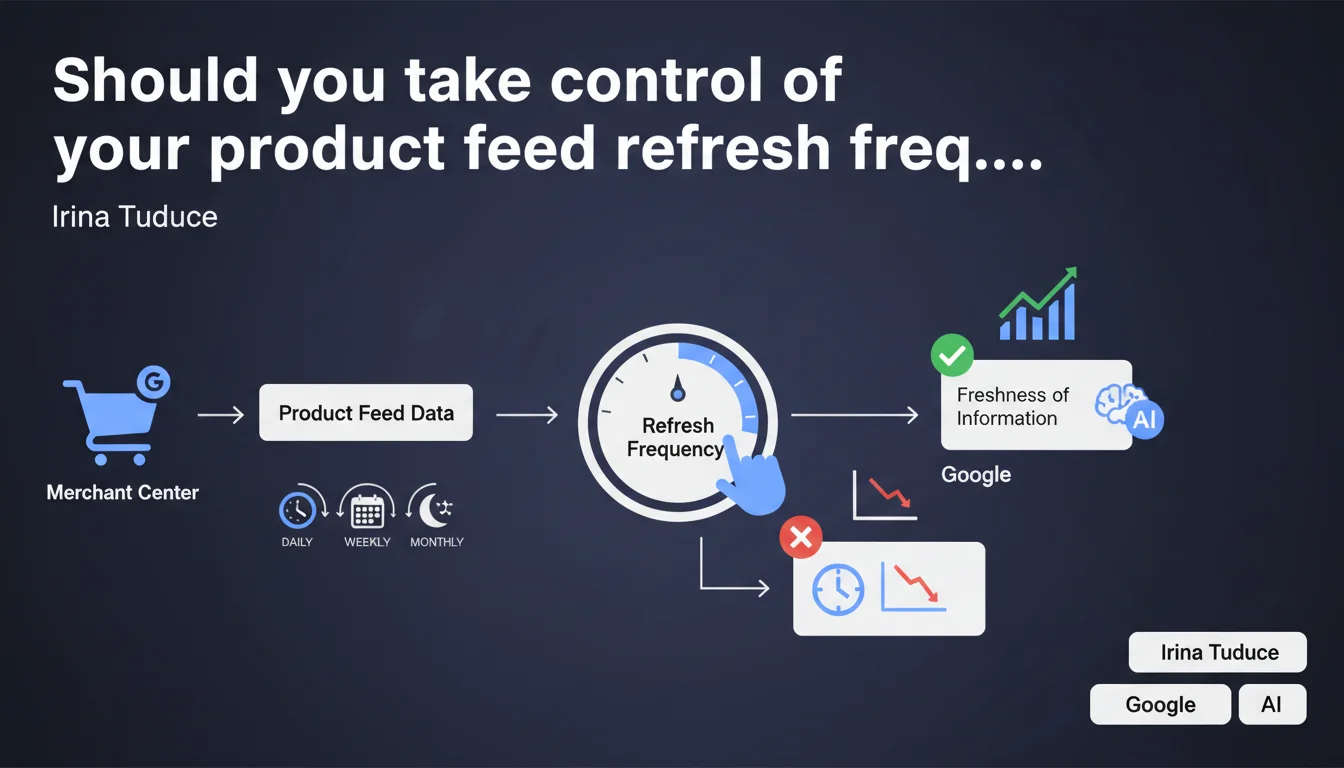
Google now allows e-commerce merchants to choose the refresh frequency of their product feeds in Merchant Center: daily, weekly, or monthly. This option provides direct control over the freshness of data displayed in Shopping results. It looks useful at first glance, but the real question is whether it actually makes a meaningful difference in practice.
What you need to understand
What actually changes with this feature?
Google is introducing a parameter in Merchant Center that lets you define the refresh frequency of your product feeds. Three options: daily, weekly, or monthly.
Until now, most e-commerce companies pushed their feeds at a fixed pace — often daily — without clear visibility into what Google was actually doing with those updates. This new option officially puts you in control of the refresh cadence.
Why is Google offering this level of control now?
The obvious answer: not all product catalogs move at the same speed. A fast fashion site with inventory changing every hour doesn't have the same needs as a furniture seller with a stable catalog for weeks.
Offering this setting also reduces server load on Google's side and avoids unnecessary crawling of feeds that never change. Win-win in theory — if the option works as promised.
What are the typical use cases for each frequency?
The daily frequency suits volatile catalogs: frequent stockouts, flash promotions, regular price variations. It's the default setting for most e-commerce players.
The weekly frequency is sufficient for stable catalogs with occasional adjustments — furniture, industrial equipment, books. Monthly? Reserved for nearly static catalogs, which remains marginal.
- Daily frequency: standard e-commerce, moving inventory, recurring promos
- Weekly frequency: stable catalogs, rare variations, durable products
- Monthly frequency: static catalogs, highly specialized niches
- Your choice should match the reality of your product management, not a theoretical ideal
SEO Expert opinion
Does this option really change anything in practice?
Let's be honest: Google was already crawling your feeds according to its own logic. This parameter formalizes a control that, until now, mostly depended on your submission frequency and the algorithm's mood.
The real question: does Google actually respect this declared frequency, or is it just one signal among many? No data provided on that. [To be verified] in the field by monitoring crawl logs and update timestamps in Shopping results.
What are the risks if you choose the wrong frequency?
Switching to weekly or monthly when your catalog changes daily risks displaying outdated information: expired prices, out-of-stock products visible for several days. Poor user experience guaranteed, bounce rates up.
Conversely, staying on daily for a catalog that never changes poses no technical issue — but it unnecessarily overloads your infrastructure if you generate a complete feed each time. On Google's side, it can dilute crawl priority if the algorithm detects your updates are cosmetic.
In which cases does this feature remain anecdotal?
If you use the Content API to push real-time product updates, this parameter becomes secondary. The API always takes priority over static feed settings.
For large catalogs (500k+ products), the question of crawl budget and internal prioritization remains infinitely more critical than this frequency toggle. A clean, segmented feed with well-managed deltas will always have more impact than a simple frequency switch.
Practical impact and recommendations
What should you concretely do with this option?
Start by auditing your actual update rhythm. Analyze the frequency of your product changes over the last 30 days: prices, inventory, descriptions, images. If 90% of your catalog doesn't move for a week, daily frequency is probably oversized.
Then test switching to weekly on a subset of low-volatility products and monitor impacts: update delay in Shopping, ad performance, disappearance rate for outdated data. Adjust based on observed results.
What errors should you avoid in configuration?
Don't switch your entire catalog to monthly out of convenience. That's the best way to display outdated information and degrade your Quality Score. Google penalizes feeds inconsistent with site reality.
Also avoid changing this frequency too often. Once configured, let it run for at least 4 to 6 weeks before adjusting — time for Google to stabilize its crawl on your new rhythm.
- Audit the actual volatility of your catalog over 30 rolling days
- Segment your products by update rhythm (daily, weekly, monthly)
- Configure refresh frequency by feed or product group
- Monitor actual update delays in Shopping results
- Cross-reference with Merchant Center crawl logs to verify consistency
- Adjust after at least 4 weeks of observation to avoid side effects
How do you verify the setting works as intended?
Compare the crawl timestamps in Merchant Center diagnostics with your configured frequency. If you're set to weekly and Google crawls daily anyway, the parameter is being ignored or overridden by other signals.
Also monitor the data freshness displayed in Shopping: make a test change to a product and note the delay before it appears in ads. If it consistently exceeds your declared frequency, investigate feed quality or product eligibility.
❓ Frequently Asked Questions
Puis-je définir une fréquence différente pour chaque flux dans Merchant Center ?
Est-ce que choisir une fréquence mensuelle réduit la visibilité de mes produits dans Shopping ?
Cette option remplace-t-elle la soumission automatique de flux via FTP ou API ?
Faut-il changer ce réglage si on utilise l'API Content pour les mises à jour temps réel ?
Comment savoir quelle fréquence choisir pour mon catalogue ?
🎥 From the same video 13
Other SEO insights extracted from this same Google Search Central video · published on 05/09/2024
🎥 Watch the full video on YouTube →
💬 Comments (0)
Be the first to comment.