
Official statement
Other statements from this video 13 ▾
- □ How does Google display price ranges in rich snippets using Schema.org markup?
- □ What's the best way to feed your products into Google Shopping to maximize visibility and sales?
- □ Should you take control of your product feed refresh frequency in Merchant Center?
- □ Does Google really refresh your Merchant Center product data multiple times per day?
- □ Will the Merchant Listing report in Search Console replace Merchant Center?
- □ Do you really need both schema.org AND Merchant Center to rank in Google Shopping?
- □ How do price and availability updates impact your product eligibility in Google Shopping results?
- □ Should you use schema.org or feed specification for Google Shopping? Here's why you actually need both
- □ Can Schema.org really manage product variants better than flat feeds?
- □ Is Google really hiding your products because prices don't match between your feed and website?
- □ Does Google really apply the same policy filters to Shopping as it does to organic search?
- □ Does Google's crawl budget really limit how fast your product prices update in Shopping results?
- □ Why is Google launching a dedicated impressions and clicks report for products in Merchant Center?
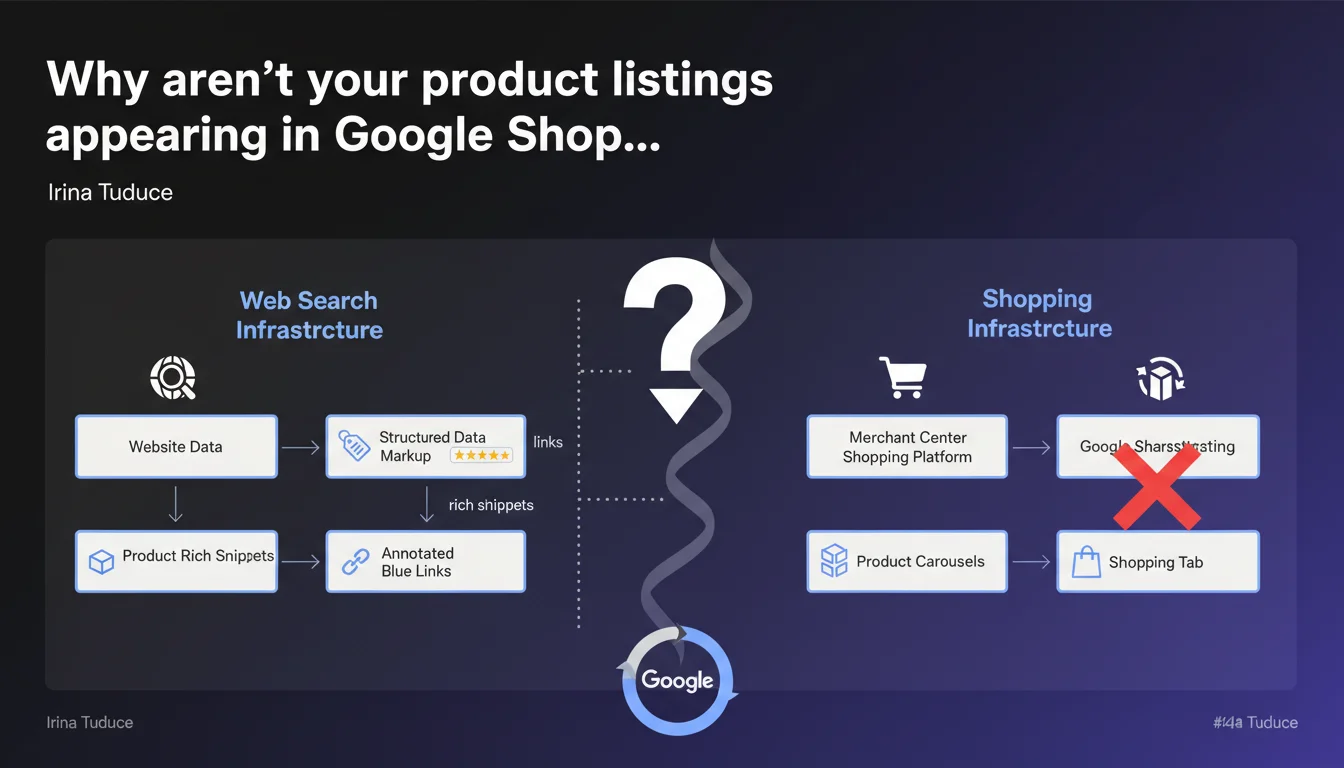
Google uses two distinct infrastructures to display product results: the classical web search infrastructure (rich snippets, annotated blue links) and the dedicated Shopping infrastructure (Merchant Center, carousels, Shopping tab). Optimizing your classical SEO is not enough to appear in product carousels — you absolutely must be present in Merchant Center.
What you need to understand
What are these two infrastructures and how do they differ?
The classical web search infrastructure treats your product pages like any other page on your site. It indexes them, analyzes them, and can display product rich snippets (price, availability, reviews) or annotated blue links in standard organic search results.
The dedicated Shopping infrastructure operates on a completely separate circuit. It is fed exclusively through Merchant Center and generates the product carousels you see at the top of SERPs as well as the entire Shopping tab. It's a separate ecosystem with its own validation rules, quality standards, and ranking criteria.
Why is this distinction critical for e-commerce?
Because 90% of e-commerce businesses believe that by optimizing their on-page SEO (schema.org Product tags, perfect structured data), they will naturally appear in Shopping carousels. That's wrong.
Carousels pull exclusively from Merchant Center. You can have the cleanest product markup in the world — if you don't have an active and validated feed in Merchant Center, you will never exist in these ultra-visible positions. And conversely: a site with mediocre SEO but a flawless Merchant Center feed can crush it in carousels.
Concretely, where do we see this dual infrastructure in action?
Search for "mens running shoes" on Google. You'll likely see:
- A product carousel at the top (horizontal, with images, prices) → powered by Merchant Center
- Organic blue links to category pages or product pages → classical web crawl
- Sometimes rich snippets with stars and prices on certain blue links → web crawl + schema.org, but still web infrastructure
- The Shopping tab (if you click on it) → 100% Merchant Center
Two circuits, two logics, two sets of quality criteria. This is where many e-commerce businesses lose traffic without knowing it.
SEO Expert opinion
Is this statement consistent with real-world observations?
Absolutely. We regularly see e-commerce sites with flawless SEO (perfect Product schema markup, pristine crawlability, Core Web Vitals in the green) that can't understand why they never appear in product carousels. Answer: no active Merchant Center feed.
Conversely, some sites with mediocre on-page SEO but rigorous Merchant Center management (optimized feeds, crafted product titles, clean Google categorization) dominate carousels. The correlation is clear and reproducible.
What nuances should be added to this assertion?
Google doesn't specify how these two infrastructures interact — and that's where things get fuzzy. For example: does a site's SEO quality (authority, links, engagement) influence ranking in Merchant Center carousels? [To be verified]
Field observations suggest yes, there is some form of cross-influence. A site with strong authority seems to rank better in carousels at equal product data. But Google doesn't document this point — we're left with empirical evidence.
Another gray area: can Product structured data on your pages serve as a "backup source" if your Merchant Center feed is incomplete? Nothing is said officially, but some tests show Google can pull from schema.org markup to enrich incomplete Merchant Center listings. Take this with caution.
In which cases does this distinction become a trap?
When you invest heavily in on-page optimization (schema.org, rich snippets) while neglecting Merchant Center, thinking "Google will see the data anyway." Result: zero ROI on Shopping visibility.
Another trap: believing Merchant Center is enough. If you neglect classical SEO, you lose clicks on organic blue links — which still represent a huge portion of traffic, especially for informational queries or broad category searches.
Practical impact and recommendations
What do you need to do concretely to cover both infrastructures?
First, activate and maintain a clean Merchant Center feed. No approximations: product titles optimized with relevant keywords, unique descriptions, precise Google categorization, compliant images (white background, high resolution), price and stock data updated in real-time.
Next, optimize classical SEO on your product pages: title/meta tags, complete Product schema.org markup (price, availability, review, aggregateRating), internal linking to product pages, enriched content (long descriptions, FAQs, integrated buying guides).
Both workstreams must move forward in parallel. You cannot choose one or the other if you're aiming for maximum coverage of product SERPs.
What mistakes must you absolutely avoid?
- Believing that flawless Product structured data will automatically generate Shopping carousels → false, you need Merchant Center
- Neglecting product title quality in your Merchant Center feed thinking "it's just for Google Shopping" → these titles are critical for carousel ranking
- Having a Merchant Center feed but letting it degrade (out-of-stock products not removed, outdated prices, broken images) → Google penalizes heavily
- Not segmenting your efforts: some products perform better in classical SEO (long-tail queries), others in carousels (short transactional queries)
- Forgetting that the Shopping tab represents significant click volume — being absent from it means leaving market share on the table
How do you verify your coverage is complete?
Audit your positions on strategic product queries. Note for each one: carousel presence? Position in organic blue links? Rich snippet displayed? Shopping tab presence?
If you have gaps (e.g., good classical SEO but no carousels), identify the weak link. Often it's a Merchant Center feed issue (rejected products, incorrect categorization) or lack of product title optimization in the feed.
Managing these two infrastructures simultaneously requires distinct skill sets: classical SEO expertise on one side, Merchant Center and product feed mastery on the other. Many e-commerce businesses underestimate the complexity of this dual optimization. If your internal team lacks resources or expertise on either of these fronts, it may be wise to get support from an SEO agency specializing in both areas — one that can audit, prioritize, and execute the most impactful optimizations for your catalog.
❓ Frequently Asked Questions
Est-ce que les données structurées schema.org Product remplacent Merchant Center pour les carrousels ?
Si j'optimise mon flux Merchant Center, est-ce que mon SEO classique va s'améliorer automatiquement ?
Pourquoi certains de mes produits apparaissent en carrousel et d'autres non, alors qu'ils sont tous dans Merchant Center ?
Les rich snippets produits (étoiles, prix) dans les liens bleus viennent-ils de Merchant Center ?
Faut-il dupliquer les optimisations entre les titres de pages et les titres Merchant Center ?
🎥 From the same video 13
Other SEO insights extracted from this same Google Search Central video · published on 05/09/2024
🎥 Watch the full video on YouTube →
💬 Comments (0)
Be the first to comment.