
Official statement
Other statements from this video 13 ▾
- □ Why aren't your product listings appearing in Google Shopping carousels?
- □ How does Google display price ranges in rich snippets using Schema.org markup?
- □ What's the best way to feed your products into Google Shopping to maximize visibility and sales?
- □ Should you take control of your product feed refresh frequency in Merchant Center?
- □ Does Google really refresh your Merchant Center product data multiple times per day?
- □ Will the Merchant Listing report in Search Console replace Merchant Center?
- □ Do you really need both schema.org AND Merchant Center to rank in Google Shopping?
- □ How do price and availability updates impact your product eligibility in Google Shopping results?
- □ Should you use schema.org or feed specification for Google Shopping? Here's why you actually need both
- □ Is Google really hiding your products because prices don't match between your feed and website?
- □ Does Google really apply the same policy filters to Shopping as it does to organic search?
- □ Does Google's crawl budget really limit how fast your product prices update in Shopping results?
- □ Why is Google launching a dedicated impressions and clicks report for products in Merchant Center?
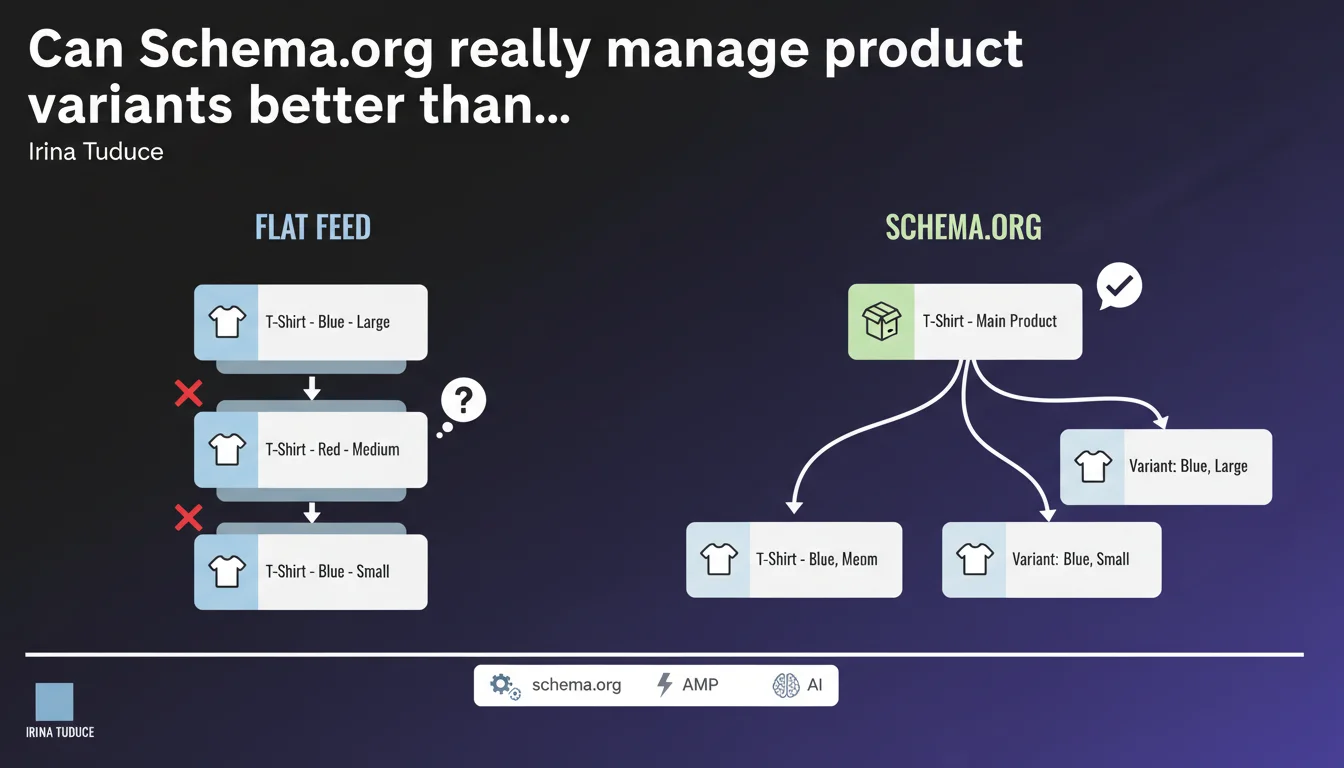
Google confirms that the Schema.org format, thanks to its hierarchical structure, allows you to specify relationships between product variants (size, color) and the main product group page — something flat feeds cannot do as effectively. For e-commerce sites, this is a compelling argument for prioritizing the implementation of structured data directly in HTML.
What you need to understand
This statement from Irina Tuduce sheds technical light on a choice that e-commerce SEO teams often have to make: Schema.org structured data integrated into HTML or product feeds submitted via Google Merchant Center?
Google's answer is clear. The Schema.org format, because it follows a hierarchical logic, allows you to express complex relationships between pages — notably between a main product page and its variants (sizes, colors, models). Feeds, on the other hand, remain flat files: each line describes a product, but the kinship links between products are difficult if not impossible to represent properly.
Why does Schema.org hierarchy make a difference?
In Schema.org, you can use properties like isVariantOf or variesBy to link a variant ("Red T-shirt size M") to its parent product group ("T-shirt"). This structuring helps Google understand that this is a single product in different versions, not 15 unrelated distinct products.
An XML or CSV feed, on the other hand, forces you to repeat product info for each variant. Google has to guess the relationship — and it doesn't always work. Result: perceived duplication, chaotic indexing, inconsistent display in rich results.
What does this change for product page ranking?
Concretely, if Google better understands your product structure, it can consolidate signals (reviews, availability, price) at the group level rather than scattering them across each isolated variant. This improves the relevance of rich snippets and prevents cannibalization between variants in the SERPs.
For complex catalogs — fashion, electronics, furniture — this is a competitive advantage. Sites that rely only on generic feeds risk losing visibility against competitors who have structured their data correctly.
- Hierarchical Schema.org allows you to explicitly link variants and main product
- Flat feeds do not support this notion of kinship between products
- Better structuring helps Google consolidate signals (reviews, price, stock) at the right level
- It reduces the risk of cannibalization between variants in search results
- E-commerce sites with complex catalogs have much to gain by prioritizing on-page Schema.org
SEO Expert opinion
Does this statement really reflect real-world practices?
Yes — and it's one of the rare cases where Google is completely transparent. In the field, Schema.org implementations that use isVariantOf or variesBy actually work better for structuring variants. Sites that migrated from feeds alone to hierarchical Schema.org often saw a consolidation of impressions and better consistency in rich snippets.
But let's be honest: many e-commerce platforms generate Schema.org automatically, without leveraging these advanced properties. Result? Markup present, validated by the Rich Results Test, but which doesn't convey product relationships. So the advantage remains theoretical.
What nuances should be added to this claim?
Google isn't saying feeds are useless. For Google Merchant Center and Shopping, they remain mandatory. The hierarchy Irina Tuduce mentions concerns organic indexing and rich results — not Shopping campaigns.
In practice, most large e-commerce operators use both: feeds for Merchant Center, Schema.org for SEO. The real issue is that Schema.org requires specific development, while feeds are often auto-generated by CMSs. It's more investment — but also more control.
In what cases doesn't this recommendation fully apply?
If your e-commerce catalog is simple — say fewer than 500 products, few variants — the SEO impact of a hierarchical structure will be marginal. The effort isn't always worth it if your CMS doesn't support it natively.
Similarly, some sites prefer to put everything on a single product page with a variant selector ("single-page product" model). In this case, isVariantOf relationships don't apply: you have a single URL, so no inter-page hierarchy to declare. It's a different approach — not necessarily less effective, just different.
Practical impact and recommendations
What should you do concretely to leverage this recommendation?
Start with an audit of your current markup. If you're using Schema.org Product, verify that your variant pages properly declare a relationship with the group page via isVariantOf or if the group uses hasVariant to point to its variants. If these properties are missing, Google probably sees your variants as independent products.
Next, structure your URLs and content consistently. A classic architecture: a main product page (e.g., /organic-cotton-tshirt) and variant URLs (e.g., /organic-cotton-tshirt?color=red&size=M). The main page contains the group markup, variants point back to it.
What mistakes should you avoid during implementation?
Don't declare hierarchical relationships if your variants are duplicate pages with no unique content. Google might interpret this as manipulation. Variants should provide real value (specific description, different images, distinct stock info).
Also avoid creating overly long chains of parentage: variant → sub-group → main group → category. Google can get lost. Keep it simple: variant ↔ main product, that's enough in 90% of cases.
- Audit your current Schema.org markup (Product, isVariantOf, variesBy)
- Verify that hierarchical relationships are properly declared between variants and main group
- Structure your URLs logically (main page + parameters or sub-URLs for variants)
- Ensure each variant has unique content (images, description, stock)
- Test your markup with the Rich Results Test and monitor errors in Search Console
- Compare your variant page performance before/after implementation (impressions, clicks, CTR)
- If you also use Merchant Center feeds, keep them up to date — they remain necessary for Shopping
Google's statement is clear: hierarchical Schema.org > flat feeds for structuring product variants in SEO. But implementation requires custom development, rigorous testing, and continuous monitoring. If your catalog is complex and you lack in-house technical resources, bringing in an e-commerce SEO specialist agency can help you deploy a robust solution without risking costly markup errors.
❓ Frequently Asked Questions
Schema.org remplace-t-il complètement les feeds produits pour Google Merchant Center ?
Quelles propriétés Schema.org utiliser pour relier variantes et produit principal ?
Faut-il créer une URL distincte pour chaque variante produit ?
Comment vérifier que mon markup de variantes est correctement compris par Google ?
Quel impact réel sur le trafic peut-on attendre d'une meilleure structuration des variantes ?
🎥 From the same video 13
Other SEO insights extracted from this same Google Search Central video · published on 05/09/2024
🎥 Watch the full video on YouTube →
💬 Comments (0)
Be the first to comment.