
Official statement
Other statements from this video 13 ▾
- □ Pourquoi vos fiches produits n'apparaissent-elles pas dans les carrousels Shopping de Google ?
- □ Comment Google affiche-t-il les fourchettes de prix dans les rich snippets grâce au balisage Schema.org ?
- □ Comment alimenter efficacement l'infrastructure shopping de Google pour maximiser la visibilité produit ?
- □ Faut-il contrôler la fréquence de rafraîchissement de vos flux produits dans Merchant Center ?
- □ Google rafraîchit-il vos données produits Merchant Center plusieurs fois par jour ?
- □ Le rapport Merchant Listing dans Search Console va-t-il remplacer Merchant Center ?
- □ Faut-il vraiment utiliser schema.org ET Merchant Center pour ranker en shopping ?
- □ Pourquoi le prix et la disponibilité déterminent-ils la visibilité de vos fiches produits dans Google Shopping ?
- □ Schema.org vs feed specification : faut-il choisir entre les deux formats de données pour le shopping ?
- □ Comment Schema.org peut-il mieux gérer les variantes produits que les feeds ?
- □ Pourquoi Google refuse-t-il d'afficher vos produits si les prix ne correspondent pas entre le flux et le site ?
- □ Google applique-t-il vraiment les mêmes filtres de politique à Shopping qu'en recherche classique ?
- □ Pourquoi Google lance-t-il un rapport dédié aux impressions et clics produits dans Merchant Center ?
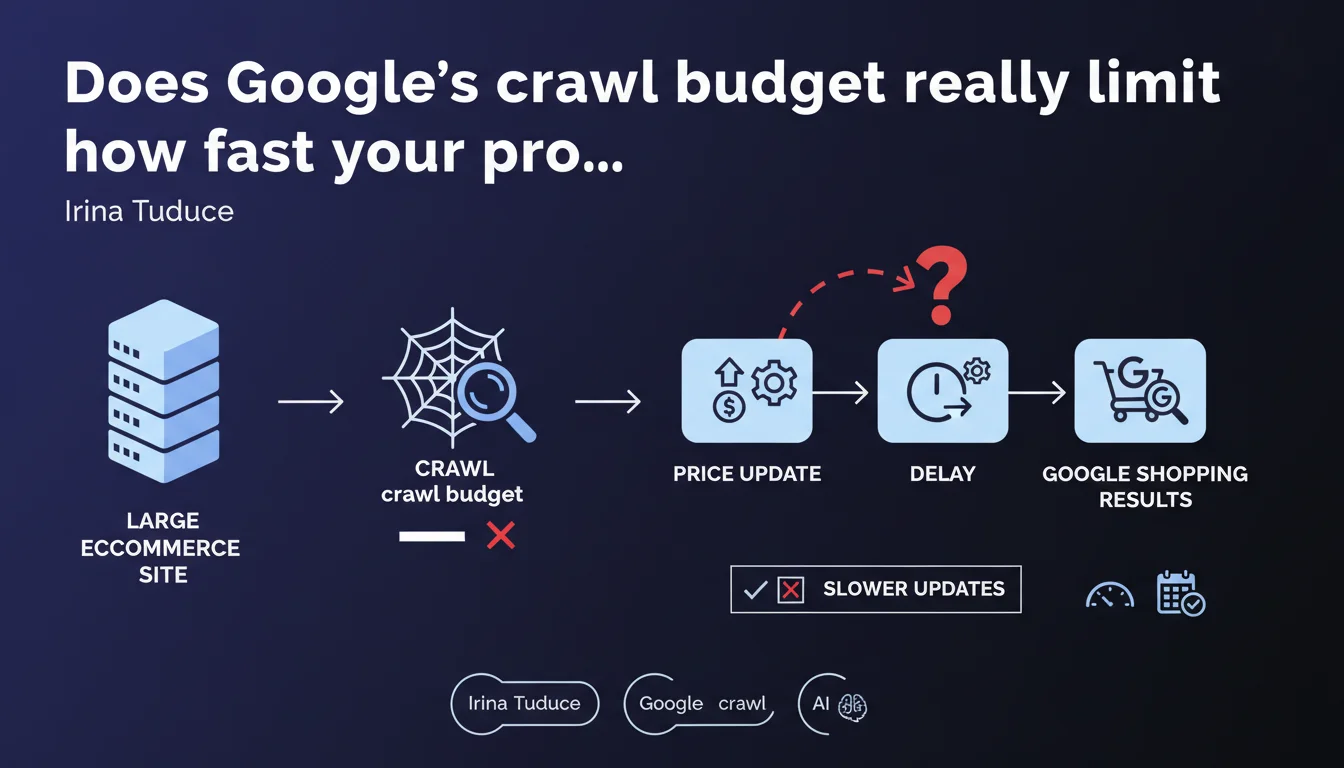
Google confirms that crawl budget constraints apply to product feeds, not just traditional web pages. On very large e-commerce catalogs, this can delay how quickly price changes are reflected in Shopping results — a major blind spot for retailers.
What you need to understand
What exactly is crawl budget for Google Shopping?
We talk a lot about crawl budget for web pages, but rarely about its impact on Shopping product feeds. Yet Google applies the same logic: it can't process millions of product listings instantly.
Concretely, Google allocates limited resources to crawl and update your product data. If you have a catalog of 500,000 items with prices fluctuating daily, all those changes won't be reflected in Shopping immediately.
Why is this a problem for large-catalog e-commerce sites?
Imagine a site adjusting prices multiple times a day to stay competitive — a standard strategy in electronics or travel. If Google takes 24 to 48 hours to crawl your entire feed, your competitors are already showing lower prices while you're losing clicks.
This lag creates a mechanical competitive disadvantage: you drop your price at 10am, but Google doesn't display it until 2pm the next day. Meanwhile, you've lost qualified traffic.
How does Google determine the crawl budget for Shopping?
Google stays vague — as usual — but we can extrapolate from known web crawl mechanics. Probably a mix of your historical update frequency, your feed quality (errors, rejections), and your commercial performance with those products.
The cleaner and more stable your feed, the more resources Google allocates to you. Conversely, a feed full of errors or unavailable products sees its budget reduced.
- Shopping crawl budget exists and works like regular web crawl budget
- Very large catalogs experience update delays ranging from 24-48 hours
- Frequent price adjustments are not instantly reflected in results
- Feed quality and site history probably influence this budget
SEO Expert opinion
Does this statement really explain why some prices stay outdated in Shopping?
Let's be honest: this Google confirmation addresses a pain point every e-commerce SEO knows well. How many times have you seen a client lower prices and discover, 36 hours later, that Google is still showing the old price?
The problem is Google gives no numbers. What's the threshold for a "very large site"? 10,000 products? 100,000? And what delay should be considered normal? [Needs verification] Without official data, we're flying blind.
Why doesn't Google offer concrete solutions to work around this limitation?
Because it would be a bit too convenient to say "pay for Shopping ads if you want real-time price updates." I'm not saying it's a conscious strategy, but the absence of a technical lever to force priority recrawl of certain products raises questions.
In Search Console, you can request indexing of a URL. For Shopping? Nothing. You're at the mercy of Google's crawl schedule. And that's problematic for ultra-competitive sectors where every hour counts.
When does this crawl budget constraint become negligible?
If you have 500 products that change price once a month, you'll never see this issue. Shopping crawl budget is only critical for large catalogs with high turnover: marketplaces, travel aggregators, electronics, fast-fashion.
And even then: with 50,000 items, if prices are stable and you only make minor weekly adjustments, the impact remains limited. It's the combination of volume + volatility that creates the bottleneck.
Practical impact and recommendations
What should you do concretely if your catalog is affected?
First, audit the actual frequency of your price updates. If you adjust 10,000 items daily but Google only processes 5,000, you have a structural problem. Track update delays in Merchant Center — even approximately.
Next, prioritize your updates. Rather than refreshing the entire feed every hour, focus changes on high-rotation or high-margin products. A product that sells twice a year doesn't need real-time price updates.
What mistakes should you avoid to not worsen crawl delays?
A feed full of errors or chronically out-of-stock products will sabotage your crawl budget. Google allocates fewer resources to unreliable feeds. Clean your data: no products unavailable for 3 months, no broken URLs, no miscategorized items.
Another trap: massive cosmetic changes. Changing descriptions for 50,000 products at once can trigger heavy recrawling — and slow down taking in genuinely critical price adjustments. Batch your updates intelligently.
- Audit the frequency of your price updates and the update delay in Shopping
- Prioritize changes on high-rotation or high-margin products
- Clean your feed: remove unavailable products, broken URLs, mapping errors
- Avoid massive cosmetic changes that waste crawl budget unnecessarily
- Track quality metrics in Google Merchant Center (rejection rate, errors)
- Test feed segmentation: send a dedicated feed for priority products
❓ Frequently Asked Questions
Le crawl budget Shopping est-il distinct du crawl budget SEO classique ?
À partir de combien de produits le crawl budget Shopping devient-il un problème ?
Peut-on forcer Google à recrawler certains produits en priorité ?
Les erreurs de flux réduisent-elles le crawl budget alloué ?
Les annonces Shopping payantes contournent-elles cette limite de crawl ?
🎥 From the same video 13
Other SEO insights extracted from this same Google Search Central video · published on 05/09/2024
🎥 Watch the full video on YouTube →
💬 Comments (0)
Be the first to comment.