
Official statement
Other statements from this video 13 ▾
- □ Pourquoi vos fiches produits n'apparaissent-elles pas dans les carrousels Shopping de Google ?
- □ Comment Google affiche-t-il les fourchettes de prix dans les rich snippets grâce au balisage Schema.org ?
- □ Faut-il contrôler la fréquence de rafraîchissement de vos flux produits dans Merchant Center ?
- □ Google rafraîchit-il vos données produits Merchant Center plusieurs fois par jour ?
- □ Le rapport Merchant Listing dans Search Console va-t-il remplacer Merchant Center ?
- □ Faut-il vraiment utiliser schema.org ET Merchant Center pour ranker en shopping ?
- □ Pourquoi le prix et la disponibilité déterminent-ils la visibilité de vos fiches produits dans Google Shopping ?
- □ Schema.org vs feed specification : faut-il choisir entre les deux formats de données pour le shopping ?
- □ Comment Schema.org peut-il mieux gérer les variantes produits que les feeds ?
- □ Pourquoi Google refuse-t-il d'afficher vos produits si les prix ne correspondent pas entre le flux et le site ?
- □ Google applique-t-il vraiment les mêmes filtres de politique à Shopping qu'en recherche classique ?
- □ Le crawl budget limite-t-il vraiment les mises à jour de prix dans Google Shopping ?
- □ Pourquoi Google lance-t-il un rapport dédié aux impressions et clics produits dans Merchant Center ?
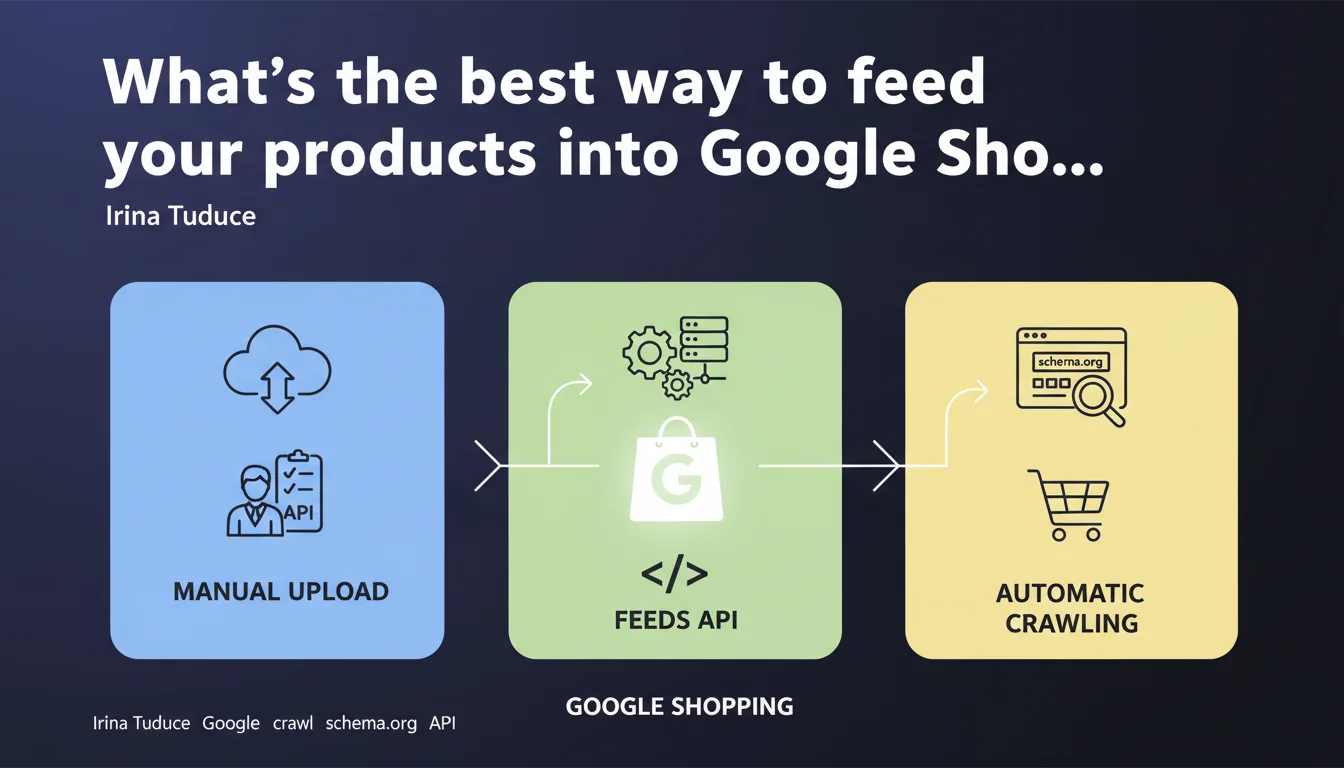
Google offers three methods to integrate your products into its shopping infrastructure: manual upload via Merchant Center, automation via the Feeds API, or automatic crawling that extracts products with schema.org markup directly from your website. The choice between these approaches depends on your product volume, technical resources, and ability to maintain up-to-date data.
What you need to understand
Why does Google offer three distinct methods for product data feed?
Google aims to maximize product coverage of its shopping infrastructure by adapting to the varying technical capabilities of e-commerce businesses. A small site with 50 products doesn't have the same needs as a marketplace with 100,000 SKUs.
Each method addresses a different level of technical maturity. Manual upload suits restricted catalogs, the API meets the automation needs of medium to large structures, and automatic crawling rewards sites that have invested in clean structured markup.
What's the difference between the Feeds API and automatic crawling?
The Feeds API allows you to push your product data to Google programmatically. You maintain full control over what is sent, how frequently, and can fine-tune updates (stock, price, availability).
Automatic crawling, on the other hand, reverses the logic: Google comes to fetch information directly from your product pages via schema.org Product markup. You delegate collection but lose some control over timing and granularity.
Is schema.org markup really enough to feed Merchant Center?
In theory, yes. In practice, it depends on the quality of your implementation and consistency between your markup and visible content. Google must be able to extract all required information: price, availability, image, description, GTIN if applicable.
Automatic crawling remains less predictable than a controlled feed. Update delays can vary, and any error in your markup directly impacts your shopping visibility without necessarily giving you immediate feedback.
- Three methods coexist: manual upload, Feeds API, automatic crawling
- The API offers the best balance between control and automation for dynamic catalogs
- Automatic crawling rewards clean and comprehensive schema.org Product markup
- Each approach has its data freshness constraints and maintenance requirements
SEO Expert opinion
Is this multi-track approach consistent with real-world observations?
Absolutely. Google has been multiplying entry points to its shopping infrastructure for years to expand its product base. It's a strategy for acquiring e-commerce content, not technical philanthropy.
Automatic crawling in particular pushes sites to structure their data even without active effort toward Merchant Center. Google thus captures catalogs that would never go through the traditional feed route, either through lack of knowledge or lack of motivation.
Which method should you prioritize based on your situation?
For a catalog under 500 items with few variations, manual upload remains acceptable if you have the discipline for updates. Beyond that, it's self-defeating — you'll be constantly out of sync with your actual stock.
The Feeds API becomes essential once your catalog exceeds 1,000 SKUs or your prices/stocks fluctuate daily. This is the case for most serious e-commerce businesses. Automatic crawling can complement this approach but shouldn't be your only source.
[To verify] Google remains vague on prioritization between these sources when multiple ones coexist. If you have both an API feed and schema.org markup, which takes precedence in case of price divergence? No clear official answer.
What underestimated risks come with automatic crawling?
The main pitfall: you delegate error detection to Google. If your markup contains an error, wrong price, or unreported stock outage, you may not know until it impacts your performance.
With an API feed or even manual upload, you have feedback via Merchant Center on rejected products, warnings, and data issues. With crawling, this feedback loop is less obvious.
Practical impact and recommendations
Which method should you implement first?
If you're starting out and your catalog doesn't exceed 200-300 products, begin with manual upload to familiarize yourself with Merchant Center and its quality requirements. Document the process thoroughly.
Once you reach a volume where manual updates become time-consuming (usually beyond 500 SKUs or with weekly updates), switch to the Feeds API. It's a development investment that pays off quickly through time saved and data freshness.
Automatic crawling via schema.org should be seen as a complement, not an exclusive solution. Implement it properly on your product pages anyway — it also benefits your regular SEO and rich snippets.
How do you verify that your schema.org markup is exploitable by Google Shopping?
Use Google's Rich Results Test on your product pages to validate that the Product markup is detected and correctly structured. Pay special attention to price, availability, image, and name fields.
Check Search Console for reports on structured data errors. Common issues: price without currency, inaccessible images, ambiguous availability ("in stock" vs "out of stock" poorly filled in).
Test under real conditions too: enable automatic crawling in Merchant Center and monitor which products are actually surfaced. Compare with what you expected — gaps reveal your weak points.
What mistakes should you absolutely avoid?
- Don't fail to maintain consistency between API feed and schema.org markup — choose a single source of truth
- Forget to verify and claim your site in Merchant Center before enabling crawling
- Implement schema.org Product with incomplete or incorrect data (net price instead of gross, low-resolution images)
- Neglect real-time stock updates if using the API — showing a product as available when it's out of stock kills your conversion rate
- Believe that automatic crawling dispenses you from a structured feed for complex Shopping campaigns (supplementary feeds, promotions, etc.)
Google's shopping infrastructure offers appreciable technical flexibility, but this diversity of approaches can create complexity if not orchestrated intelligently. Best practice is to prioritize the Feeds API for control and responsiveness, while ensuring clean schema.org Product markup on your product pages to maximize your exposure surface.
Choosing between these methods requires deep understanding of your technical constraints, product volume, and internal resources. If your team lacks expertise to optimize this product feed chain — between API implementation, schema.org validation, and Merchant Center monitoring — engaging a specialized SEO agency can significantly accelerate your compliance and prevent costly visibility errors.
❓ Frequently Asked Questions
Peut-on utiliser les trois méthodes simultanément sur un même site ?
Le crawl automatique via schema.org est-il aussi rapide que l'API pour les mises à jour de prix ?
Faut-il un balisage schema.org Product même si on utilise déjà l'API Feeds ?
Google facture-t-il différemment selon la méthode d'alimentation choisie ?
Quelle méthode assure la meilleure qualité de données dans Merchant Center ?
🎥 From the same video 13
Other SEO insights extracted from this same Google Search Central video · published on 05/09/2024
🎥 Watch the full video on YouTube →
💬 Comments (0)
Be the first to comment.