
Official statement
Other statements from this video 13 ▾
- □ Why aren't your product listings appearing in Google Shopping carousels?
- □ How does Google display price ranges in rich snippets using Schema.org markup?
- □ What's the best way to feed your products into Google Shopping to maximize visibility and sales?
- □ Should you take control of your product feed refresh frequency in Merchant Center?
- □ Does Google really refresh your Merchant Center product data multiple times per day?
- □ Will the Merchant Listing report in Search Console replace Merchant Center?
- □ Do you really need both schema.org AND Merchant Center to rank in Google Shopping?
- □ Should you use schema.org or feed specification for Google Shopping? Here's why you actually need both
- □ Can Schema.org really manage product variants better than flat feeds?
- □ Is Google really hiding your products because prices don't match between your feed and website?
- □ Does Google really apply the same policy filters to Shopping as it does to organic search?
- □ Does Google's crawl budget really limit how fast your product prices update in Shopping results?
- □ Why is Google launching a dedicated impressions and clicks report for products in Merchant Center?
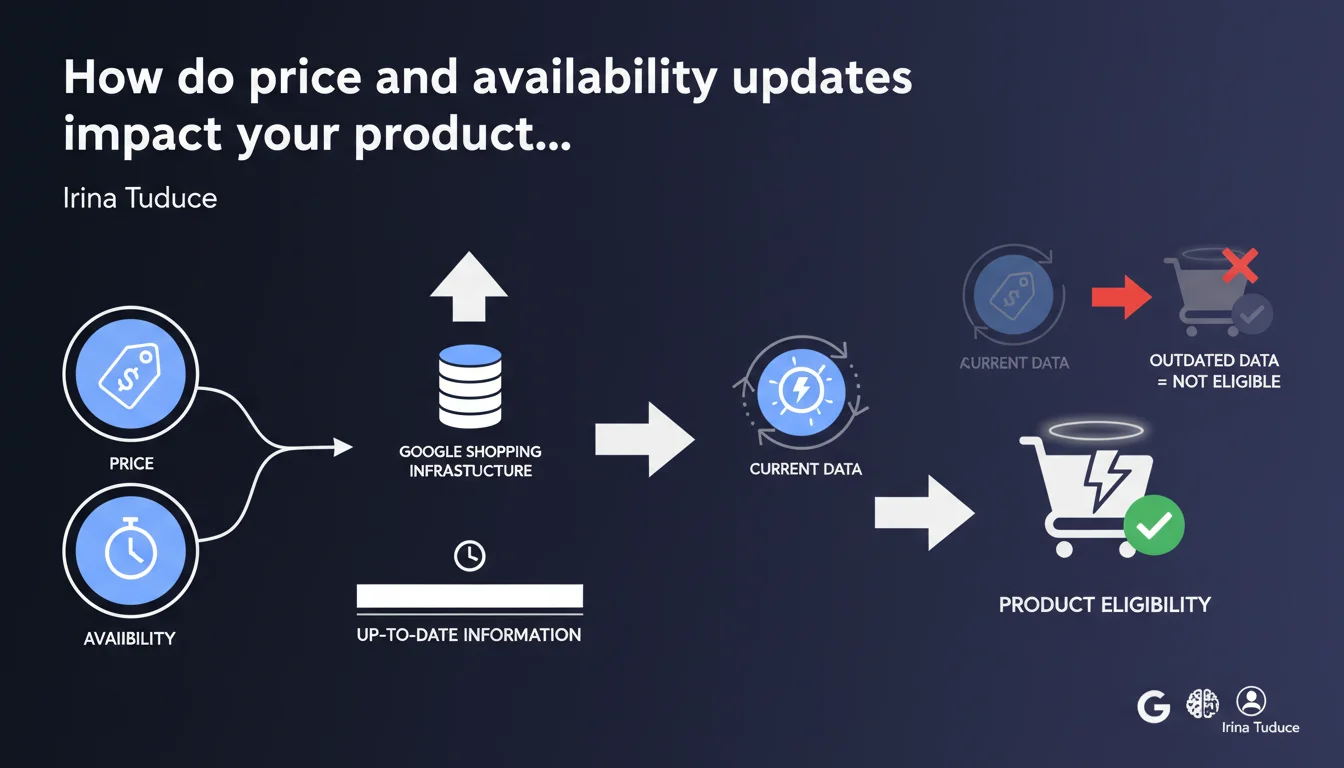
Google states that price and availability are critical signals for shopping infrastructure: without up-to-date data, your products won't be eligible for display. These two criteria determine access to shopping results themselves, not just ranking position. A product listing with outdated pricing or incorrect availability will be simply excluded.
What you need to understand
What exactly does Google mean by "critical signals"?
Unlike other ranking signals that influence position in results, price and availability act as eligibility criteria. If this data is missing, outdated, or inconsistent, your products simply won't appear on Google's shopping surfaces.
This statement reminds us that Google Shopping operates with transactional logic: the user wants to buy now, with a known price. A listing without this information doesn't serve the commercial intent and will be excluded, regardless of the quality of the rest of your feed.
Why does Google emphasize data freshness so heavily?
Shopping infrastructure relies on user trust: if Google displays a price that has changed or a product that's out of stock, the experience degrades. The search engine therefore prioritizes feeds updated frequently, with short synchronization delays.
A feed sent once a week won't be enough for fast-moving products or dynamic pricing. Google expects near real-time updates for certain sectors — fashion, electronics, travel.
Which formats and channels are affected by this requirement?
This rule applies to all of Google's shopping surfaces: standard Google Shopping, Shopping tab in search, free listings, paid ads via Google Ads. Merchant Center is the sole entry point, and that's where price and availability data quality is verified.
- Price and availability are display conditions, not just ranking signals
- Without regular updates, your products disappear from shopping results
- Google prioritizes feeds synchronized in real time or with minimal latency
- This logic applies to all formats: free listings and paid ads
- Merchant Center remains the only channel for feeding Google's shopping infrastructure
SEO Expert opinion
Is this statement aligned with what we observe in the field?
Absolutely. Audits of Merchant Center accounts show that rejections for missing price or incorrect availability rank among the top causes of exclusion. Google doesn't joke around: a product flagged as "in stock" but actually out of stock triggers rapid deactivation.
What's missing from this statement is the definition of "regular updates." Google remains vague about the minimum acceptable frequency. For some sectors, daily feed updates suffice; for others (fashion, electronics), a delay of several hours becomes problematic. [To verify] depends on your vertical.
What nuances should we add to this rule?
Google doesn't specify how it handles minor price variations or stock fluctuations. Does a product going from "5 in stock" to "3 in stock" require immediate update? Let's be honest: most feeds don't capture these micro-changes.
Similarly, nothing is said about pre-order or backorder products. Google accepts these cases, but availability must be explicitly flagged (availability attribute with value preorder or backorder). A vague mention on your site won't be interpreted correctly.
In what cases does this rule become a trap?
Large catalogs with rapid rotation are most exposed. If you manage 50,000 SKUs with prices changing several times daily, synchronization becomes a technical challenge. A delay of a few hours can trigger cascading deactivations.
Practical impact and recommendations
What needs to be implemented concretely to stay compliant?
First, automate feed updates. A manual weekly feed won't cut it for fast-moving products. Prioritize automatic synchronization from your inventory management system (ERP, PIM) to Merchant Center.
Next, verify consistency between the price displayed in your feed and the price visible on the landing page. Google crawls your product pages to compare — a gap of more than 10% between the two will trigger a rejection.
What mistakes should you absolutely avoid?
Never leave a product marked "in stock" in your feed when it's actually out of stock. Google detects these inconsistencies through crawling your pages and through user signals (bounce rate, cart abandonment). A product listing showing "out of stock" on site but "available" in Merchant Center will be deactivated.
Also avoid approximate or price range listings. Google expects an exact, unique price per SKU. If your product has multiple variants with different prices, each variant must have its own line in the feed.
How do you verify that your feed meets these requirements?
Use the Merchant Center diagnostics tool: it flags products with missing price, incorrect availability, or detected discrepancies. Set up alerts to be notified of mass deactivations.
Also test synchronization latency: how much time elapses between a price change in your back-office and its integration into Merchant Center? If this delay exceeds a few hours, you risk temporary deactivations.
- Automate feed updates from your inventory management system
- Verify price and availability consistency between feed and landing pages
- Never leave an out-of-stock product marked as "in stock"
- Use the correct availability attribute (in stock, out of stock, preorder, backorder)
- Set up alerts in Merchant Center to detect deactivations
- Test synchronization latency between back-office and Merchant Center
- Prioritize Content API for large catalogs or fast-moving inventory
- Monitor price discrepancies detected by Google between feed and crawled pages
❓ Frequently Asked Questions
Quelle est la fréquence minimale de mise à jour du flux Merchant Center ?
Que se passe-t-il si le prix affiché dans le flux diffère de celui sur la page produit ?
Peut-on afficher un produit en précommande dans Google Shopping ?
Les produits en rupture temporaire doivent-ils être retirés du flux ?
L'API Content est-elle obligatoire pour rester conforme ?
🎥 From the same video 13
Other SEO insights extracted from this same Google Search Central video · published on 05/09/2024
🎥 Watch the full video on YouTube →
💬 Comments (0)
Be the first to comment.