
Official statement
Other statements from this video 16 ▾
- □ Does Google really apply the same weight to every single one of your backlinks?
- □ Does the position of internal links really impact your SEO rankings?
- □ Does Google really categorize websites into rigid, fixed types?
- □ Does NAP consistency really impact local SEO rankings, or is it just about the Knowledge Graph?
- □ Is Your Business Data Contradicting Itself? How Conflicting Information Between Your Website and Google Business Profile Hurts Your Local SEO
- □ Are reciprocal links really risk-free for your SEO strategy?
- □ Does keyword frequency really influence your Google rankings?
- □ Should you really clean up ALL hacked pages or can you let Google sort them out?
- □ Why does Google refuse to index part of your site even when it's technically perfect?
- □ Do emojis in title tags and meta descriptions really boost your SEO rankings?
- □ Does the Search Console API really show the exact same data as your web interface?
- □ Why aren't your FAQs showing up in rich results despite correct markup?
- □ Do Core Web Vitals really have no impact on crawling and indexation?
- □ Does Google really reset your site's evaluation when migrating from a subdomain to a primary domain?
- □ Does the .edu domain extension really boost your SEO rankings?
- □ Are geo-redirects really blocking your content from getting indexed by Google?
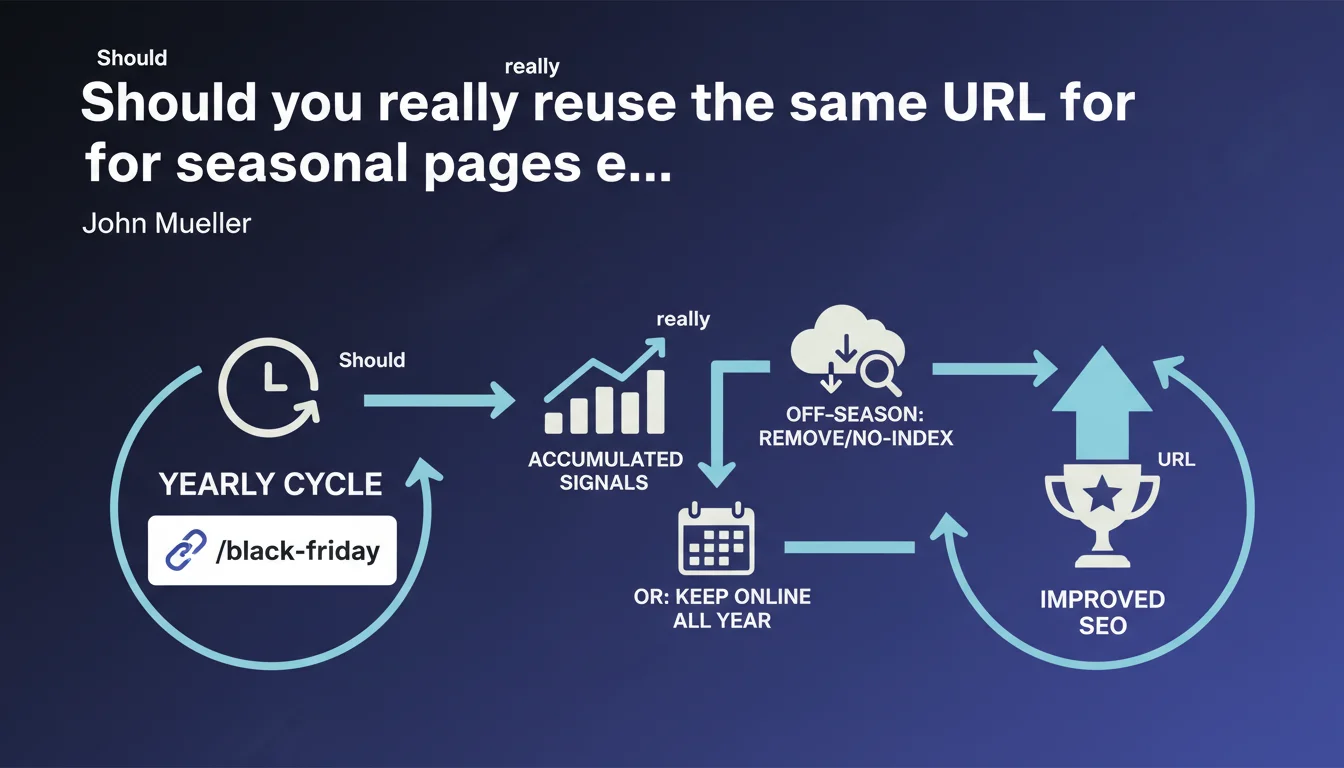
Google recommends using a fixed URL for seasonal pages (e.g., /black-friday) rather than adding the year. This allows you to capitalize on accumulated signals (backlinks, authority, history). Outside the season, you can either de-index/remove the content and republish it, or keep the page online year-round.
What you need to understand
Why does Google insist on reusing the same seasonal URLs?
The logic is straightforward: each URL accumulates trust signals over time. Backlinks, historical traffic, click-through rates, user engagement — all of this contributes to page authority.
When you create a new URL every year (e.g., /black-friday-2024, /black-friday-2025), you start from scratch. Links pointing to the old URL no longer pass their juice directly. You lose the performance history that, for Google, signals that a page is relevant for a given query.
What does this actually change for rankings?
A URL that returns to the same location every year benefits from a cumulative effect. Search engines recognize the seasonal pattern and can anticipate republication.
Backlinks acquired in previous editions remain active. No need to redo your link-building campaign every year. The URL retains its PageRank and potential ranking position in search results.
What should you do with content during off-season?
John Mueller offers two options: either you de-index or temporarily remove the content (via noindex or complete removal), or you keep the page online year-round with adapted content.
Both approaches work. The first avoids displaying outdated content. The second allows you to keep the page active for informational queries outside the period (e.g., "when will Black Friday happen").
- Reuse the same URL each year to capitalize on accumulated signals
- Avoid URLs with years (e.g., /black-friday-2024) that fragment authority
- Two off-season options: temporary de-indexing or maintenance with adapted content
- Backlinks and performance history remain active from year to year
- Google recognizes seasonal patterns and can anticipate republications
SEO Expert opinion
Is this recommendation really new?
No. It's an established best practice that's been around for years in e-commerce and event-based SEO. Most sites managing recurring promotions already apply this principle.
What's interesting is that Mueller formalizes it clearly. This puts an end to internal debates in teams that still hesitate to create dated URLs "for freshness".
Does temporary de-indexing present any risks?
Let's be honest: yes, potentially. If you put a page on noindex for 10 months, Google can theoretically "forget" some of its context. Certain signals erode over time.
[To verify] — Google has never clarified how long a page can remain de-indexed without losing its gains. Field observations suggest that for pages with strong history (several years of solid backlinks), the impact is minimal. For more recent pages, it's less clear.
Keeping the page online year-round: what content strategy should you adopt?
If you keep the page active during off-season, the content must remain relevant and useful. There's no place for a countdown showing "in 347 days" or a generic message saying "see you next year".
Strategies observed in the field: recap of the last edition, announcement of the next date, informational content about the event, email capture to notify users. The idea is to justify the page's presence even outside immediate commercial context.
Practical impact and recommendations
What should you concretely do for your seasonal pages?
Audit your existing seasonal URLs. If you've accumulated dated URLs (e.g., /sales-2022, /sales-2023, /sales-2024), now is the time to consolidate.
Choose a canonical URL (e.g., /sales) and properly redirect all old versions with 301s to it. You thus recover some of the link juice that was dispersed.
Which option to choose: de-indexing or keeping online?
It depends on your ability to produce off-season content that makes sense. If you have nothing useful to say in July about Black Friday, temporary de-indexing is cleaner.
If you can feed the page with informational content, forecasts, recaps, then keeping it online brings an advantage: you maintain an active touchpoint year-round.
How should you technically manage the seasonal transition?
If you opt for de-indexing, implement a strict calendar: add noindex after the event ends, remove noindex 3-4 weeks before the next edition, update content, push sitemap to accelerate recrawl.
If you maintain the page, plan conditional templates: different content depending on the time of year, without changing the URL. A good CMS allows you to manage this cleanly with scheduled publication rules.
- Audit all your current seasonal URLs to identify dated versions
- Define a canonical URL per recurring event (without year in the slug)
- Redirect with 301s all old versions to the canonical URL
- Choose between temporary de-indexing or keeping online based on your content production capacity
- If de-indexing: use meta robots noindex (not robots.txt) and plan reindexing 3-4 weeks before the event
- If keeping online: create an editorial calendar to feed the page with relevant off-season content
- Set up conditional templates to adapt content based on the time of year
- Monitor crawl and indexing via Search Console during transitions
❓ Frequently Asked Questions
Dois-je supprimer physiquement les pages saisonnières hors saison ou juste les noindexer ?
Si je redirige mes anciennes URLs millésimées vers l'URL canonique, je perds du référencement ?
Combien de temps avant l'événement dois-je réactiver une page saisonnière noindexée ?
Que mettre sur une page saisonnière maintenue en ligne hors saison ?
Est-ce que ça s'applique aussi aux pages de produits saisonniers ?
🎥 From the same video 16
Other SEO insights extracted from this same Google Search Central video · published on 30/01/2022
🎥 Watch the full video on YouTube →
💬 Comments (0)
Be the first to comment.