
Official statement
Other statements from this video 16 ▾
- □ Google attribue-t-il vraiment le même poids à tous vos backlinks ?
- □ L'emplacement des liens internes a-t-il vraiment un impact sur le SEO ?
- □ Google classe-t-il vraiment les sites dans des catégories fixes ?
- □ La cohérence NAP impacte-t-elle vraiment le référencement local ou seulement le Knowledge Graph ?
- □ Comment éviter que Google se trompe à cause d'informations conflictuelles entre votre site et votre profil d'établissement ?
- □ Les liens réciproques sont-ils vraiment sans risque pour votre SEO ?
- □ La fréquence des mots-clés influence-t-elle vraiment le classement Google ?
- □ Faut-il vraiment nettoyer TOUTES les pages hackées ou peut-on laisser Google faire le tri ?
- □ Pourquoi Google refuse-t-il d'indexer une partie de votre site même s'il est techniquement parfait ?
- □ L'API Search Console et l'interface affichent-elles vraiment les mêmes données ?
- □ Pourquoi vos FAQ n'apparaissent-elles pas en rich results malgré un balisage correct ?
- □ Faut-il vraiment réutiliser la même URL pour les pages saisonnières chaque année ?
- □ Les Core Web Vitals n'affectent-ils vraiment ni le crawl ni l'indexation ?
- □ Pourquoi Google réinitialise-t-il l'évaluation d'un site lors d'une migration de sous-domaine vers domaine principal ?
- □ Le TLD .edu booste-t-il vraiment votre référencement ?
- □ Les géo-redirects peuvent-ils réellement bloquer l'indexation de votre contenu ?
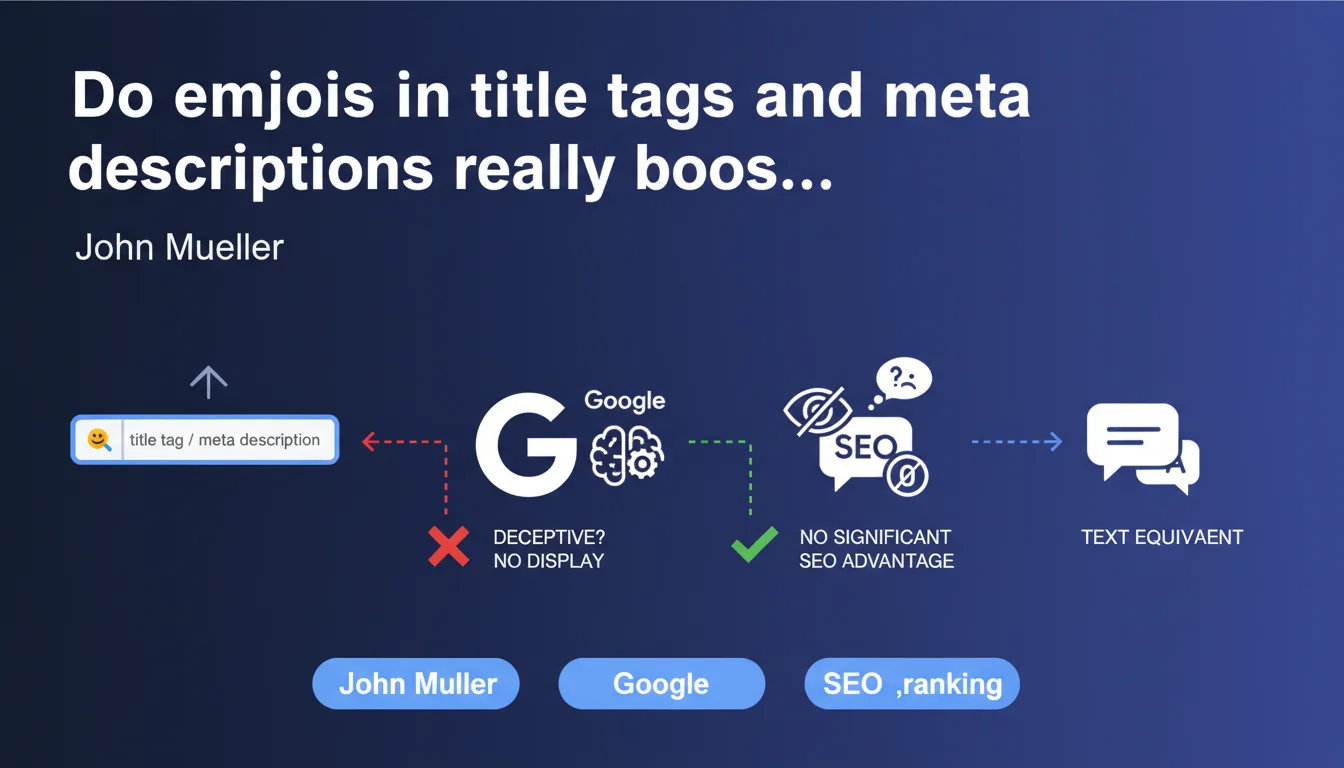
Google tolerates emojis in titles and descriptions but doesn't display them all, especially if they seem deceptive. Zero positive impact on rankings: the search engine simply looks for the text equivalent. Bottom line: it's cosmetic, not strategic.
What you need to understand
Emojis have become ubiquitous in our digital communications, and some SEO professionals are testing their integration into HTML tags visible in SERPs. Google clarifies its position here: technically possible, but with no impact on ranking.
Why doesn't Google display all of them?
The search engine applies a relevance filter. If an emoji appears designed to manipulate click-through rate (aggressive clickbait, exaggerated promises), Google may decide to ignore it in the final display.
This decision falls under the snippet generation algorithm, not crawling or indexing. The tag content remains intact on the server side — only the user-facing display changes.
What does "text equivalent" actually mean?
Google treats emojis as standard Unicode characters. The search engine attempts to map each emoji to its text description (🔥 becomes "fire", ⭐ becomes "star").
No semantic bonus is awarded. A title with "🚀 SEO" will be interpreted as "rocket SEO", without any special valorization compared to "fast SEO" or "SEO acceleration".
- No algorithmic advantage: emojis boost neither ranking nor semantic understanding
- Anti-spam filtering: deceptive usage = automatic removal from SERPs
- Text equivalence: Google converts the emoji to its literal meaning without enrichment
- CTR impact only: only measurable effect = visual differentiation versus competitors
SEO Expert opinion
Does this statement match real-world observations?
Yes, broadly speaking. A/B tests across thousands of pages show that emojis can improve click-through rate (CTR) by 5 to 15% depending on sectors — lifestyle e-commerce, travel, entertainment notably.
But this improvement never translates directly into organic ranking gains. Improved CTR can theoretically send a positive signal to Google (user engagement), but this mechanism remains indirect and diluted among hundreds of other signals.
What nuances deserve to be added?
Mueller's position is technically correct but ignores one reality: in SEO, anything that improves CTR eventually indirectly impacts ranking. If your snippet with emoji performs better, Google may eventually value it through engagement metrics.
Be careful however: Google displays emojis inconsistently across devices, browsers and contexts. An emoji visible on Chrome desktop may disappear on Safari mobile. [To verify]: the filtering algorithm isn't publicly documented — it's impossible to predict with certainty which emojis will pass the filter.
In which cases does this advice not apply?
In very formal sectors (finance, health, legal), emojis can damage perceived credibility. Even if Google tolerates them, users may interpret their presence as a lack of professionalism.
Conversely, in lifestyle niches or young B2C segments, their absence can make your snippet bland compared to competitors using them intelligently. The issue isn't algorithmic SEO but user psychology in the SERP.
Practical impact and recommendations
Should you integrate emojis into your title and meta description tags?
It depends. If your audience and sector lend themselves to it (e-commerce, mainstream content, creative niches), test on a sample of pages and measure CTR impact via Google Search Console.
Never roll out massively without A/B testing. A poorly chosen or spam-perceived emoji can tank your CTR instead of improving it.
What mistakes should you absolutely avoid?
Don't overload: one or two emojis maximum per tag. Beyond that, you slip into visual spam that Google will likely filter.
Avoid ambiguous or contextually odd emojis (🍆 on a food e-commerce site works; on a B2B site, it raises eyebrows). Google may interpret them as deceptive and remove them.
Never use emojis to mask weak content. If your page doesn't answer search intent, an emoji won't help — and could actually worsen bounce rate.
- Analyze competitor SERPs: how many use emojis? Which ones?
- Test on 10-20% of your product catalog or blog articles before rolling out
- Measure CTR before/after via GSC over a minimum of 30 days
- Verify actual display on mobile (iOS + Android) and desktop (Chrome, Safari, Firefox)
- Ban emojis on institutional pages, legal notices, sensitive pages (health, finance)
- Document retained emojis and their Unicode codes for editorial consistency
Emojis are not an algorithmic SEO lever, but a visual differentiation tool in SERPs. Their real impact depends on sector, audience and measured usage. Test, measure, adjust — and never make it a strategic priority.
If optimizing your snippets to maximize CTR sounds complex or time-consuming, know that some specialized SEO agencies support their clients in this type of granular testing. They have the tools and methodologies to isolate variables and measure real impact on your business KPIs.
❓ Frequently Asked Questions
Google pénalise-t-il l'usage d'emojis dans les balises HTML ?
Les emojis dans les balises title comptent-ils dans la limite de caractères ?
Peut-on forcer Google à afficher un emoji spécifique en SERP ?
Les emojis améliorent-ils le CTR de manière mesurable ?
Faut-il utiliser les codes HTML ou copier-coller les emojis directement ?
🎥 From the same video 16
Other SEO insights extracted from this same Google Search Central video · published on 30/01/2022
🎥 Watch the full video on YouTube →
💬 Comments (0)
Be the first to comment.