
Official statement
Other statements from this video 16 ▾
- □ Google attribue-t-il vraiment le même poids à tous vos backlinks ?
- □ L'emplacement des liens internes a-t-il vraiment un impact sur le SEO ?
- □ La cohérence NAP impacte-t-elle vraiment le référencement local ou seulement le Knowledge Graph ?
- □ Comment éviter que Google se trompe à cause d'informations conflictuelles entre votre site et votre profil d'établissement ?
- □ Les liens réciproques sont-ils vraiment sans risque pour votre SEO ?
- □ La fréquence des mots-clés influence-t-elle vraiment le classement Google ?
- □ Faut-il vraiment nettoyer TOUTES les pages hackées ou peut-on laisser Google faire le tri ?
- □ Pourquoi Google refuse-t-il d'indexer une partie de votre site même s'il est techniquement parfait ?
- □ Les emojis dans les balises title et meta description apportent-ils un avantage SEO ?
- □ L'API Search Console et l'interface affichent-elles vraiment les mêmes données ?
- □ Pourquoi vos FAQ n'apparaissent-elles pas en rich results malgré un balisage correct ?
- □ Faut-il vraiment réutiliser la même URL pour les pages saisonnières chaque année ?
- □ Les Core Web Vitals n'affectent-ils vraiment ni le crawl ni l'indexation ?
- □ Pourquoi Google réinitialise-t-il l'évaluation d'un site lors d'une migration de sous-domaine vers domaine principal ?
- □ Le TLD .edu booste-t-il vraiment votre référencement ?
- □ Les géo-redirects peuvent-ils réellement bloquer l'indexation de votre contenu ?
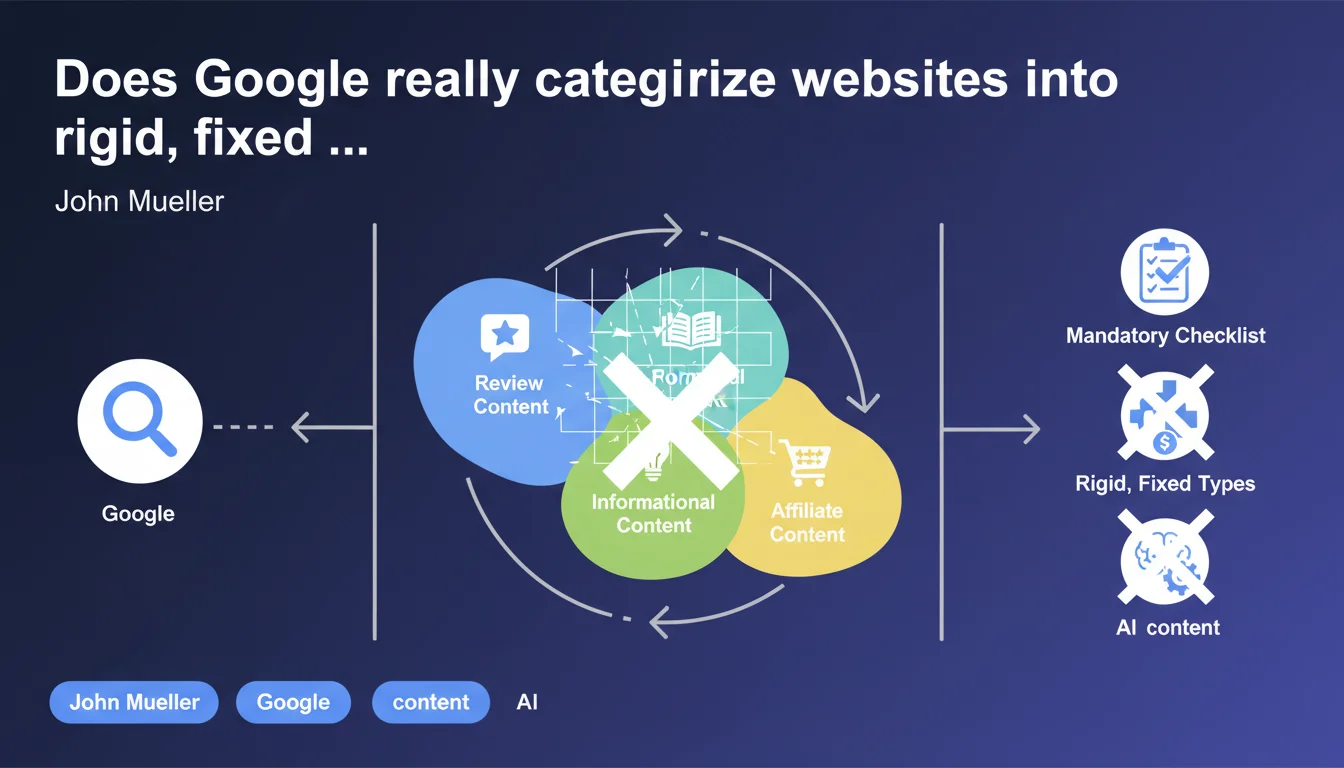
Google does not categorize websites in a binary manner. A single website can blend review content, informational content, and affiliate content without needing to check every box on a guidelines checklist. Flexibility takes precedence over strict adherence to a single model.
What you need to understand
Why this clarification now?
Since the arrival of Product Reviews Updates and the proliferation of guidelines, many SEOs have developed a binary approach: is my site a review site? An affiliate site? An informational site? This compartmentalized view does not reflect the reality of Google's algorithm.
John Mueller cuts through this oversimplification. Google analyzes content page by page, not site by site. A blog can publish informational guides, detailed comparisons, and affiliate selections — and this is perfectly acceptable. The algorithm does not expect a site to conform 100% to the guidelines of a single category.
What does this change in concrete terms?
This statement invalidates the idea that you need to pick a camp and stick with it. Hybrid sites — which mix multiple types of content — are not penalized for their versatility. On the contrary, editorial diversification can even strengthen thematic authority if it remains coherent.
What matters is the quality of each individual page, not the overall label of the site. A review page must meet review criteria. An informational page must meet the expectations of informational content. But nothing prevents the two from coexisting on the same domain.
Should we ignore guidelines then?
No. Guidelines remain essential reference points, but they are not rigid checklists. Google expects intelligent application, adapted to the context of each page.
Thinking in terms of "my site is X or Y" is a trap. The real question: does each page deliver what it promises to users? If yes, the theoretical categorization of the site matters little.
- Google analyzes content page by page, not by site category
- A site can legitimately mix multiple types of content (review, informational, affiliate)
- Guidelines are reference points, not mandatory checklists to complete entirely
- The quality and relevance of each page takes precedence over the site's overall label
- Editorial versatility is not a flaw if it remains thematically coherent
SEO Expert opinion
Is this statement consistent with observed practices?
In the field, we indeed observe that hybrid sites perform very well — provided each type of content is treated seriously. A site that publishes solid informational guides AND detailed comparisons gains in overall thematic authority.
The problem is that many affiliate sites hide behind this flexibility to publish low-effort content. They create a few hollow informational articles to "diversify," then drown everything in sloppy affiliate lists. Google does not penalize diversification — it penalizes mediocrity.
What nuances should be added?
This statement does not mean anything goes. If 90% of your content is affiliate and the 10% informational merely serves as a facade, the algorithm detects it. Editorial coherence remains essential.
Another nuance: some updates explicitly target types of sites. The Product Reviews Updates target review pages, not informational pages. But this does not turn your site into a "review site." Google evaluates each page by its own criteria.
[To verify]: how far can this hybridization go before the algorithm interprets the site as opportunistic? Google remains vague on the critical threshold. Field feedback suggests that a 60/40 or 70/30 balance between content types works well, but beyond that, it becomes unclear.
In which cases does this rule not apply?
YMYL sites (health, finance) remain subject to stricter E-E-A-T criteria. Even if Google does not categorize them binary, the displayed expertise must be coherent. A medical site that suddenly publishes unrelated product reviews poorly credibilizes its authority.
Similarly, sites that juggle too many topics without a connecting thread lose relevance. Diversification works within the same vertical — it becomes suspicious if it goes in all directions.
Practical impact and recommendations
What should you do concretely?
Stop asking yourself "is my site a type X site?". Instead, ask yourself page by page: what is the purpose of this page? What promise does it make to users? Then apply the appropriate standards to this specific type of content.
If you publish a product review, actually test the product, add original photos, document your experience. If you publish an informational guide, structure it for understanding, cite reliable sources, exhaustively answer the search intent. Each format has its requirements — respect them.
What mistakes should you avoid?
Do not dilute your editorial line under the guise of "diversification." Publishing three hollow informational articles to justify 50 affiliate pages is an obvious red flag. Diversification must provide complementary value, not serve as camouflage.
Also avoid blatant thematic incoherence. A tech site that suddenly starts publishing beauty reviews without transition loses its coherence. Versatility works in a logic of deepening, not scattering.
How do you verify that your site respects this logic?
Audit your content by type: are your reviews up to the Product Reviews guidelines standards? Do your informational articles actually provide value or are they filler? Are your affiliate pages transparent and honest?
If each content category holds up individually, your site is probably aligned with this approach. If one type of content is pulling down, that is where you need to correct — not try to "balance" with more volume.
- Evaluate each page according to the criteria of the type of content it proposes
- Verify that each content type respects appropriate quality standards
- Ensure that diversification remains thematically coherent
- Audit reviews according to Product Reviews guidelines if applicable
- Document the real expertise behind each content type (authors, tests, sources)
- Avoid hollow informational content that just serves as a "facade"
- Maintain transparency about affiliate links where they appear
❓ Frequently Asked Questions
Si mon site mélange du contenu informatif et affilié, Google va-t-il le pénaliser ?
Dois-je suivre toutes les guidelines Product Reviews si seulement 30% de mon contenu est constitué de reviews ?
Comment Google détermine-t-il le type d'une page spécifique ?
Peut-on transformer un site affilié pur en site hybride pour améliorer son ranking ?
Les sites YMYL peuvent-ils aussi mélanger plusieurs types de contenus ?
🎥 From the same video 16
Other SEO insights extracted from this same Google Search Central video · published on 30/01/2022
🎥 Watch the full video on YouTube →
💬 Comments (0)
Be the first to comment.