
Official statement
Other statements from this video 16 ▾
- □ Google attribue-t-il vraiment le même poids à tous vos backlinks ?
- □ L'emplacement des liens internes a-t-il vraiment un impact sur le SEO ?
- □ Google classe-t-il vraiment les sites dans des catégories fixes ?
- □ Comment éviter que Google se trompe à cause d'informations conflictuelles entre votre site et votre profil d'établissement ?
- □ Les liens réciproques sont-ils vraiment sans risque pour votre SEO ?
- □ La fréquence des mots-clés influence-t-elle vraiment le classement Google ?
- □ Faut-il vraiment nettoyer TOUTES les pages hackées ou peut-on laisser Google faire le tri ?
- □ Pourquoi Google refuse-t-il d'indexer une partie de votre site même s'il est techniquement parfait ?
- □ Les emojis dans les balises title et meta description apportent-ils un avantage SEO ?
- □ L'API Search Console et l'interface affichent-elles vraiment les mêmes données ?
- □ Pourquoi vos FAQ n'apparaissent-elles pas en rich results malgré un balisage correct ?
- □ Faut-il vraiment réutiliser la même URL pour les pages saisonnières chaque année ?
- □ Les Core Web Vitals n'affectent-ils vraiment ni le crawl ni l'indexation ?
- □ Pourquoi Google réinitialise-t-il l'évaluation d'un site lors d'une migration de sous-domaine vers domaine principal ?
- □ Le TLD .edu booste-t-il vraiment votre référencement ?
- □ Les géo-redirects peuvent-ils réellement bloquer l'indexation de votre contenu ?
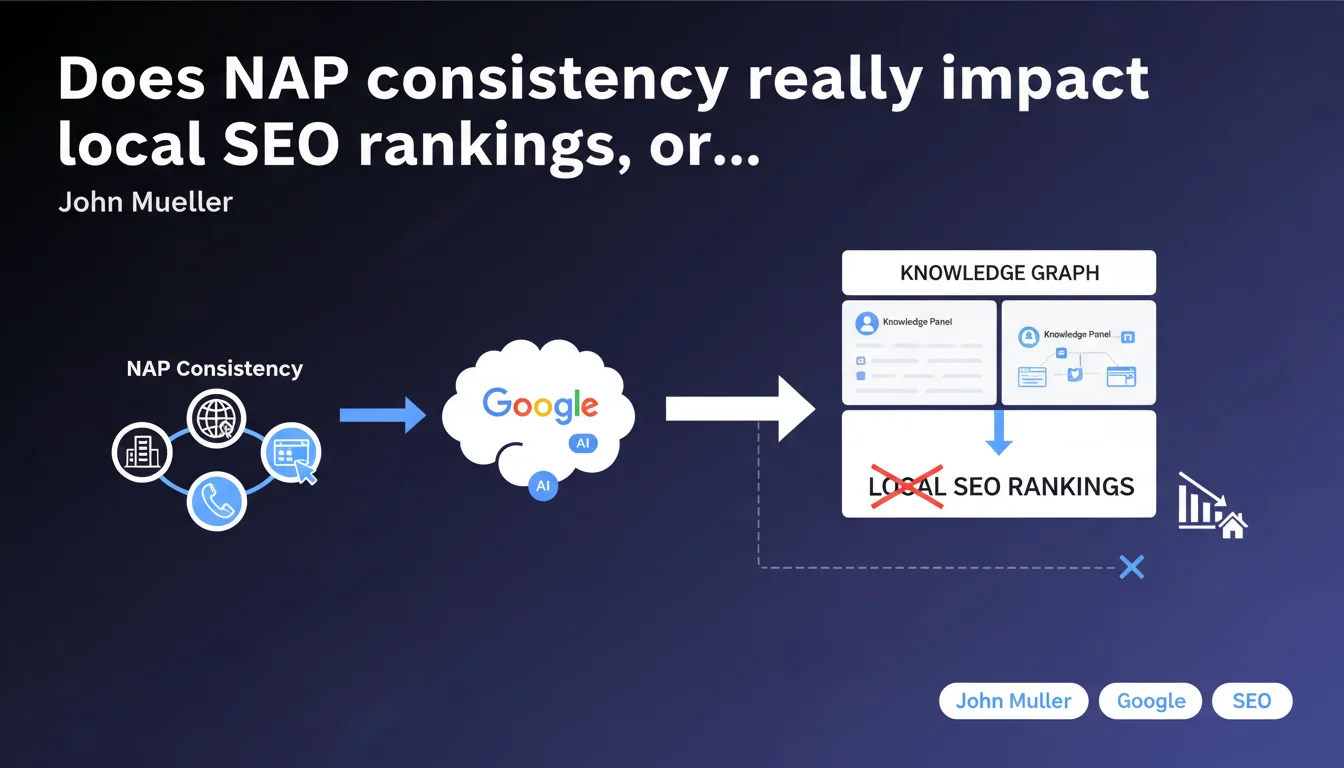
Google confirms that consistent NAP information (name, address, phone) primarily serves to identify your business entity for the Knowledge Graph and knowledge panels. Contrary to popular belief, it's not a direct ranking factor for local SEO—though indirect impact exists through entity recognition.
What you need to understand
Why does Google emphasize NAP consistency?
Google uses NAP signals to recognize and validate a business entity across different web sources. When your business name, address, and phone number appear consistently on your website, in directories, on social media, it helps the algorithm understand that these are all references to the same entity.
This recognition primarily feeds the Knowledge Graph—Google's semantic database that structures information about entities. This is what enables a knowledge panel to display when someone searches for your business, showing your contact information, hours, photos, and reviews.
How does this differ from traditional local SEO?
John Mueller clarifies a point often misunderstood: NAP consistency is not a direct ranking factor for the Local Pack or Google Maps. It's not that a slight variation in your address between two directories will cause you to lose rankings.
The real local ranking criteria remain geographical proximity, Google Business Profile relevance, and customer reviews. NAP consistency operates upstream—it helps Google confirm you're a legitimate business and correctly associate signals related to you.
What was the context of this statement?
This clarification addresses years of confusion in the SEO community. Many agencies and consultants have overvalued NAP importance, even selling massive citation cleanup services as a miracle solution for local ranking.
Google is setting the record straight: yes, consistency helps, but not the way people think. It serves entity construction, not direct algorithmic ranking.
- Consistent NAP helps Google identify your business as a single unique entity
- This impact primarily applies to the Knowledge Graph and knowledge panels
- It is not a direct ranking factor for the Local Pack or Google Maps
- Minor variations ("Street" vs "St.") won't break your local SEO
- The obsession with perfect NAP is often disproportionate to actual ROI
SEO Expert opinion
Is this statement consistent with real-world observations?
Yes, and it finally explains why some businesses with imprecise NAP information rank very well locally. I've audited dozens of profiles where the address varied between "Avenue" and "Ave.," or where the phone number differed across directories—with no measurable impact on Maps ranking.
What really matters is that Google manages to attribute these signals to the correct entity. If your business name is distinctive enough and variations remain logical, the algorithm handles this very well. The problem arises mainly when inconsistencies create identification ambiguity—like two completely different addresses, for example.
Should we ignore NAP consistency altogether?
No, but you need to rationalize the effort. Targeting reasonable consistency across major sources (your website, Google Business, Facebook, primary directories) remains worthwhile. It facilitates entity recognition and improves user experience—a customer who finds contradictory information loses trust.
However, spending weeks tracking every minor variation across 150 obscure directories? That's wasted time. [Needs verification]: we have no solid data showing that 100% uniform NAP generates more visibility than 90% consistent NAP across sources that actually matter.
What are the implications for local citation strategy?
This statement redefines citation priorities. The goal is no longer "be everywhere with pixel-perfect NAP," but "be present on platforms that deliver authority and qualified traffic."
A backlink from a quality directory brings more SEO value than a simple NAP citation. Focus your efforts on authoritative sources in your industry—chambers of commerce, professional associations, local media—rather than a generic list of 200 directories.
Practical impact and recommendations
What should you concretely do with your NAP information?
Start by auditing your primary sources: your website (header, footer, contact page), your Google Business Profile, your Facebook page, LinkedIn, and the 5-10 most visible directories in your industry. Verify that information is consistent and current.
For inevitable minor variations (address abbreviations, phone formats), don't panic. Google handles these nuances. Focus on glaring inconsistencies—two different addresses, an old phone number lingering around, a completely different business name.
What mistakes should you absolutely avoid?
Don't launch into a massive "citation cleanup" project sold as a miracle solution. Many agencies oversell this service when the actual impact is marginal. Use that budget for more profitable actions—Google Business Profile improvement, review generation, local content creation.
Also avoid creating citations just for volume. Better to have 20 citations on relevant, visited platforms than 200 in ghost directories that nobody consults.
- Verify that your website displays accurate, current contact information
- Sync your Google Business Profile with this information
- Update your Facebook, LinkedIn, and major social media pages
- Identify the 5-10 authoritative directories in your industry and fix inconsistencies
- Don't waste time on minor directories with zero traffic
- Prioritize Google review generation and Business Profile optimization
- Monitor address/phone changes and propagate them quickly
❓ Frequently Asked Questions
Dois-je absolument avoir le même format de téléphone partout (avec ou sans espaces, tirets, etc.) ?
Si mon entreprise a plusieurs adresses, comment gérer le NAP ?
Faut-il corriger toutes les citations dans les vieux annuaires qu'on ne contrôle plus ?
La cohérence NAP peut-elle compenser un manque d'avis Google ?
Comment savoir si Google a bien identifié mon entreprise comme une entité unique ?
🎥 From the same video 16
Other SEO insights extracted from this same Google Search Central video · published on 30/01/2022
🎥 Watch the full video on YouTube →
💬 Comments (0)
Be the first to comment.