
Official statement
Other statements from this video 16 ▾
- □ Google attribue-t-il vraiment le même poids à tous vos backlinks ?
- □ L'emplacement des liens internes a-t-il vraiment un impact sur le SEO ?
- □ Google classe-t-il vraiment les sites dans des catégories fixes ?
- □ La cohérence NAP impacte-t-elle vraiment le référencement local ou seulement le Knowledge Graph ?
- □ Comment éviter que Google se trompe à cause d'informations conflictuelles entre votre site et votre profil d'établissement ?
- □ Les liens réciproques sont-ils vraiment sans risque pour votre SEO ?
- □ Faut-il vraiment nettoyer TOUTES les pages hackées ou peut-on laisser Google faire le tri ?
- □ Pourquoi Google refuse-t-il d'indexer une partie de votre site même s'il est techniquement parfait ?
- □ Les emojis dans les balises title et meta description apportent-ils un avantage SEO ?
- □ L'API Search Console et l'interface affichent-elles vraiment les mêmes données ?
- □ Pourquoi vos FAQ n'apparaissent-elles pas en rich results malgré un balisage correct ?
- □ Faut-il vraiment réutiliser la même URL pour les pages saisonnières chaque année ?
- □ Les Core Web Vitals n'affectent-ils vraiment ni le crawl ni l'indexation ?
- □ Pourquoi Google réinitialise-t-il l'évaluation d'un site lors d'une migration de sous-domaine vers domaine principal ?
- □ Le TLD .edu booste-t-il vraiment votre référencement ?
- □ Les géo-redirects peuvent-ils réellement bloquer l'indexation de votre contenu ?
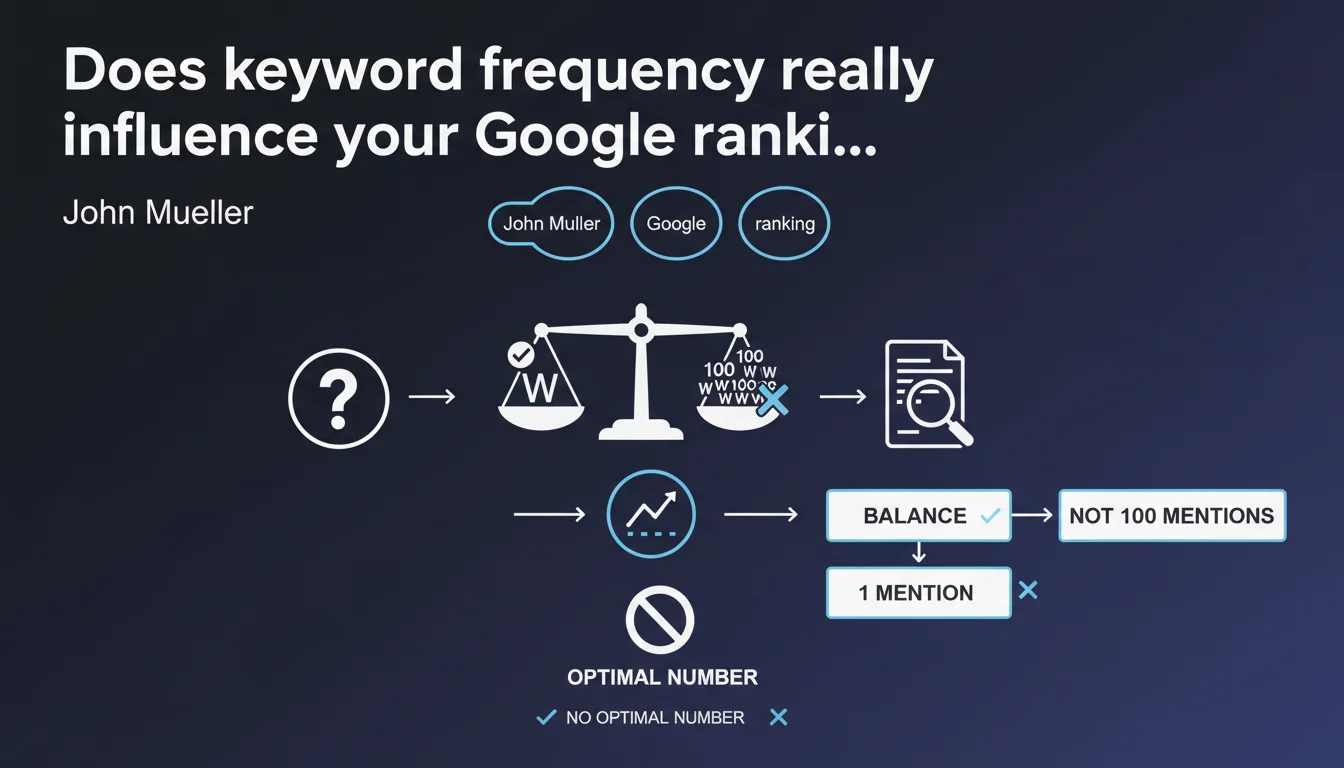
Google states that keyword frequency is not a direct ranking factor. The principle: the keyword must appear at least once for the page to be eligible, but keyword stuffing doesn't improve anything. There is no optimal number of occurrences.
What you need to understand
What exactly does "not a ranking factor" mean?
When Mueller says that frequency is not a factor, he's talking about the raw number of occurrences. Repeating a keyword 10, 20, or 50 times on a page won't mechanically give you better rankings than 3 well-placed occurrences.
Google uses semantic models that understand context, synonyms, and intent. Simple keyword density — that KPI from the 2000s — no longer has direct algorithmic weight. What matters is that the term is present and relevant in the overall context of the page.
Why does the word still need to appear at least once?
Without mentioning the term, Google can't establish an obvious relevance signal. If you're targeting "running shoes" but these words never appear on your page, the algorithm will have to rely solely on semantic context — a risky bet.
Minimum presence creates a clear thematic anchor. It's the difference between letting Google guess your topic and giving it an explicit indication. A single well-placed occurrence (title, intro) is often enough if the rest of the content is coherent.
What does Google mean by "balance"?
Mueller alludes to a balance between zero mentions (ineffective) and stuffing (useless or even counterproductive). But he refuses to give an exact number — because there isn't one.
Balance depends on context: content length, semantic richness, lexical variety. A 300-word page can afford 2-3 natural occurrences. A 3000-word page can have 15 without sounding forced. The test: read your text aloud. If it sounds robotic, it's too much.
- Raw frequency ≠ ranking factor: repeating doesn't mechanically improve rankings
- Minimum presence mandatory: at least one mention to establish relevance
- No optimal number: balance depends on context and naturalness
- Semantic models: Google understands synonyms, variations, overall context
- Stuffing counterproductive: too many occurrences degrades user experience
SEO Expert opinion
Is this position consistent with what we observe in practice?
Yes and no. On competitive queries, well-ranked pages do mention the main keyword several times — but rarely in a mechanical way. They use variations, synonyms, reformulations. Correlation exists, but it doesn't prove causality.
The real problem: many high-performing contents have natural semantic richness that includes the target term without conscious effort. Hard to tell if it's frequency that helps or simply the fact that the content is comprehensive and well-structured. [To verify]: the real share of frequency in the algorithm versus other more sophisticated semantic signals.
In what cases doesn't this rule really apply?
On niche or ultra-specific queries, the exact presence of the term can make a clear difference. If you're targeting a rare technical phrase, not including it textually can exclude you from the race — even with excellent semantic context.
Another edge case: featured snippets and rich results. Google often extracts passages containing the exact query term. Here, lexical matching becomes important again — not for overall ranking, but for eligibility in these premium positions.
What nuance should be added to Mueller's statement?
Mueller simplifies for a broad audience. In reality, frequency interacts with other factors: position in the DOM, proximity to other important terms, immediate semantic context. An occurrence in the title weighs more than one buried in the middle of a 200-word paragraph.
Furthermore, saying "not a factor" doesn't mean Google ignores it completely. The algorithm probably uses frequency as a secondary or validation signal — one clue among hundreds. It's simply no longer the mechanical lever it was in the 2000s.
Practical impact and recommendations
What should you concretely do to optimize keyword presence?
Start by ensuring your target term appears at least once in strategic zones: title, H1, first paragraph. This is the vital minimum to establish thematic relevance.
Then write naturally. Use variations and synonyms rather than mechanically repeating the same term. Google understands "running shoes," "trainers," "athletic footwear" as converging signals. This lexical richness strengthens your relevance without stuffing.
Test readability: reread your content aloud. If you stumble over forced repetitions, simplify. User experience takes priority — and Google detects it through behavioral signals (bounce rate, time on page).
What mistakes must you absolutely avoid?
Don't calculate a target keyword density (like "2.5% of text"). This metric is outdated and pushes you to write for the algorithm rather than the user. Forget old tools that tell you "3 more occurrences needed."
Avoid stuffing in meta tags, alt text, internal anchors. Yes, these elements matter, but overloading them harms overall coherence. A 50-word alt stuffed with keywords does nothing and can raise over-optimization flags.
Don't fall into the opposite extreme: some writers, fearing stuffing, completely avoid the target term. Result: vague content where Google must guess your intent. Find the middle ground.
How do you verify your content respects this balance?
Use semantic analysis tools (not raw density) to identify whether your content covers the expected lexical field. Look at entities, associated terms, thematic coverage — not just the frequency of one word.
Compare with well-ranking competitor pages. If they use 5 variations of the main term and you use one, you might be missing semantic richness. It's not about quantity but about lexical spectrum coverage.
- Include the main keyword at least once in title, H1, and introduction
- Favor variations and synonyms over mechanical repetitions
- Test readability by rereading aloud — remove forced repetitions
- Abandon keyword density calculations (obsolete metric)
- Analyze the overall lexical field, not just one term's frequency
- Compare semantic richness with well-ranking competitors
- Don't overload meta tags, alt text, anchors with the same term
- Verify that the target term is present without being omnipresent
❓ Frequently Asked Questions
Combien de fois dois-je répéter mon mot-clé principal sur une page ?
La densité de mots-clés est-elle encore un indicateur pertinent ?
Si je n'utilise que des synonymes, Google comprendra-t-il quand même ma page ?
Le bourrage de mots-clés peut-il encore pénaliser mon site ?
Les mots-clés dans les balises alt et meta comptent-ils dans la fréquence ?
🎥 From the same video 16
Other SEO insights extracted from this same Google Search Central video · published on 30/01/2022
🎥 Watch the full video on YouTube →
💬 Comments (0)
Be the first to comment.