
Official statement
Other statements from this video 16 ▾
- □ L'emplacement des liens internes a-t-il vraiment un impact sur le SEO ?
- □ Google classe-t-il vraiment les sites dans des catégories fixes ?
- □ La cohérence NAP impacte-t-elle vraiment le référencement local ou seulement le Knowledge Graph ?
- □ Comment éviter que Google se trompe à cause d'informations conflictuelles entre votre site et votre profil d'établissement ?
- □ Les liens réciproques sont-ils vraiment sans risque pour votre SEO ?
- □ La fréquence des mots-clés influence-t-elle vraiment le classement Google ?
- □ Faut-il vraiment nettoyer TOUTES les pages hackées ou peut-on laisser Google faire le tri ?
- □ Pourquoi Google refuse-t-il d'indexer une partie de votre site même s'il est techniquement parfait ?
- □ Les emojis dans les balises title et meta description apportent-ils un avantage SEO ?
- □ L'API Search Console et l'interface affichent-elles vraiment les mêmes données ?
- □ Pourquoi vos FAQ n'apparaissent-elles pas en rich results malgré un balisage correct ?
- □ Faut-il vraiment réutiliser la même URL pour les pages saisonnières chaque année ?
- □ Les Core Web Vitals n'affectent-ils vraiment ni le crawl ni l'indexation ?
- □ Pourquoi Google réinitialise-t-il l'évaluation d'un site lors d'une migration de sous-domaine vers domaine principal ?
- □ Le TLD .edu booste-t-il vraiment votre référencement ?
- □ Les géo-redirects peuvent-ils réellement bloquer l'indexation de votre contenu ?
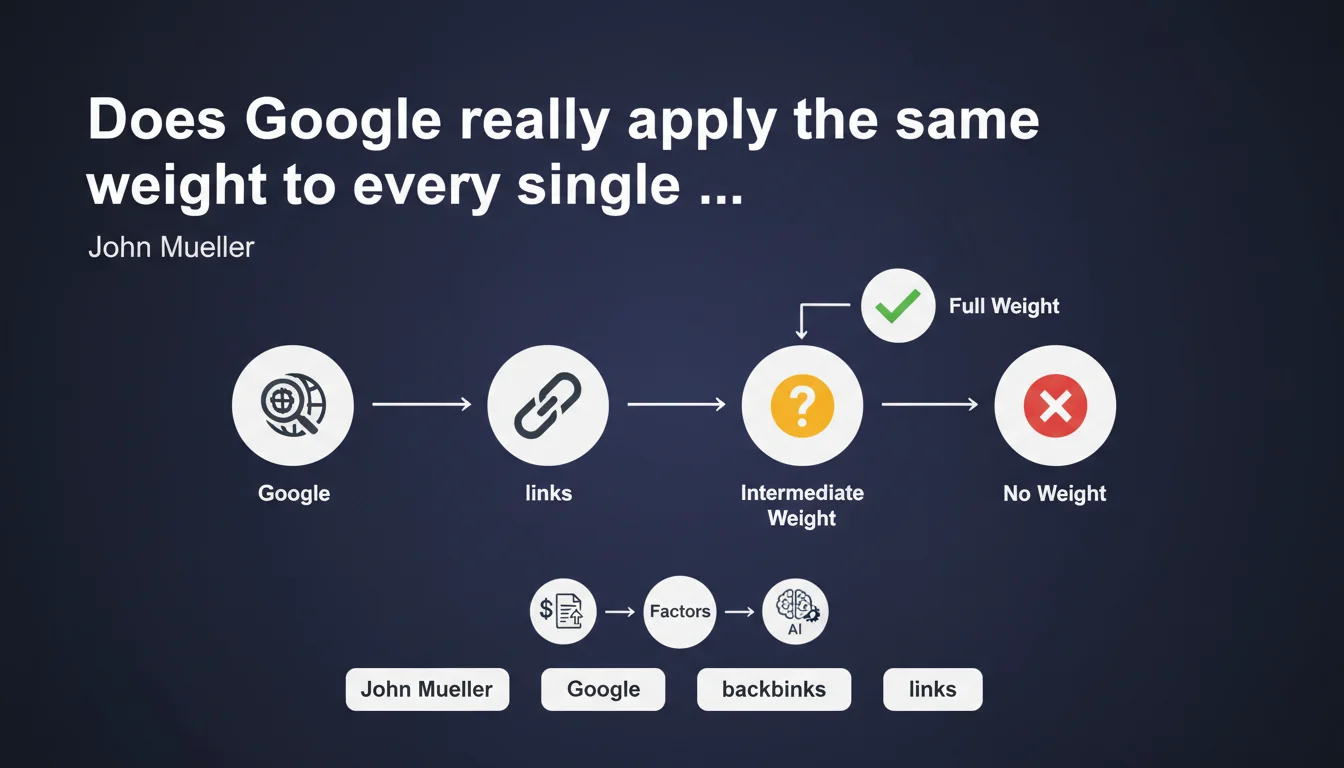
Google applies a variable weighting system to links: some receive full weight, others receive partial weight, or even zero weight. Even without certainty that a link is paid, the algorithm can decide to devalue it partially. This evaluation is based on multiple signals, far beyond simple manual reports.
What you need to understand
How does Google actually evaluate the weight of a link?
Google's algorithm analyzes each link individually based on multiple criteria: thematic relevance, referring domain authority, link context, site history, linking behavior patterns. Contrary to the misconception that a link is either followed or ignored, Google applies a weighting spectrum that can vary from 0% to 100%.
This statement from Mueller confirms what many suspected: a suspicious link without being manifestly paid can receive a reduced coefficient — say 30% or 50% of its potential value. The search engine doesn't need formal proof to apply this partial devaluation.
What signals trigger this intermediate weighting?
Google obviously won't divulge the complete list, but several observable patterns come into play. Links from sites with high advertising density, overly symmetrical link exchanges, over-optimized anchors, or links from satellite pages thematically disconnected.
Manual reports represent only a fraction of the system. Most of the work relies on trained machine learning designed to recognize manipulation schemes — even subtle ones. A site can see its links partially devalued without ever receiving manual action.
Why this nuanced approach rather than binary?
Because the reality of the web is rarely clear-cut. Between a pure editorial link and a manifestly purchased link exists a massive gray zone: paid guest posts, editorial partnerships, triangular exchanges, disguised sponsorships.
Rather than rejecting everything or accepting everything, Google prefers to adjust the dial. This flexibility allows it to absorb noise without excessively penalizing sites that push boundaries without crossing the line.
- Google applies a variable coefficient to each link based on its confidence in its editorial nature
- Manual reports are just one signal among dozens of others
- A suspicious link can be partially devalued without triggering manual action
- This nuanced logic allows Google to manage the gray zone between natural and manipulated links
- The algorithm constantly evolves to refine its detection through machine learning
SEO Expert opinion
Does this statement confirm on-the-ground observations?
Absolutely. For years, we've observed unexplained discrepancies between the apparent quality of a link profile and actual performance. Sites with objectively solid backlinks stagnate, while others with average profiles outperform. This variable weighting explains these anomalies.
The real insight here is confirmation of intermediate weight. Google doesn't operate in all-or-nothing fashion (follow/nofollow), but on a continuum. A link can deliver 20% of its theoretical value if Google detects suspicious signals without having absolute certainty.
What gray areas remain in this explanation?
Mueller remains vague on the precise thresholds and criteria. At what suspicion level does a link drop from 100% to 50%? How long does this partial devaluation persist? Can you recover full weight after an observation period? [To verify]
Another unclear point: how does Google arbitrate between partial devaluation and manual penalty? Logic would suggest that beyond a certain certainty threshold, the spam team intervenes directly. But this threshold remains opaque. Sites in the gray zone navigate blind.
In what cases does this rule apply differently?
Large authority sites probably benefit from higher tolerance. A questionable link on a reference media will more easily be interpreted as an acceptable anomaly than a similar pattern on a new site. The weight of history and reputation matters enormously.
Conversely, a site already under scrutiny or with a manipulation history will have its new links examined with greater severity. The applied coefficient depends on the broader domain context, not just the isolated link's attributes.
Practical impact and recommendations
How to adapt your netlinking strategy to this reality?
Prioritize genuine editorial quality over superficial metrics. A contextual link in a relevant article, even from an average site, will often outperform a footer link on a DR80 that's thematically disconnected. Google detects the difference.
Avoid overly repetitive patterns. If all your backlinks come from the same platform type (directories, guest posts on generic B2B sites), you're creating a manipulation signal even if each individual link seems legitimate. Vary sources, formats, and anchors.
Should you disavow intermediate-weight links?
Not necessarily. If Google already assigns them a reduced coefficient, disavowing won't help — it might even eliminate the residual benefit. Focus disavow on manifestly toxic links: spam, obvious PBNs, aggressively over-optimized anchors.
The real risk involves volume. A few intermediate-weight links fly under the radar, but if 40% of your profile falls into this category, Google can interpret it as a systematic manipulation pattern and harden the entire evaluation.
What indicators should you monitor to detect partial devaluation?
Unfortunately, Google won't warn you. Monitor disconnects between link acquisition and organic traffic growth. If you regularly gain new backlinks with no measurable impact on rankings, that's a red flag.
Also analyze performance by link segment. Are pages receiving primarily links of a certain type (e.g., guest posts on specialized platforms) progressing less than those benefiting from spontaneous links? This comparison sometimes reveals devaluation patterns.
- Audit the diversity of your link profile (sources, formats, contexts)
- Identify suspicious links without being manifestly toxic — possible targets for reduced weighting
- Don't rely solely on third-party metrics (DR, DA) to evaluate a backlink's value
- Correlate link acquisition with ranking evolution to detect partial devaluations
- Prioritize contextual natural links even from sites of medium authority
- Avoid massive volumes of links from similar sources (detectable pattern)
- Use disavow only for clearly toxic links, not suspects
- Monitor real impact of each netlinking campaign on organic KPIs
This statement changes the game: accumulating backlinks is no longer enough, they also need to pass Google's weighting filters. The winning strategy now rests on sophistication — understanding what triggers suspicion versus trust, diversifying intelligently, and measuring real impact rather than vanity metrics.
Faced with this growing complexity, many sites would benefit from specialized expertise capable of finely analyzing devaluation signals and adjusting strategy accordingly — personalized support often prevents months of low-yield effort.
❓ Frequently Asked Questions
Google pénalise-t-il un site qui reçoit des liens à poids intermédiaire ?
Peut-on identifier quels liens reçoivent un poids réduit de Google ?
Un lien nofollow a-t-il plus de valeur qu'un lien follow dévalué ?
Cette pondération variable s'applique-t-elle aussi aux liens internes ?
Combien de temps Google maintient-il un lien en statut de poids intermédiaire ?
🎥 From the same video 16
Other SEO insights extracted from this same Google Search Central video · published on 30/01/2022
🎥 Watch the full video on YouTube →
💬 Comments (0)
Be the first to comment.