
Official statement
Other statements from this video 16 ▾
- □ Google attribue-t-il vraiment le même poids à tous vos backlinks ?
- □ L'emplacement des liens internes a-t-il vraiment un impact sur le SEO ?
- □ Google classe-t-il vraiment les sites dans des catégories fixes ?
- □ La cohérence NAP impacte-t-elle vraiment le référencement local ou seulement le Knowledge Graph ?
- □ Comment éviter que Google se trompe à cause d'informations conflictuelles entre votre site et votre profil d'établissement ?
- □ La fréquence des mots-clés influence-t-elle vraiment le classement Google ?
- □ Faut-il vraiment nettoyer TOUTES les pages hackées ou peut-on laisser Google faire le tri ?
- □ Pourquoi Google refuse-t-il d'indexer une partie de votre site même s'il est techniquement parfait ?
- □ Les emojis dans les balises title et meta description apportent-ils un avantage SEO ?
- □ L'API Search Console et l'interface affichent-elles vraiment les mêmes données ?
- □ Pourquoi vos FAQ n'apparaissent-elles pas en rich results malgré un balisage correct ?
- □ Faut-il vraiment réutiliser la même URL pour les pages saisonnières chaque année ?
- □ Les Core Web Vitals n'affectent-ils vraiment ni le crawl ni l'indexation ?
- □ Pourquoi Google réinitialise-t-il l'évaluation d'un site lors d'une migration de sous-domaine vers domaine principal ?
- □ Le TLD .edu booste-t-il vraiment votre référencement ?
- □ Les géo-redirects peuvent-ils réellement bloquer l'indexation de votre contenu ?
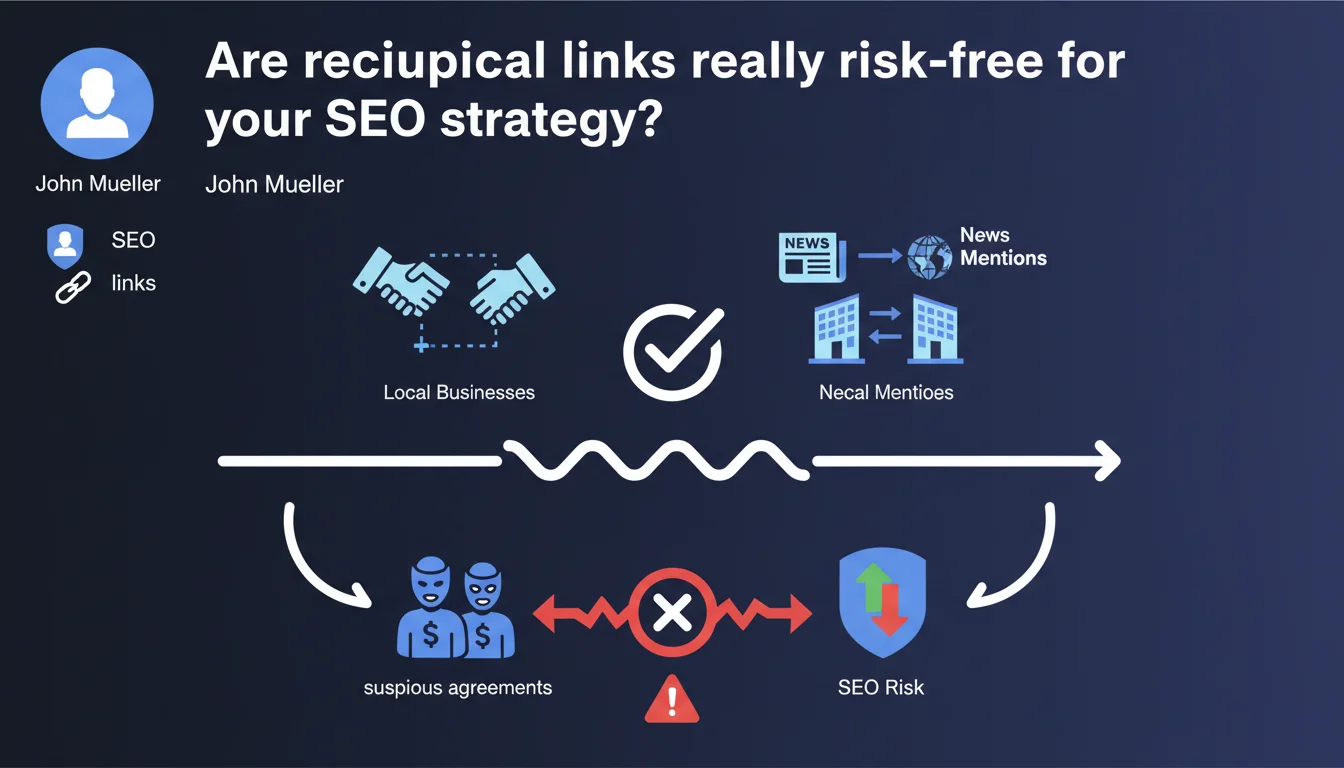
Google affirms that natural reciprocal links — between local businesses, mentions in press releases with return links — pose no problem whatsoever. The message: stop overthinking if exchanges are organic and free from questionable arrangements. The real challenge remains distinguishing what is genuinely natural from what could look like manipulation.
What you need to understand
What does Google mean by "natural reciprocal links"?
Google is referring to situations where two sites link to each other without explicit prior arrangement to manipulate rankings. A local business mentioning a partner, a media outlet citing a source and receiving a return link — that's what falls into this category.
The key criterion? The absence of suspicious deals. If the link exists because it provides real value to the reader, not because an agreement was struck to boost PageRank, Google sees no problem with it.
Why this clarification now?
For years, the SEO industry has maintained an irrational fear of reciprocal links — to the point of systematically refusing to link a site that already links to you. This paranoia stems from an era when Google penalized massive and coordinated exchanges of links between site networks.
But Google never said that every reciprocal link was toxic. Mueller is simply reminding us of what should have been obvious: if two entities naturally mention each other, nobody is going to penalize them for that.
Where is the line between acceptable and manipulative?
This is where it gets murky. Google doesn't provide a quantitative threshold — how many reciprocal links are tolerated before crossing into suspicious territory? No answer. The algorithm relies on behavioral signals: optimized anchors, repetitive patterns, unrelated topics.
The problem is that "natural" remains a subjective notion. What seems organic to a webmaster can appear coordinated to an algorithm analyzing 500 backlinks at once.
- Acceptable reciprocal links: spontaneous editorial mentions, legitimate local partnerships, source exchanges between media outlets.
- Suspicious links: formal agreements "you link me, I link you", over-optimized anchors, abnormal volumes between same actors.
- Gray area: displayed commercial partnerships with cross-links — Google says that passes if it's transparent, but practice shows the algorithm can flag it.
SEO Expert opinion
Is this statement consistent with what we observe in practice?
Yes and no. On one hand, we do see sites exchanging links in legitimate editorial contexts without visible penalty. Two niche blogs citing each other in in-depth articles? No problem observed.
On the other hand, we regularly see sites penalized for reciprocal link patterns — even when webmasters swear they coordinated nothing. [To verify]: Google claims to only target suspicious agreements, but the algorithm sometimes detects patterns where there are only thematic coincidences.
What nuances should we add to this rule?
First point: Mueller is talking about natural links, not all reciprocal links. If you sign a commercial agreement with 50 sites to exchange links with optimized anchors, you're outside the "natural" framework — even if each individual link could seem justified.
Second nuance — and this is crucial: volume matters. A site with 80% of backlinks being reciprocal sends a weird signal, even if each individual link is legitimate. The algorithm doesn't just look at the nature of the link, but also the overall profile.
In what cases does this rule not apply?
As soon as manipulative intent becomes detectable. A footer "Partners" with 30 clickable logos to sites that all link back to you? That's a classic scheme Google explicitly disavows elsewhere in its guidelines.
Triangular exchanges (A links B, B links C, C links A) are also not covered by this statement. Mueller is talking about direct reciprocity, not multi-site schemes to dilute the obviousness of coordination.
Practical impact and recommendations
What should you do concretely with this information?
Stop systematically refusing to link a site that has already mentioned you. If you write an article where that site constitutes a relevant source, link to it. Period. Don't self-censor yourself out of fear of a reciprocal link.
Conversely, don't go around contacting every site that links to you to propose a return link "since Google says it's OK". That's not what Mueller said — he said that when it happens naturally, it poses no problem. Forcing it is already stepping outside the natural framework.
What mistakes should you absolutely avoid?
Don't set up formal partnerships based solely on link exchange. Even if each link has editorial justification, a contractual agreement "we'll link each other" remains a scheme Google can identify and ignore — or even penalize if it's massive.
Avoid over-optimized anchors in reciprocal contexts. If a site links you with your brand and you link them back with their main commercial keyword, that smells like coordination. Vary your anchors, use natural contexts.
How do you verify that your link profile remains healthy?
Analyze the ratio of reciprocal links in your overall profile. If it exceeds 30-40%, dig deeper to understand why. It's not a magic threshold, but it deserves investigation — especially if these links share common patterns (same anchors, same placements).
Use tools like Ahrefs or Majestic to identify reciprocity clusters. If you see groups of sites all exchanging links with each other, you may be in a network — intentional or not.
- Audit your backlink profile to identify existing reciprocal links
- Verify that these links have clear individual editorial justification
- Eliminate formal exchange agreements if you have any — replace with natural mentions if relevant
- Diversify your anchors in reciprocal contexts — avoid exact commercial keywords
- Monitor the overall reciprocity ratio — alert yourself if it climbs above 40%
- Document the editorial contexts of your main reciprocal links — in case of manual action, you'll have proof of legitimacy
❓ Frequently Asked Questions
Un lien réciproque avec un concurrent direct pose-t-il problème ?
Faut-il utiliser nofollow sur les liens réciproques pour se protéger ?
Les annuaires locaux qui se lient entre eux sont-ils concernés par cette tolérance ?
Combien de liens réciproques peut-on avoir avant que ça devienne suspect ?
Un partenariat commercial affiché avec échange de liens est-il acceptable ?
🎥 From the same video 16
Other SEO insights extracted from this same Google Search Central video · published on 30/01/2022
🎥 Watch the full video on YouTube →
💬 Comments (0)
Be the first to comment.