
Official statement
Other statements from this video 16 ▾
- □ Google attribue-t-il vraiment le même poids à tous vos backlinks ?
- □ L'emplacement des liens internes a-t-il vraiment un impact sur le SEO ?
- □ Google classe-t-il vraiment les sites dans des catégories fixes ?
- □ La cohérence NAP impacte-t-elle vraiment le référencement local ou seulement le Knowledge Graph ?
- □ Comment éviter que Google se trompe à cause d'informations conflictuelles entre votre site et votre profil d'établissement ?
- □ Les liens réciproques sont-ils vraiment sans risque pour votre SEO ?
- □ La fréquence des mots-clés influence-t-elle vraiment le classement Google ?
- □ Faut-il vraiment nettoyer TOUTES les pages hackées ou peut-on laisser Google faire le tri ?
- □ Pourquoi Google refuse-t-il d'indexer une partie de votre site même s'il est techniquement parfait ?
- □ Les emojis dans les balises title et meta description apportent-ils un avantage SEO ?
- □ L'API Search Console et l'interface affichent-elles vraiment les mêmes données ?
- □ Faut-il vraiment réutiliser la même URL pour les pages saisonnières chaque année ?
- □ Les Core Web Vitals n'affectent-ils vraiment ni le crawl ni l'indexation ?
- □ Pourquoi Google réinitialise-t-il l'évaluation d'un site lors d'une migration de sous-domaine vers domaine principal ?
- □ Le TLD .edu booste-t-il vraiment votre référencement ?
- □ Les géo-redirects peuvent-ils réellement bloquer l'indexation de votre contenu ?
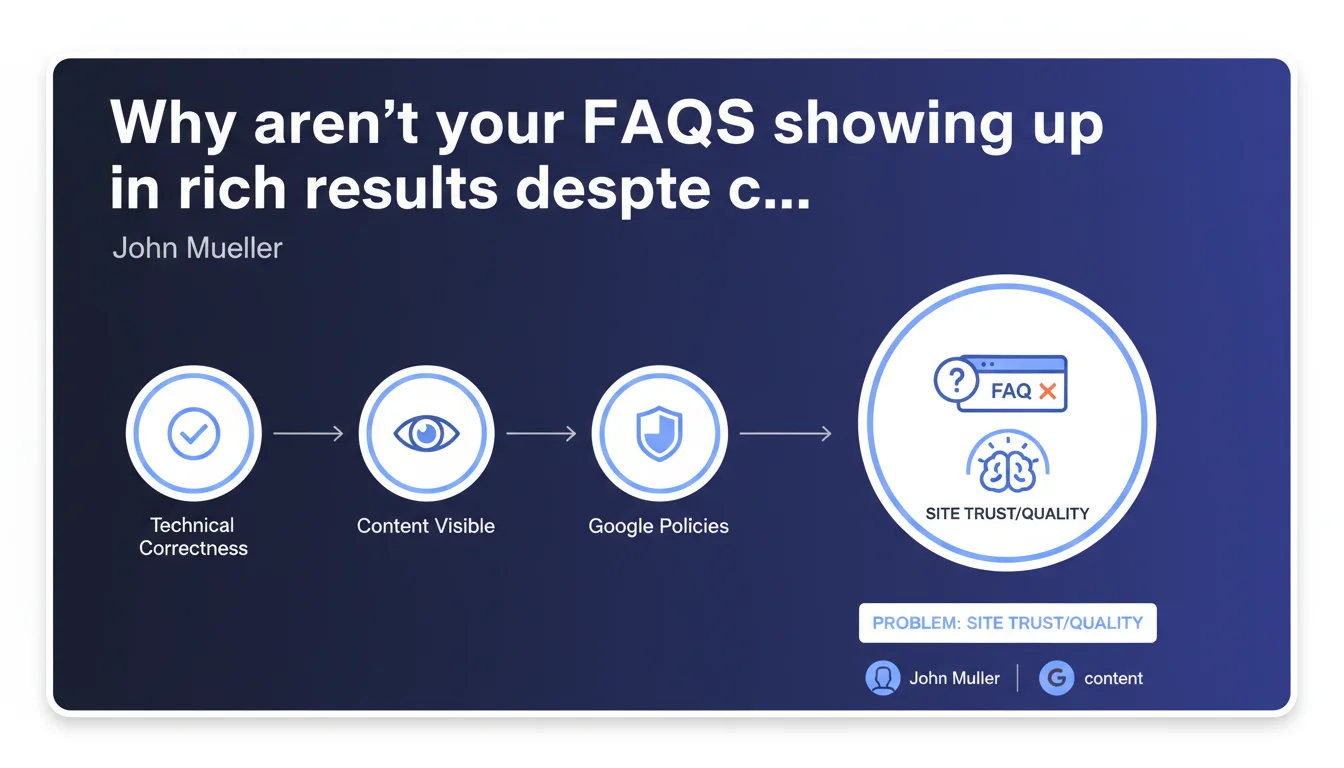
Google requires three cumulative conditions to display FAQs in rich results: technically valid markup, compliance with policies (notably content visibility on the page), and above all, trust granted to the site. It's this last criterion — the perceived quality of the domain — that blocks the majority of cases.
What you need to understand
FAQ rich results seem simple to obtain: you add the schema.org FAQPage, validate with Search Console, and there you go. Except many technically flawless sites never see their FAQs displayed.
Mueller lays out the rules of the game explicitly here. Three barriers to cross, and it's the third one that causes problems.
What exactly are these three criteria?
The first is technical: your JSON-LD or Microdata markup must comply with Schema.org specifications and be error-free in Search Console. Nothing sorcerous about it—tools like the Rich Results Test allow you to verify.
The second relates to Google policies. The content of questions/answers must be visible on the page—not hidden in an accordion invisible on initial load, not generated solely client-side without server rendering. Google wants the user accessing the page to actually see these FAQs.
The third criterion is the murkiest: Google must consider your site trustworthy. Mueller doesn't detail the exact metrics, but we understand this is an overall assessment of the domain.
Why is trust the blocking point?
Because the first two criteria are objective and verifiable. You can fix defective markup in minutes. You can make your FAQs HTML-visible.
Trust, on the other hand, has no checklist. It stems from the site's history, its link profile, overall content quality, perhaps E-E-A-T signals. In short, factors you don't fix in an afternoon.
What does "trust" concretely mean for Google?
Mueller stays evasive—intentionally. We can assume Google crosses several dimensions: domain age, absence of past manual or algorithmic penalties, content quality (no spam, no massive scraping), natural backlink profile.
New sites or domains with a questionable history can have perfect markup and never land FAQ rich results. It's frustrating, but consistent with Google's logic: limit enriched display to sources deemed credible.
- Three cumulative conditions: technical, policy, trust
- Markup alone never suffices
- Content visibility on the page is non-negotiable
- Trust is the most determining and least controllable criterion in the short term
- No public metric to measure this trust threshold
SEO Expert opinion
Does this explanation match field observations?
Yes, largely. We regularly observe sites with technically impeccable markup that never achieve enriched display. Conversely, some major players get rich results even with approximate implementations.
This confirms that Google applies an upstream filter, likely based on domain reputation. Rich results aren't a right acquired through code compliance alone—they're a privilege granted to sites deemed trustworthy.
What are the gray areas of this statement?
Mueller stays intentionally vague about what constitutes "trust." No metrics, no explicit thresholds. [To verify]: we don't know if this assessment relies on quantitative signals (like internal Domain Authority) or more subjective criteria (manual review, domain history).
Another question mark: timing. How long does a new but quality site need to cross this trust threshold? Google doesn't say. Some domains wait months, others never do.
Finally, Mueller mentions "quality" without specifying if it concerns only the page with FAQs or the entire site. Probably both, but [To verify]: can an otherwise mediocre site with a handful of excellent pages unlock FAQ rich results on those pages alone?
Should you abandon FAQs if you don't get rich results?
No. Structured FAQs with Schema.org remain useful even without enriched display. They improve semantic understanding of your content by Google, potentially help with long-tail query ranking, and optimize user experience.
But don't expect immediate ROI in terms of boosted CTR if you don't yet have Google's trust. Consider FAQ markup as a medium/long-term investment rather than a quick win.
Practical impact and recommendations
How do I check if my site meets all three criteria?
For the technical criterion, use Google's Rich Results Test and Search Console (Enhancements > FAQ section). If you see errors, fix them. Simple.
For the policy criterion, ensure your questions/answers are visible in the initial HTML source (not just client-side JavaScript). Test by disabling JS in your browser: if FAQs vanish, that's a problem.
For the trust criterion—here's where it gets tricky. No official tool will tell you "your site has a trust score of 42/100." You must evaluate indirectly: domain history, absence of penalties, clean backlink profile, original quality content.
What if markup is OK but rich results don't appear?
First, wait. Google can take several weeks to re-evaluate a site after corrections. Don't panic after 48 hours.
Next, work on overall quality signals: improve existing content, gain backlinks from trusted sources, eliminate thin or duplicate pages, strengthen your E-E-A-T.
If nothing moves after several months, ask yourself: does your site have a problematic history? Domain purchased with spam baggage? Old manual penalty never fully resolved? Sometimes the problem goes way back.
What errors to absolutely avoid?
Don't create fake FAQs just for markup. Google detects questions/answers that add no user value. That hurts trust.
Don't hide FAQ content behind complex user interactions. If your answers only display after clicking a pure JavaScript tab, Google may consider it not visible.
Don't pile up rich result types on one page without logic. An FAQ page should be an FAQ page—not a FAQ + Recipe + Product mashup that screams over-optimization.
- Validate markup with Rich Results Test and Search Console
- Check HTML visibility of FAQ content (test without JS)
- Audit domain history and overall reputation
- Improve E-E-A-T signals if needed (backlinks, expert content)
- Wait several weeks after corrections before drawing conclusions
- Never spam FAQs to force enriched display
- Monitor Core Web Vitals and overall user experience
FAQ rich results aren't just a code story. They demand a site that's technically clean, policy-compliant, and above all perceived as trustworthy by Google. If you're stuck on this last criterion, focus on overall domain quality rather than tweaking markup around the edges.
These optimizations—especially improving a site's trust in Google's eyes—can prove complex to diagnose and implement alone. Between technical audits, domain history analysis, cleaning up a dodgy link profile, and strengthening E-E-A-T, the work piles up fast. If you lack time or internal resources, consulting a specialized SEO agency can significantly speed up the process and spare you months of trial and error.
❓ Frequently Asked Questions
Un site neuf peut-il obtenir les FAQ rich results immédiatement ?
Si mes FAQ sont dans un accordéon JavaScript, est-ce bloquant ?
La Search Console indique-t-elle pourquoi mes FAQ ne s'affichent pas en rich results ?
Peut-on perdre les FAQ rich results après les avoir obtenus ?
Les backlinks influencent-ils la confiance pour les rich results FAQ ?
🎥 From the same video 16
Other SEO insights extracted from this same Google Search Central video · published on 30/01/2022
🎥 Watch the full video on YouTube →
💬 Comments (0)
Be the first to comment.