
Official statement
Other statements from this video 10 ▾
- □ Should you still optimize meta descriptions if Google ignores them anyway?
- □ Should you still optimize meta descriptions for SEO in 2024?
- □ Is one backlink really all Google needs to discover and index your site?
- □ Do you still need rel=prev/next for pagination in 2024?
- □ Is boilerplate content really hurting your pages' search rankings?
- □ Is boilerplate really a threat to your search engine rankings?
- □ Are geolocation redirects killing your Google crawl?
- □ How does Google really determine user location for local SEO?
- □ Are IP geolocation databases really reliable enough for international SEO?
- □ Should you configure the Content-Language header for PDFs and non-HTML files?
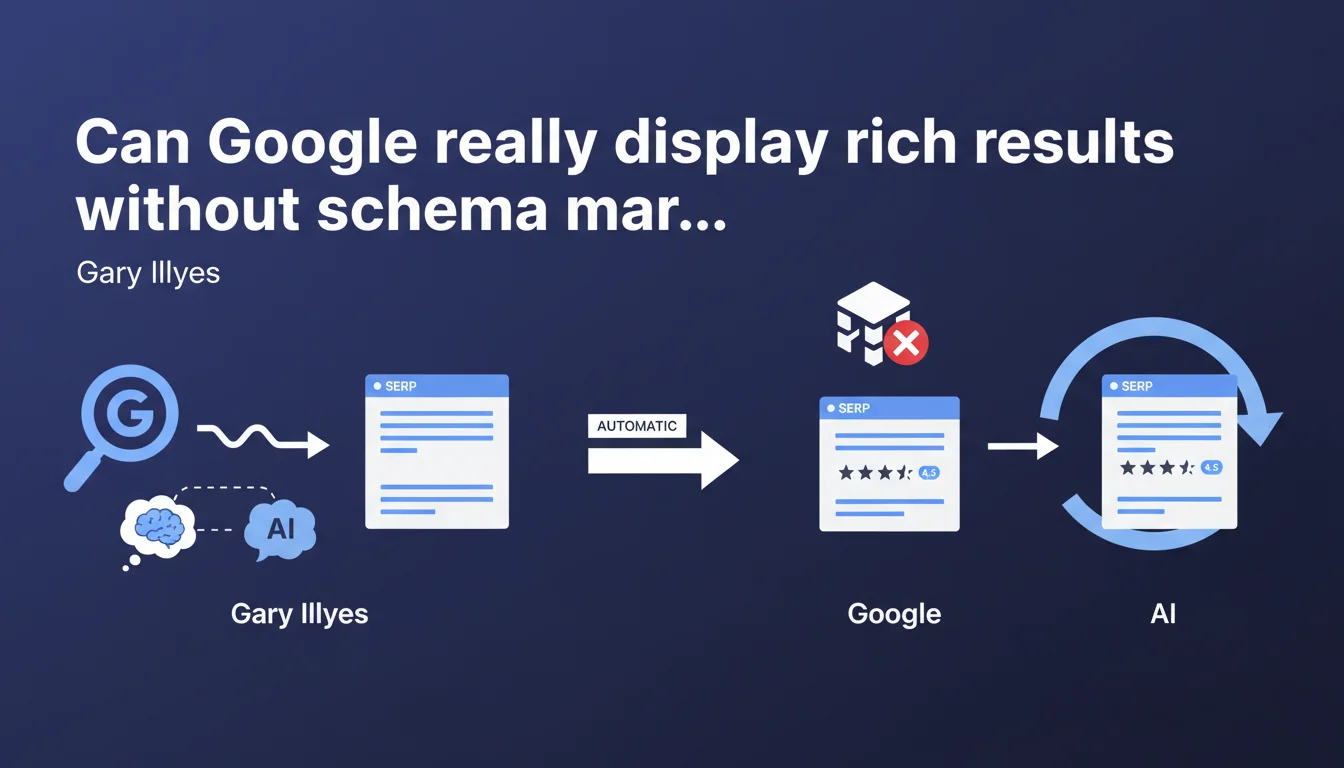
Google can automatically generate certain rich results elements (such as review stars) even without specific schema markup. Structured markup is therefore not always a prerequisite for obtaining these enriched displays in SERPs. This challenges the systematic necessity of implementing structured data.
What you need to understand
Can Google really do without schema markup?
Gary Illyes confirms that Google is capable of detecting and automatically extracting certain information from the visible content of a page, without needing explicit schema.org markup. Concretely, if your page contains customer reviews with ratings, Google can identify them and transform them into rich snippets with stars.
This capability relies on natural language processing (NLP) algorithms and Google's machine learning. The search engine analyzes HTML structure, semantic context, and recurring patterns to identify entities such as ratings, prices, events, or products.
What types of rich results are affected?
The statement primarily targets review stars, but Google applies this logic to other elements: recipe snippets, contact information, business hours, or product prices. The search engine is not limited to sites marked with schema.org only.
Caution: this automatic generation remains less reliable and less controllable than explicit structured markup. Google can make mistakes, misinterpret data, or display nothing at all if your data format is not sufficiently clear.
Why is Google communicating about this now?
This statement likely aims to defuse the frustration of webmasters who see competitors obtaining rich results without implementing schema markup. Google wants to clarify that the absence of markup is not a bug or an injustice, but an intentional feature.
It also emphasizes that well-structured content in standard HTML retains value. A clean table, well-formatted lists, semantic tags — all of this helps Google understand your content, even without JSON-LD.
- Google can automatically generate certain rich results without schema markup
- Review stars are the most frequent example of this automation
- This capability relies on NLP and HTML pattern analysis
- Automatic generation remains less reliable than explicit markup
- Semantic and well-structured HTML retains crucial importance
SEO Expert opinion
Is this statement consistent with field observations?
Yes, but with important nuances. We do observe sites displaying rich snippets without schema markup — particularly on e-commerce platforms or review aggregators. Google identifies recurring patterns and generates stars automatically.
However, the frequency and stability of these displays remain lower than those of correctly marked-up sites. A site without schema can lose its stars overnight, while a site with proper markup maintains them more predictably. [To verify]: Google provides no statistics on the success rate of this automatic generation.
What risks does this approach carry?
The main problem is the lack of control. If Google misinterprets your data — for example, it confuses a recipe difficulty score with a review rating — you have no direct way to correct this error. Schema markup offers explicit communication with the search engine.
Another point: Google can extract and display partial or outdated information. If your customer reviews are dynamically updated via JavaScript but the initial HTML contains old ratings, that is what Google risks capturing. Schema markup allows you to explicitly point to updated data.
In what cases does this rule not apply?
For certain more complex rich results types — FAQ, HowTo, JobPosting, Event — schema markup remains nearly mandatory. Google does not have the capacity (or willingness) to automatically detect these structures with sufficient precision to display them reliably.
Let's be honest: if you want to maximize your chances of obtaining rich results and maintain control over their display, schema markup remains the best practice. Automatic generation is a safety net, not a strategy.
Practical impact and recommendations
Should you always implement schema markup?
Yes, absolutely. This statement does not mean that structured markup has become optional. It only confirms that Google has a fallback capacity to extract certain information even in its absence.
Schema markup offers you several decisive advantages: complete control over displayed data, better stability of rich results over time, and the ability to quickly correct errors via Search Console. Do not neglect it on the grounds that Google can do without it.
How can you verify if Google is automatically generating rich results on my site?
Use the URL inspection tool in Search Console and compare the displayed results with your actual markup. If you see rich results without corresponding schema, that means Google is generating them automatically.
Also monitor display fluctuations in the SERPs. If your stars appear and disappear randomly, it's probably a sign of unstable automatic generation. A correctly marked-up site shows far superior display consistency.
What should you do if you notice incorrect rich results?
If Google is automatically displaying incorrect information, the fastest solution is to implement the correct schema markup. This allows you to replace automatically extracted data with your explicit data.
You can also improve your pages' HTML structure to reduce ambiguities: clear semantic tags, well-formatted tables, itemprop attributes even without complete JSON-LD. The cleaner your code, the less Google will risk making mistakes.
- Audit your site to identify pages with automatic rich results
- Prioritize schema markup implementation on strategic pages (products, reviews, events)
- Test your markup with Google's Rich Results Test before production deployment
- Monitor Search Console to detect markup errors or display variations
- Maintain clean semantic HTML even if you implement schema
- Never rely on automatic generation for elements critical to your visibility
❓ Frequently Asked Questions
Google peut-il afficher des étoiles d'avis sans schema markup ?
Le schema markup est-il encore nécessaire pour le SEO ?
Quels types de rich results sont concernés par cette génération automatique ?
Comment savoir si mes rich results sont générés automatiquement ?
Que faire si Google affiche des informations incorrectes automatiquement ?
🎥 From the same video 10
Other SEO insights extracted from this same Google Search Central video · published on 25/04/2024
🎥 Watch the full video on YouTube →
💬 Comments (0)
Be the first to comment.