
Official statement
Other statements from this video 10 ▾
- □ Faut-il encore optimiser ses meta descriptions si Google les ignore ?
- □ Faut-il encore optimiser les meta descriptions pour le SEO ?
- □ Un seul lien suffit-il vraiment pour que Google découvre et indexe votre site ?
- □ Faut-il encore utiliser rel=prev/next pour la pagination ?
- □ Le contenu boilerplate nuit-il vraiment au référencement de vos pages ?
- □ Le boilerplate est-il vraiment un danger pour votre référencement naturel ?
- □ Les redirections IP géolocalisées tuent-elles votre crawl Google ?
- □ Les bases de données IP pour la géolocalisation sont-elles vraiment fiables pour le SEO international ?
- □ Google peut-il vraiment afficher des rich results sans schema markup ?
- □ Faut-il configurer le header Content-Language pour les PDF et fichiers non-HTML ?
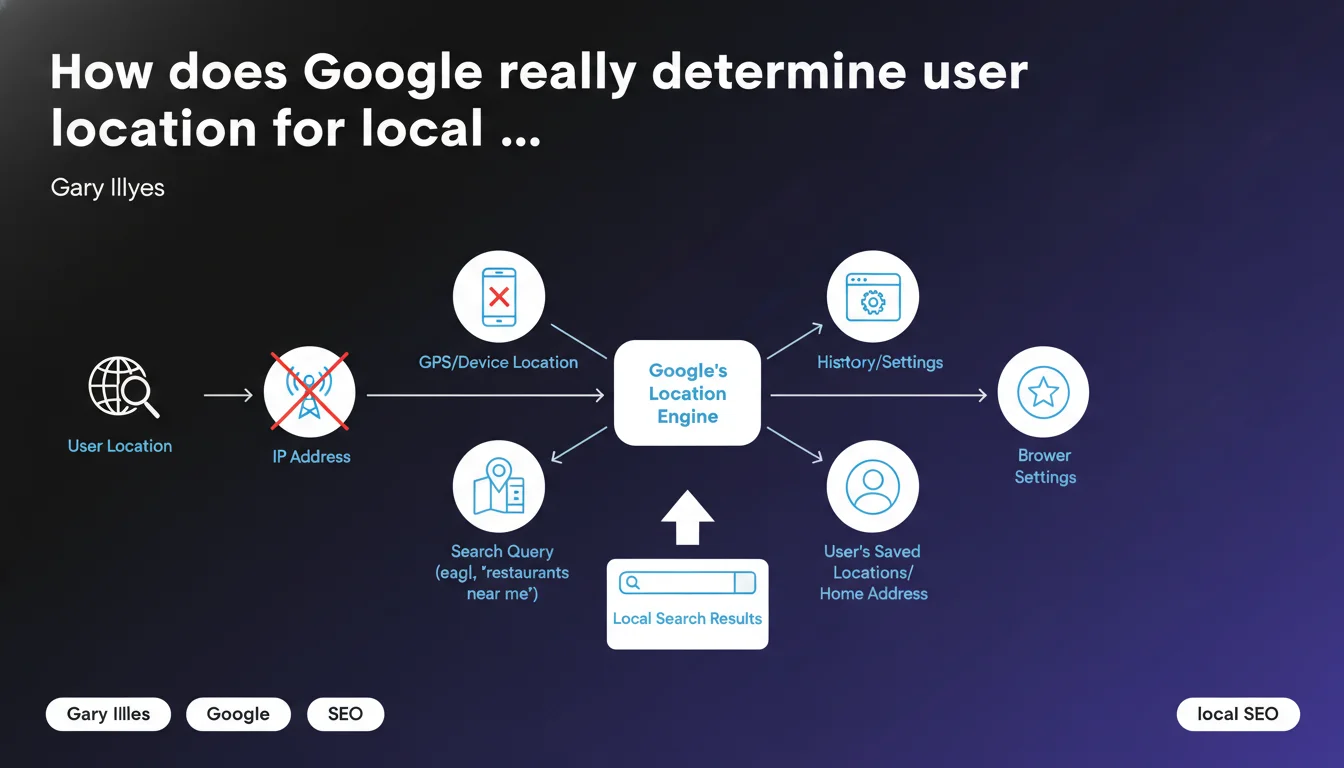
Google combines multiple signals beyond IP address to determine user geolocation and display adapted search results. This multi-signal approach has direct implications for your geographic targeting strategies and local optimization. IP alone is no longer sufficient to guarantee that your content appears in the right geographic zones.
What you need to understand
What signals does Google combine for geolocation?
Google is not limited to the user's IP address to determine their location. The engine crosses multiple contextual signals: search history, browser language, GPS location (mobile), Google account settings, and even previous queries.
This multi-signal approach explains why two users with the same IP can see different localized results. The system adapts to individual behavior rather than relying on a single technical indicator.
Why does this statement change the game for local SEO?
For a long time, SEO professionals overestimated the importance of IP in geographic targeting. This clarification from Google sets the record straight: local optimization is not just about server hosting or CDN issues.
Concretely, your on-page signals (hreflang tags, localized content, geographic mentions) gain in relative importance. Google can ignore IP if other signals are stronger — and that's great news for sites targeting multiple areas.
What are the implications for multilingual and multi-region sites?
Sites with multiple local versions need to carefully manage their technical architecture. Google won't automatically redirect a user to the right version just because their IP matches a given country.
Hreflang tags, URL structure (ccTLD, subdomains, subdirectories), and content signals become critical. A French user in the United States could very well see the US version if behavioral signals point in that direction.
- IP is just one signal among many — not the decisive factor
- Google favors a contextual approach based on user behavior
- On-page signals (hreflang, content, structure) carry more weight
- Two users with the same IP can see different results
- Local optimization goes far beyond server localization
SEO Expert opinion
Is this statement really breaking news?
Let's be honest: this clarification doesn't revolutionize anything. Experienced SEO professionals have known for years that IP alone doesn't determine geolocation. Google has always used multiple signals — simply, the company had never formalized it so clearly.
What's changing is the official confirmation. No more sterile debates about server hosting as a local ranking factor. We can now rely on a documented Google position to educate clients who insist on hosting each local version on a physical server in the target country.
What nuances should be made to this statement?
Gary Illyes remains deliberately vague about the weighting of signals. Which ones take priority? In what contexts? [To verify]: Google provides no clear hierarchy, making optimization difficult to calibrate.
Another gray area: how does Google handle VPNs and proxies? Do users masking their IP see degraded results or, conversely, better personalization through other signals? The statement provides no insight into these edge cases, yet they happen frequently.
Finally, one might legitimately wonder if this multi-signal logic applies the same way to local transactional queries ("restaurant near me") and informational searches without geographic intent. [To verify]: Google makes no such distinction in its communications.
What contradictions do we observe in practice?
In practice, IP remains a very influential signal for queries without explicit local intent. An American user searching "best insurance" will almost always see US results, even if they have a history of French-language searches.
And that's where it gets tricky: Google says it combines multiple signals, but in fact, some weigh far more heavily than others depending on query type. For pure local SEO (Google Business Profile, local pack), mobile GPS position overrides everything else — IP becomes almost negligible.
Practical impact and recommendations
What should you change in your international SEO strategy?
Stop stressing about physical server localization. If you use a modern CDN, the question of geographic hosting is settled for performance — but it was never critical for local SEO.
Focus on structural signals: clean hreflang tags, clearly identified local versions, authentically adapted content (not just translated). Google needs these markers to understand which version to serve to which user.
How to optimize for this multi-signal approach?
Strengthen the geographic coherence of each local version. Local address in the footer, city and region mentions in content, local phone numbers, adapted currencies — all these elements are signals Google picks up.
For sites with multiple country targets, avoid automatic IP-based redirects. Google is clear about this: IP is not decisive. Instead, offer a language/region selector and let the user choose — Google values this respect for user intent.
What technical errors must you absolutely fix?
Poorly implemented hreflang tags are the number one nightmare. Verify that they are reciprocal, that they cover all language versions, and that they include the x-default tag. Without this, Google can ignore your targeting intentions.
Also monitor duplicate content between local versions. If your .fr and .be versions differ only by a few words, Google may consider them interchangeable and serve either one — nullifying your localization strategy.
- Audit and fix all hreflang tags (reciprocity, x-default, complete coverage)
- Actually differentiate the content of each local version (not just translation)
- Add on-page geographic signals (addresses, phone numbers, currencies, local mentions)
- Remove automatic IP-based redirects and implement manual selector
- Optimize each Google Business Profile locally with NAP consistency (Name, Address, Phone)
- Verify that local backlinks point to the correct language version
- Test search result display from different locations and contexts (mobile/desktop, logged in/logged out)
Google's multi-signal geolocation imposes a coordinated technical and editorial approach. Each local version must be a complete site, not just a translation.
These optimizations require specialized expertise in multilingual site architecture, hreflang implementation, and localized content strategy. If your site targets multiple countries or regions, working with an SEO agency specialized in international SEO can prove invaluable to avoid costly mistakes and maximize your visibility in each geographic zone.
❓ Frequently Asked Questions
L'adresse IP de mon serveur influence-t-elle encore mon référencement local ?
Dois-je utiliser un CDN pour améliorer mon SEO international ?
Comment Google détermine-t-il la localisation d'un utilisateur mobile ?
Les balises hreflang sont-elles obligatoires pour un site multilingue ?
Un utilisateur avec VPN verra-t-il des résultats faussés ?
🎥 From the same video 10
Other SEO insights extracted from this same Google Search Central video · published on 25/04/2024
🎥 Watch the full video on YouTube →
💬 Comments (0)
Be the first to comment.