
Official statement
Other statements from this video 10 ▾
- □ Faut-il encore optimiser ses meta descriptions si Google les ignore ?
- □ Faut-il encore optimiser les meta descriptions pour le SEO ?
- □ Un seul lien suffit-il vraiment pour que Google découvre et indexe votre site ?
- □ Faut-il encore utiliser rel=prev/next pour la pagination ?
- □ Le boilerplate est-il vraiment un danger pour votre référencement naturel ?
- □ Les redirections IP géolocalisées tuent-elles votre crawl Google ?
- □ Comment Google détermine-t-il vraiment la localisation d'un utilisateur pour le SEO local ?
- □ Les bases de données IP pour la géolocalisation sont-elles vraiment fiables pour le SEO international ?
- □ Google peut-il vraiment afficher des rich results sans schema markup ?
- □ Faut-il configurer le header Content-Language pour les PDF et fichiers non-HTML ?
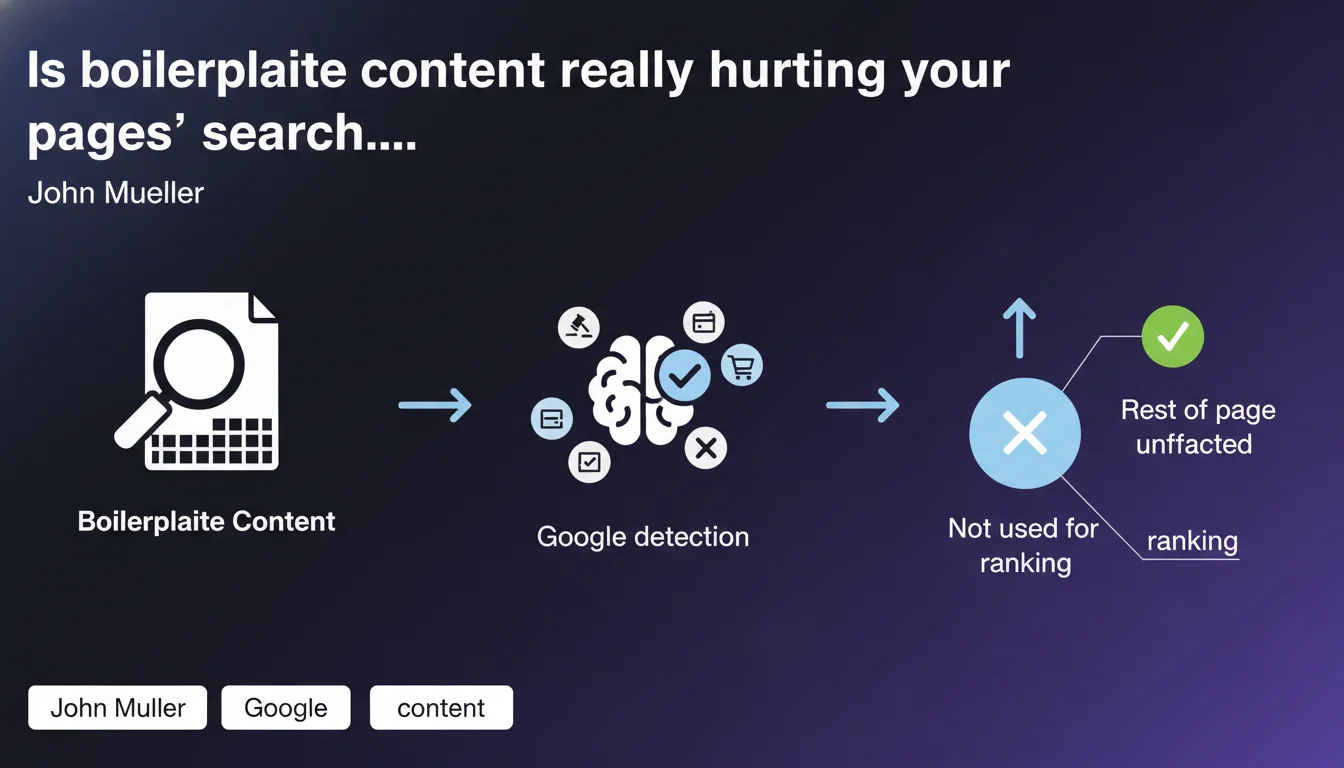
Google automatically detects repetitive content (footers, legal notices, standardized product descriptions) and ignores it for ranking purposes. This boilerplate content has no negative impact on the SEO performance of the rest of the page. The algorithm distinguishes between unique editorial content and recurring structural elements.
What you need to understand
How does Google distinguish boilerplate content from editorial content?
Google's algorithm analyzes the recurrence of text blocks across your pages and identifies patterns that repeat systematically. A footer present on 500 pages, terms and conditions displayed everywhere, a repeated disclaimer — the search engine picks up on these redundancies.
Technically, Google segments each page into functional zones: navigation, main content, sidebar, footer. This segmentation makes it possible to isolate what relates to site structure (boilerplate) and what constitutes unique content intended for the user.
Why this tolerance for repetitive content?
Google understood long ago that a modern website requires recurring structural elements. Systematically penalizing this repetition would amount to sanctioning normal site architecture.
The logic is straightforward: if your footer appears on 1,000 pages, it's not an attempt at manipulation but a technical and legal necessity. The algorithm distinguishes between intentional duplication (spam) and functional necessity.
What types of content are affected by this detection?
Footers and headers containing contact information, legal links, navigation menus. Repetitive sidebars with social widgets, advertising banners, identical calls to action. Disclaimers and legal notices duplicated on every product sheet or article.
- Google ignores boilerplate in its relevance calculation but still indexes the content (for brand search, site navigation, etc.)
- This tolerance doesn't mean you can stuff keywords in your footers — keyword stuffing is still detected and penalized
- Duplicated editorial content (product descriptions copied from the manufacturer, republished articles) does not fall into this category and remains problematic
- Detection works at the intra-site level: Google compares your pages with each other, not with other sites
SEO Expert opinion
Is this statement consistent with on-the-ground observations?
Yes, and it's actually one of the rare points where Google's theory perfectly aligns with practice. We regularly see sites with massive footers (200-300 words of legal text) ranking without issue, as long as the main content remains unique and high-quality.
Tests I've conducted on e-commerce sites show that duplicating a text block like "Why buy from us" across 500 product sheets doesn't impact ranking — provided the product description itself is differentiated. Google does isolate these blocks well.
What are the limits of this tolerance?
The critical nuance: Google tolerates boilerplate as long as it doesn't represent the majority of visible content. If your page contains 50 words of unique content and 400 words of repetitive footer, the ratio becomes problematic.
I've observed cases where sites with a boilerplate-to-unique-content ratio exceeding 70% saw their pages treated as "thin content". Google doesn't penalize boilerplate itself, but if your page offers little else, there's no reason for it to rank. [To verify]: Google has never communicated a precise threshold, but on-the-ground experience suggests a 30/70 ratio (boilerplate/unique) is a prudent maximum.
In what cases does this rule not apply?
Watch out for standardized product descriptions provided by the manufacturer. Google treats them as editorial content, not structural boilerplate — even if they repeat across 10,000 competing sites.
Article templates with generic introductions and conclusions repeated across hundreds of pages don't benefit from this tolerance either. Google sees them as replicated thin content, not structural elements.
Practical impact and recommendations
Should you remove or reduce existing boilerplate content?
No, unless this content represents the bulk of your pages. Keep your footers, menus, disclaimers — they serve a user and legal function. The energy you'd spend trimming them would be better invested in enriching unique content.
However, if you find that certain pages display 80% repetitive content and 20% unique content, invert the proportion. Add substantial editorial content rather than cutting back on structural elements.
How do you optimize boilerplate detection by Google?
Use semantic HTML5 markup: <header>, <nav>, <aside>, <footer>, <main>. These tags help Google properly segment your pages and identify zones of main content versus structure.
Isolate editorial content within a <main> or <article> tag. The clearer the demarcation, the more effectively Google can ignore what needs to be ignored and value what matters.
What mistakes must you absolutely avoid?
Don't try to "hide" boilerplate in CSS (display:none, text-indent) thinking Google will ignore it better. It's the opposite: this looks like cloaking and can trigger manual action.
Avoid stuffing your footers with lists of geo-targeted keywords thinking "Google ignores them anyway". The algorithm detects keyword stuffing even in boilerplate, and this behavior can impact overall site trustworthiness.
- Audit the unique content/boilerplate ratio across your main templates (homepage, product sheets, articles)
- Verify that your pages contain a minimum of 200-300 words of unique editorial content outside repetitive elements
- Implement HTML5 semantic markup if not already done
- Place main content high in the DOM, before sidebars and footers (even if CSS repositions them visually)
- Test your templates with the "URL Inspection" tool in Search Console to see what Google actually indexes
- Avoid pseudo-unique boilerplate variations (spinning, dynamic city/date insertion) — embrace the repetition
❓ Frequently Asked Questions
Le contenu boilerplate compte-t-il dans la longueur de page que Google évalue ?
Puis-je inclure des liens SEO dans mon footer sans risque ?
Les descriptions produits fournies par les fabricants sont-elles considérées comme du boilerplate ?
Faut-il utiliser des balises spécifiques pour signaler le boilerplate à Google ?
Le boilerplate affecte-t-il le temps de chargement et donc indirectement le SEO ?
🎥 From the same video 10
Other SEO insights extracted from this same Google Search Central video · published on 25/04/2024
🎥 Watch the full video on YouTube →
💬 Comments (0)
Be the first to comment.