
Official statement
Other statements from this video 10 ▾
- □ Faut-il encore optimiser les meta descriptions pour le SEO ?
- □ Un seul lien suffit-il vraiment pour que Google découvre et indexe votre site ?
- □ Faut-il encore utiliser rel=prev/next pour la pagination ?
- □ Le contenu boilerplate nuit-il vraiment au référencement de vos pages ?
- □ Le boilerplate est-il vraiment un danger pour votre référencement naturel ?
- □ Les redirections IP géolocalisées tuent-elles votre crawl Google ?
- □ Comment Google détermine-t-il vraiment la localisation d'un utilisateur pour le SEO local ?
- □ Les bases de données IP pour la géolocalisation sont-elles vraiment fiables pour le SEO international ?
- □ Google peut-il vraiment afficher des rich results sans schema markup ?
- □ Faut-il configurer le header Content-Language pour les PDF et fichiers non-HTML ?
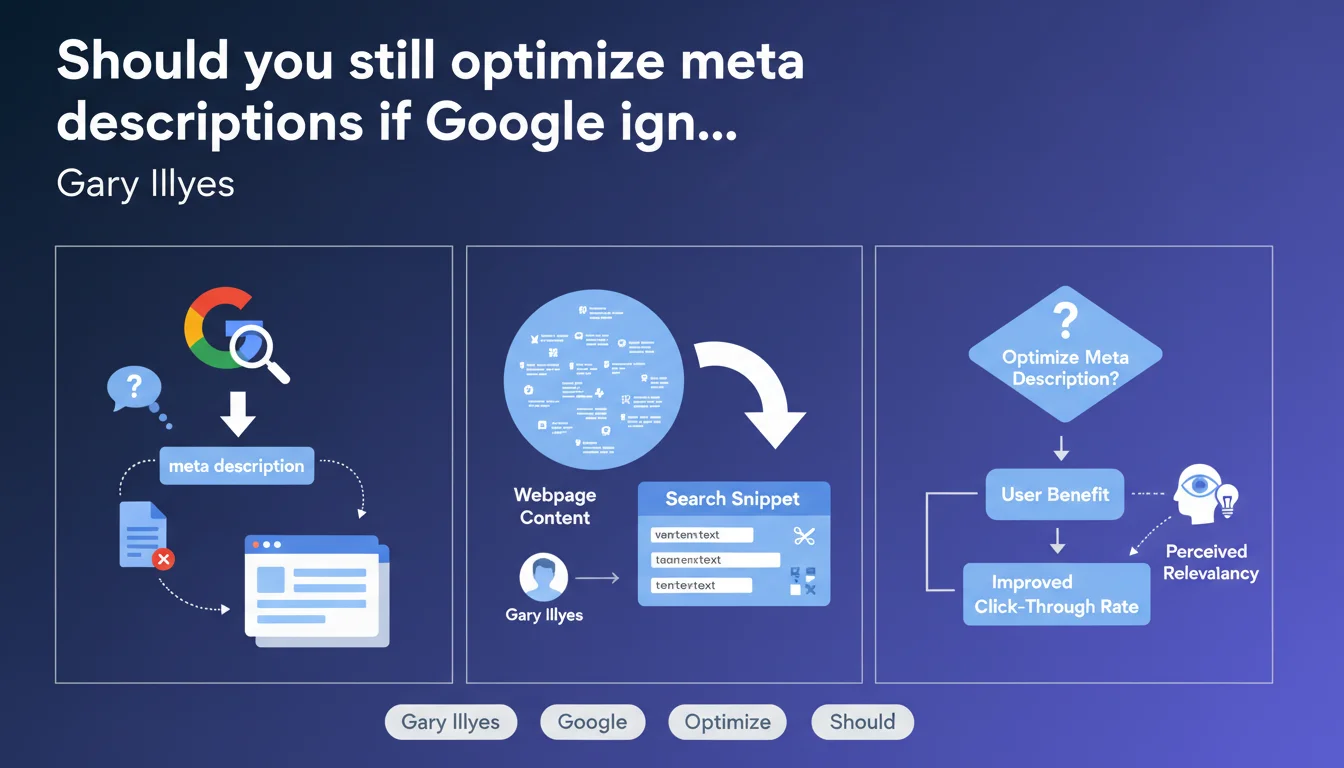
Google generates snippets by pulling content from anywhere on the page, with no obligation to respect the meta description you provide. In practice, the search engine can extract visible content, structured data tags, or even secondary text to compose what appears in the SERPs. Your meta description remains a signal, but it guarantees nothing.
What you need to understand
This statement from Gary Illyes confirms what many have observed for years: meta descriptions are not imperative directives for Google. The search engine takes what it wants, when it wants, where it wants on the page.
This is an important clarification because it puts to rest the misconception that a well-written meta description guarantees its display in search results.
Why does Google ignore the meta descriptions you provide?
Google prioritizes contextual relevance over your written description. If your meta description doesn't contain the keywords the user searched for, the engine will scan the page content to extract a passage that matches better.
It's a logic of dynamic personalization: the snippet can vary depending on the query, intent, and location. What you write in the meta description is just one suggestion among many possible sources.
What portions of text can Google extract?
Any visible or semi-visible textual content: body paragraphs, secondary headings, image captions, FAQ excerpts, even text in collapsed accordions. Google doesn't limit itself to immediately visible content.
Structured data tags (schema.org) can also influence what's displayed, particularly for rich snippets, but again, there's no absolute guarantee.
Does the meta description still serve a purpose?
Yes, but not as a directive. It remains a context signal for Google: it helps the engine understand what the page is about. If no passage in your content matches the query well, Google can fall back on it.
It also functions as a safety net. It's better to have one correctly written than none, or one auto-generated with truncated sentences.
- Google generates snippets dynamically, depending on the query and context.
- The meta description is not ignored, but it's not systematically respected either.
- The visible content of the page is the primary source for snippet extraction.
- No HTML tag guarantees exact display in the SERPs.
SEO Expert opinion
Is this statement consistent with what we observe in the field?
Completely. For years, tests have shown that Google modifies snippets in 60 to 70% of cases depending on the query. Meta descriptions are often replaced by excerpts from content that contain the exact search terms.
What's interesting is that Gary Illyes says it openly: there is no obligation to respect the meta description. This confirms that it was never a ranking factor, just a simple suggested presentation element.
What nuances should be added to this statement?
Google doesn't specify under what conditions it chooses to respect or ignore the meta description. Is it related to writing quality? Semantic relevance? Length? [To be verified]: no public data allows us to precisely quantify these criteria.
Another unclear point: what about pages with little visible content? If a page is essentially composed of images, videos, or forms, can Google systematically fall back on the meta description? The answer isn't clear.
In what cases is the meta description still displayed?
When it perfectly matches the user's query, when the page content is too technical or poorly structured to extract a readable passage from it, or when Google doesn't identify a better candidate.
In practice, for brand searches or very specific queries, the meta description has a better chance of being respected. But for generic or competitive queries, Google will almost always prefer a contextual excerpt.
Practical impact and recommendations
What should you concretely do with meta descriptions?
Continue to write them, but don't put all your eggs in that basket. They remain useful as a context signal and safety net. Write them in 150-160 characters, with the page's main keywords, and a call-to-action.
Most importantly, optimize the page content itself: structure it with clear subheadings, concise paragraphs, sentences that directly answer frequent questions. That's where Google will primarily pull from.
What errors should you avoid?
Don't duplicate meta descriptions across multiple pages. Google hates this, and if all your pages have the same description, it will systematically ignore them to generate its own snippets.
Also avoid descriptions that are too vague or generic like "Welcome to our site". They add nothing and will be systematically replaced. Be precise, concrete, user-focused.
How do you verify that your snippets are optimized?
Type strategic queries into Google and observe what appears. If the snippet matches neither your meta description nor a relevant passage from your content, your page lacks writing clarity.
Use Search Console to identify pages with low CTR: this is often a sign that the snippet generated by Google isn't attractive. In this case, revise both the meta description and visible content.
- Write unique meta descriptions for each important page
- Include main keywords in the first 150 characters
- Structure page content with clear H2/H3 subheadings
- Write short, readable paragraphs that are easy for Google to extract
- Monitor snippets displayed in SERPs for your strategic queries
- Analyze CTR in Search Console to detect ineffective snippets
The meta description remains an element worth refining, but it's not enough on its own. Snippet optimization requires comprehensive work on the structure, writing, and clarity of each page's content.
These adjustments require a methodical approach and continuous monitoring of display changes. If this fine-tuning seems complex or time-consuming, the support of a specialized SEO agency can help you structure a coherent strategy and maximize your visibility in search results.
❓ Frequently Asked Questions
Google affiche-t-il toujours un snippet même si je n'ai pas de meta description ?
Puis-je forcer Google à afficher exactement ma meta description ?
Les meta descriptions influencent-elles le classement dans les résultats ?
Quelle longueur est optimale pour une meta description ?
Faut-il mettre des mots-clés dans la meta description ?
🎥 From the same video 10
Other SEO insights extracted from this same Google Search Central video · published on 25/04/2024
🎥 Watch the full video on YouTube →
💬 Comments (0)
Be the first to comment.