
Official statement
Other statements from this video 10 ▾
- □ Should you still optimize meta descriptions if Google ignores them anyway?
- □ Is one backlink really all Google needs to discover and index your site?
- □ Do you still need rel=prev/next for pagination in 2024?
- □ Is boilerplate content really hurting your pages' search rankings?
- □ Is boilerplate really a threat to your search engine rankings?
- □ Are geolocation redirects killing your Google crawl?
- □ How does Google really determine user location for local SEO?
- □ Are IP geolocation databases really reliable enough for international SEO?
- □ Can Google really display rich results without schema markup?
- □ Should you configure the Content-Language header for PDFs and non-HTML files?
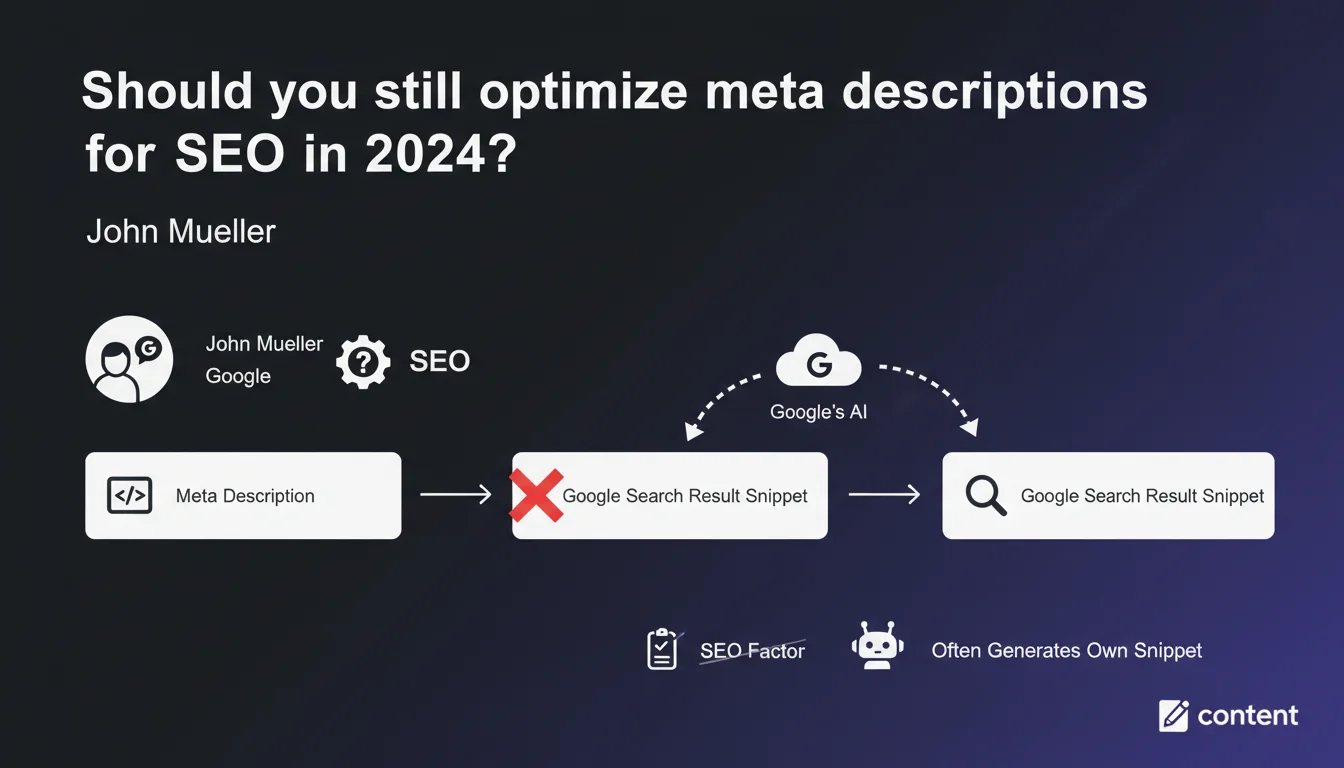
Google states that meta descriptions are not a major ranking factor and that its internal team places limited importance on them. The algorithm frequently generates its own snippets, making manual optimization less decisive than it once was. This doesn't mean you should completely neglect them either.
What you need to understand
Why does Google downplay the role of meta descriptions?
Google's position is consistent with its technical evolution. The algorithm now analyzes contextual content to generate dynamic excerpts tailored to each user's search query. A fixed meta description cannot compete with this personalization.
In practice, Google extracts the passages most relevant to search intent. Your manually written meta description will only appear if it perfectly matches the query — which happens less often than you might think.
Does this statement mean meta descriptions are useless?
No. Let's distinguish between ranking factor and conversion optimization. Google clearly states that meta descriptions don't influence algorithmic positioning. They remain visible in SERPs when Google decides to display them.
When they do appear, they play a role in your click-through rate — and CTR indirectly impacts your organic traffic. The weak signal becomes relevant at scale.
How does Google generate its own excerpts?
The algorithm scans the visible content of a page and identifies text segments that best match the search query terms. It prioritizes passages containing searched keywords and their immediate semantic context.
This process explains why you sometimes see excerpts that match neither your meta description nor your introduction — Google pulls from wherever it finds the most direct answer.
- Meta descriptions are not a direct ranking factor according to Google
- Google generates dynamic excerpts based on the user's query
- Google's own team doesn't systematically optimize its own meta descriptions
- The main impact remains the click-through rate in SERPs, not ranking
- A meta description may be displayed if it precisely matches search intent
SEO Expert opinion
Does this statement reflect what we actually observe in the field?
Yes and no. On high-volume sites, we do see Google ignoring 60 to 70% of manually written meta descriptions. Auto-generated snippets dominate, especially on long-tail queries where the algorithm favors exact matches.
However — and this is where it gets tricky — on competitive commercial queries, a well-written meta description that actually displays can shift CTR from 2% to 4%. At 100,000 monthly impressions, that's 2,000 additional clicks. Saying that's negligible would be dishonest.
What nuances should we add to this position?
Google speaks of its internal team as a reference, but their pages rarely target commercial intent. On transactional pages or high-value content, the stakes differ from technical documentation.
The statement conflates two dimensions: impact on algorithmic ranking (effectively zero) and impact on user behavior (measurable and sometimes significant). [To verify]: Google provides no data on average meta description display rates by page type.
In what cases does this rule become less relevant?
Homepage, product category pages, and e-commerce landing pages are notable exceptions. On these pages, message control has strategic value — you want your promise to appear, not a generic excerpt.
Likewise, on branded queries or pages with limited exploitable text content, Google more often falls back on the provided meta description. Context changes the equation.
Practical impact and recommendations
What should you do concretely with meta descriptions?
Adopt a selective and pragmatic approach. Focus your efforts on high-stakes pages: homepage, main categories, key commercial pages, landing pages. On these URLs, write meta descriptions oriented toward conversion with a clear call-to-action.
For the rest of your site — blog articles, low-volume product pages — don't waste time manually optimizing if you have thousands of pages. Ensure your CMS generates coherent automatic excerpts based on opening paragraphs.
What mistakes should you absolutely avoid?
Don't duplicate meta descriptions at scale. Google penalizes internal duplicate content, and hundreds of identical meta descriptions send a signal of low editorial quality.
Avoid meta descriptions that are too short (under 120 characters) or too long (over 160 characters) — Google will truncate or ignore them. And above all, don't keyword stuff: it does nothing for ranking and degrades snippet attractiveness.
How should you prioritize your optimization efforts?
Start with an audit of high-traffic pages. Identify those generating the most impressions in Search Console. Analyze their current CTR and compare it to the average for their ranking position. Abnormally low CTR on a position 2-3 signals an unattractive snippet.
Then test meta description variations on these strategic pages and measure CTR evolution over 4 to 6 weeks. This data-driven approach will tell you whether optimization is worth it on your specific site — because each industry has its own dynamics.
- Write meta descriptions only for strategic pages (homepage, categories, landing)
- Stick to 150-160 characters to avoid truncation
- Include a clear and differentiating call-to-action
- Check for duplication via Screaming Frog or Sitebulb
- Analyze CTR in Search Console to identify underperforming pages
- Test variations and measure impact over 4-6 weeks
- Automate generation for low-stakes pages via CMS
- Don't over-optimize: prioritize readability over keyword density
❓ Frequently Asked Questions
Les meta descriptions influencent-elles le classement Google ?
Pourquoi Google ignore-t-il souvent mes meta descriptions ?
Faut-il encore écrire des meta descriptions en 2024 ?
Quelle longueur idéale pour une meta description ?
Comment mesurer l'impact de mes meta descriptions ?
🎥 From the same video 10
Other SEO insights extracted from this same Google Search Central video · published on 25/04/2024
🎥 Watch the full video on YouTube →
💬 Comments (0)
Be the first to comment.