
Official statement
Other statements from this video 16 ▾
- □ Google attribue-t-il vraiment le même poids à tous vos backlinks ?
- □ L'emplacement des liens internes a-t-il vraiment un impact sur le SEO ?
- □ Google classe-t-il vraiment les sites dans des catégories fixes ?
- □ La cohérence NAP impacte-t-elle vraiment le référencement local ou seulement le Knowledge Graph ?
- □ Comment éviter que Google se trompe à cause d'informations conflictuelles entre votre site et votre profil d'établissement ?
- □ Les liens réciproques sont-ils vraiment sans risque pour votre SEO ?
- □ La fréquence des mots-clés influence-t-elle vraiment le classement Google ?
- □ Faut-il vraiment nettoyer TOUTES les pages hackées ou peut-on laisser Google faire le tri ?
- □ Pourquoi Google refuse-t-il d'indexer une partie de votre site même s'il est techniquement parfait ?
- □ Les emojis dans les balises title et meta description apportent-ils un avantage SEO ?
- □ L'API Search Console et l'interface affichent-elles vraiment les mêmes données ?
- □ Pourquoi vos FAQ n'apparaissent-elles pas en rich results malgré un balisage correct ?
- □ Faut-il vraiment réutiliser la même URL pour les pages saisonnières chaque année ?
- □ Les Core Web Vitals n'affectent-ils vraiment ni le crawl ni l'indexation ?
- □ Le TLD .edu booste-t-il vraiment votre référencement ?
- □ Les géo-redirects peuvent-ils réellement bloquer l'indexation de votre contenu ?
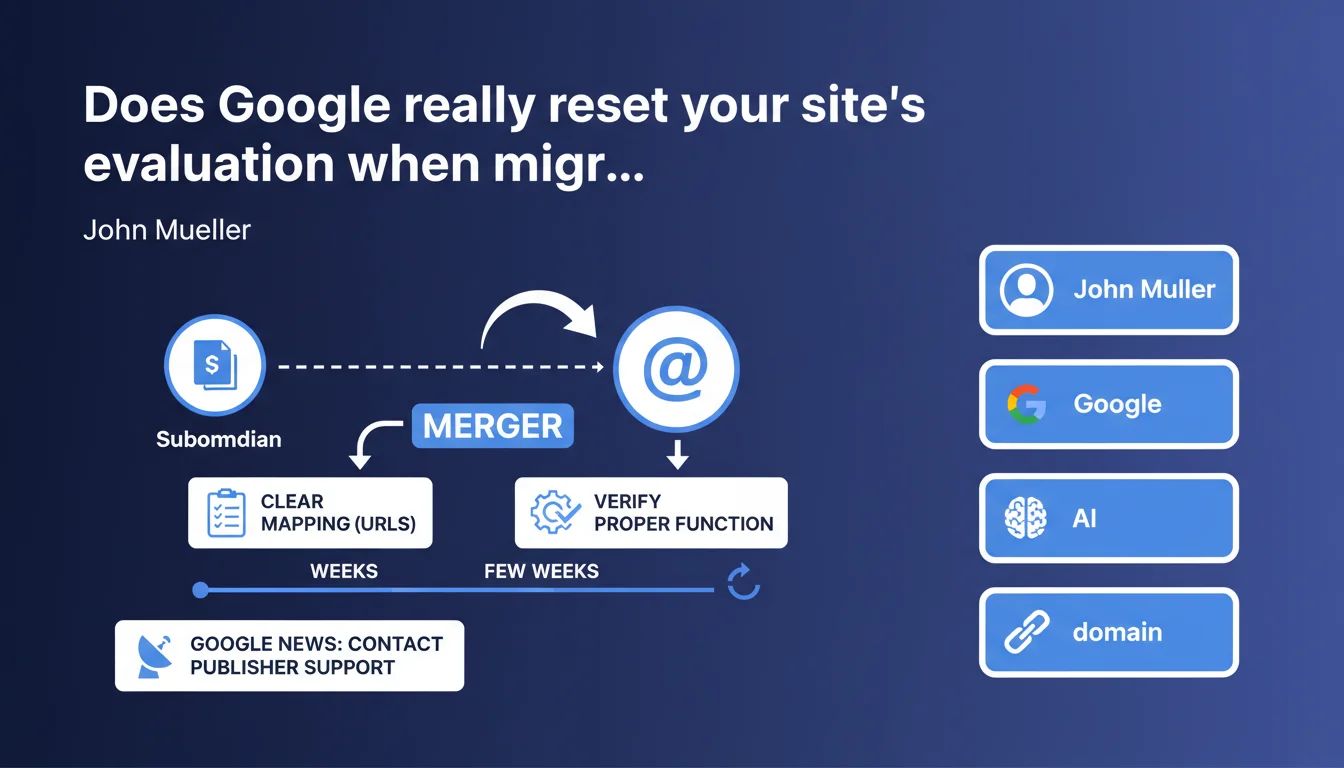
Google treats a subdomain to primary domain migration as a complete merger, requiring full site reevaluation. The process can take several weeks. Precise URL mapping and clean redirects are essential to avoid breaking your rankings.
What you need to understand
Why does a subdomain migration trigger a complete reevaluation?
When a site moves from a subdomain (ex: blog.example.com) to the primary domain (example.com/blog), Google doesn't treat it as a simple address change. It considers this a merger of two distinct entities.
A subdomain is technically perceived by Google as a separate site. Historically, it has its own authority metrics, its own crawl budget, its own quality evaluation. Merging this with the root domain forces the algorithm to recalculate all signals: internal links, link structure, depth, PageRank distribution.
What's the difference from a standard migration?
A standard migration (such as a domain name change) often preserves an equivalent structure and hierarchy. Google transfers signals by relying on 301 redirects.
Here, we're talking about an architectural redesign. URLs change structure, internal linking is rethought, content integrates differently in the main site's hierarchy. Google has to relearn everything.
How long does this reevaluation take?
Mueller mentions several weeks, which remains vague but consistent with real-world observations. In practice, this can range from 3 to 8 weeks depending on site size and crawl frequency.
The timeline also depends on mapping quality and bot responsiveness. A well-crawled site will recover faster. A site with redirect errors or multiple redirect chains can stagnate for months.
- Google treats subdomains and primary domains as two separate entities
- A migration triggers a complete merger and signal recalculation
- Estimated duration: several weeks, variable depending on the site
- Precise mapping and clean 301 redirects are essential
- Google News requires specific support contact
SEO Expert opinion
Is this statement consistent with observed real-world practices?
Yes, absolutely. We regularly observe temporary traffic drops during subdomain to primary domain migrations, even with flawless redirects. Mueller's described behavior matches real cases: SERP fluctuations, crawl budget readjustment, rankings stabilizing after 4 to 6 weeks.
What's missing from this statement: no mention of authority transfer. Does the subdomain transmit its "SEO juice" to the primary domain? Or is there partial loss? [To verify] — Google provides no clarity here, yet this is crucial for anticipating impact.
What underestimated risks can emerge during this migration?
The first trap: redirect chains. If the old subdomain already had complex internal redirects, the merger can create loops or lengthy paths. Google may lose patience and abandon certain URLs along the way.
Second problem: internal linking post-migration. Many SEOs focus on external redirects but neglect refactoring internal links to point to new URLs. Result: the site continues generating unnecessary redirects, diluting PageRank and slowing reindexing.
In what cases can this reevaluation be faster or slower?
Faster if: the primary domain has established strong authority, a high crawl budget, and the subdomain contained minimal content. Google integrates new URLs quickly because the primary domain is already well-known.
Slower if: the subdomain contained thousands of pages, with scattered external backlinks, or if the primary site's structure is disorganized. Google will take longer to crawl, index, and redistribute signals. E-commerce sites with blog subdomains are particularly exposed to these delays.
Practical impact and recommendations
What exactly must you do before and during the migration?
Before anything else, establish complete and exhaustive URL mapping from each subdomain URL to its new destination on the primary domain. No URL should be orphaned. Use a spreadsheet, verify each correspondence manually if necessary.
Next, implement permanent 301 redirects at the server level (not JavaScript, not meta refresh). Test each redirect individually with a crawler like Screaming Frog to detect chains, loops, or hidden 404s.
During migration: monitor Search Console daily. Check crawl evolution, crawl errors, indexed pages. If Google slows down or blocks, adjust the robots.txt file or crawl rate in Search Console.
What errors must you absolutely avoid?
Never bulk-redirect an entire subdomain to the primary domain's homepage. This is a classic mistake that destroys SEO. Google will interpret this as soft 404s, and you'll lose most of your authority.
Another trap: forgetting to update your XML sitemap. Submit a new sitemap including the new primary domain URLs, and remove the old subdomain sitemap once redirects are active.
Finally, don't neglect external backlinks. If possible, contact the main sites pointing to your subdomain to update links directly. The less you depend on redirects to transfer juice, the better.
How do you verify everything works after migration?
Crawl the primary domain with an SEO tool (Screaming Frog, Oncrawl, Botify). Verify that no old subdomain URLs still appear in internal linking. Track redirect chains and fix them immediately.
In Search Console, compare impressions and clicks before/after. A temporary drop is normal, but if it persists beyond 8 weeks, dig deeper: mapping issues, duplicate content, misconfigured canonicals.
- Establish complete and verifiable URL mapping
- Implement clean server-level 301 redirects
- Test each redirect with a crawler before deployment
- Submit a new XML sitemap to the primary domain
- Update internal linking to point to new URLs
- Monitor Search Console daily for 6 weeks
- Contact Google News support if the subdomain was indexed there
- Contact major external sites to update backlinks
❓ Frequently Asked Questions
Peut-on migrer un sous-domaine vers le domaine principal sans perdre de trafic ?
Faut-il conserver le sous-domaine actif après la migration ?
Quelle est la différence entre une migration sous-domaine et un changement de nom de domaine ?
Le sous-domaine transmet-il toute son autorité au domaine principal ?
Combien de temps garder les redirections 301 actives ?
🎥 From the same video 16
Other SEO insights extracted from this same Google Search Central video · published on 30/01/2022
🎥 Watch the full video on YouTube →
💬 Comments (0)
Be the first to comment.