
Official statement
Other statements from this video 16 ▾
- □ Google attribue-t-il vraiment le même poids à tous vos backlinks ?
- □ L'emplacement des liens internes a-t-il vraiment un impact sur le SEO ?
- □ Google classe-t-il vraiment les sites dans des catégories fixes ?
- □ La cohérence NAP impacte-t-elle vraiment le référencement local ou seulement le Knowledge Graph ?
- □ Comment éviter que Google se trompe à cause d'informations conflictuelles entre votre site et votre profil d'établissement ?
- □ Les liens réciproques sont-ils vraiment sans risque pour votre SEO ?
- □ La fréquence des mots-clés influence-t-elle vraiment le classement Google ?
- □ Faut-il vraiment nettoyer TOUTES les pages hackées ou peut-on laisser Google faire le tri ?
- □ Pourquoi Google refuse-t-il d'indexer une partie de votre site même s'il est techniquement parfait ?
- □ Les emojis dans les balises title et meta description apportent-ils un avantage SEO ?
- □ L'API Search Console et l'interface affichent-elles vraiment les mêmes données ?
- □ Pourquoi vos FAQ n'apparaissent-elles pas en rich results malgré un balisage correct ?
- □ Faut-il vraiment réutiliser la même URL pour les pages saisonnières chaque année ?
- □ Pourquoi Google réinitialise-t-il l'évaluation d'un site lors d'une migration de sous-domaine vers domaine principal ?
- □ Le TLD .edu booste-t-il vraiment votre référencement ?
- □ Les géo-redirects peuvent-ils réellement bloquer l'indexation de votre contenu ?
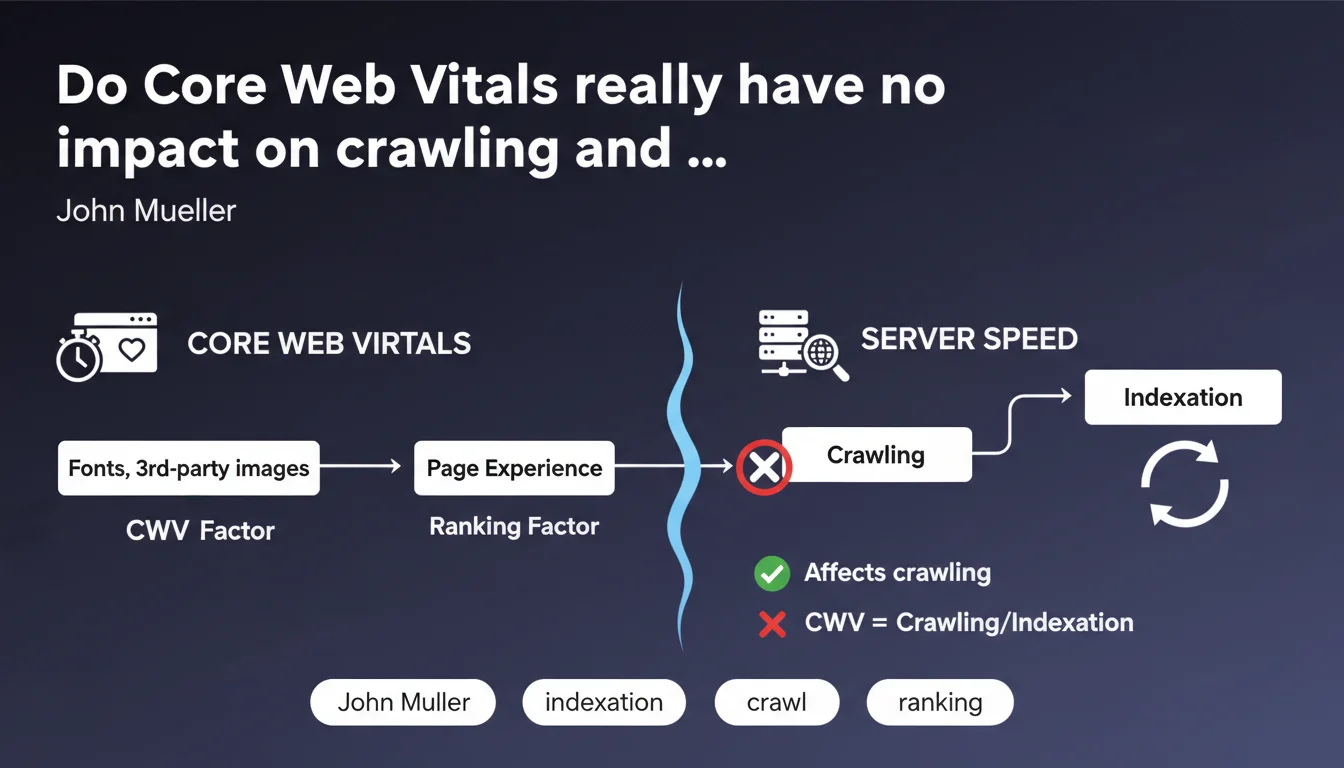
Google confirms that Core Web Vitals are a ranking factor for Page Experience, not an intrinsic quality criterion. They have no impact on crawling or indexation — only server speed can affect crawl budget. This distinction radically changes how you should prioritize technical optimizations.
What you need to understand
What's the difference between a ranking factor and a quality factor?
Google clearly distinguishes quality factors (content, expertise, relevance) from user experience factors like Core Web Vitals. A site can have excellent CWV and mediocre content — it won't rank anyway.
CWV influence ranking only within the context of Page Experience, one signal among many. Concretely: two pages of equivalent quality, the one with better CWV will have a slight advantage. But a slow page with exceptional content will always beat a fast page with bland content.
Why don't CWV affect crawling and indexation?
Core Web Vitals measure end-user experience: perceived load time, visual stability, interactivity. They include elements like web fonts, third-party images, client-side JavaScript.
Crawling, on the other hand, only cares about fetching raw HTML. Googlebot doesn't wait for your webfonts to load or your third-party image carousel to initialize. What matters for crawling: the speed at which the server responds to the bot, the page generation time on the server side.
What actually impacts crawling?
Server speed (TTFB, server response time) is the only performance element that affects crawl budget. If your server takes 2 seconds to generate a page, Googlebot will crawl fewer URLs per session.
Other factors that influence crawling: site architecture, internal linking, 5xx errors, server stability. CWV don't figure anywhere in this equation.
- Ranking factor: CWV influence ranking via Page Experience, a minor signal
- Not a quality factor: a fast site with poor content doesn't outrank a slow site with excellent content
- No impact on crawling/indexation: only server speed (TTFB) can affect crawl budget
- Critical distinction: CWV = frontend user experience (fonts, third-party images) vs server speed = backend performance
SEO Expert opinion
Does this statement contradict practices observed in the field?
No, and that's precisely why this reminder is necessary. Too many SEO practitioners have over-invested in CWV optimization thinking it was the priority ranking factor. Field observations show that a site with average CWV but exceptional content consistently outperforms a fast but hollow site.
The nuance to add: on ultra-competitive queries where content quality is comparable, CWV can make the difference. But in 80% of cases, the energy spent squeezing 10ms of LCP would be better invested in content improvement or internal linking.
Why does Google insist on this distinction?
Because the SEO industry over-reacted to the Page Experience launch in 2021. Measurement tools (PageSpeed Insights, Lighthouse) created an obsession with green scores — when Google never said a score of 100 was necessary.
This statement sets the record straight: optimize CWV for your users, not for Googlebot. If your site is indexed, it's crawlable. If your pages are slow, it won't prevent Google from crawling them — but it will drive your visitors away, which will ultimately impact your engagement metrics and thus your SEO indirectly.
When should you prioritize CWV anyway?
Three scenarios where CWV deserve immediate attention: e-commerce sites where every 100ms of latency costs conversion rate, news sites in direct competition on the same topics, and mobile sites where degraded user experience generates massive pogo-sticking.
[To verify]: Google claims that CWV don't affect indexation, but we lack data on indirect impact. A site with catastrophic CWV generates negative engagement signals (time spent, bounce rate) that can influence ranking. The line isn't as clear as it seems.
Practical impact and recommendations
How to prioritize performance optimizations?
First rule: diagnose before optimizing. If your issue is insufficient crawling, measure TTFB and server stability, not LCP. If your issue is low ranking, audit content and backlinks first before diving into CWV optimization.
Second rule: distinguish backend optimizations (server cache, compression, CDN, database optimization) from frontend optimizations (lazy loading, image optimization, defer JavaScript). The former impact crawling, the latter only user experience.
What if your CWV are in the red?
Let's be honest: catastrophic CWV often signal structural problems — undersized hosting, obsolete tech stack, uncontrolled third-party resources. But don't panic over a PageSpeed score of 60 if your users are satisfied and conversions are on target.
Prioritize quick wins: image compression, browser caching, removal of unnecessary third-party scripts. Ignore marginal optimizations that require a complete overhaul to gain 5% performance.
What mistakes should you absolutely avoid?
Mistake #1: sacrificing functionality for a green score. I've seen sites remove essential features (support chat, personalized recommendations) just to improve LCP. Absurd.
Mistake #2: optimizing CWV before solving crawling/indexation problems. If Google only indexes 40% of your pages, the issue isn't your Cumulative Layout Shift.
- Measure TTFB and server speed if you have crawl budget problems
- Audit content and authority before heavily investing in CWV
- Distinguish backend optimizations (impact crawling) from frontend (impact UX/minor ranking)
- Prioritize quick wins CWV rather than aim for perfect score
- Never sacrifice functionality or content quality for performance
- Monitor real engagement metrics, not just Lighthouse scores
❓ Frequently Asked Questions
Les Core Web Vitals peuvent-ils empêcher l'indexation d'une page ?
Dois-je atteindre un score PageSpeed de 90+ pour bien ranker ?
Quelle est la différence entre vitesse serveur et Core Web Vitals ?
Les images tierces et webfonts ralentissent-elles le crawl de Google ?
Dans quel ordre prioriser les optimisations SEO ?
🎥 From the same video 16
Other SEO insights extracted from this same Google Search Central video · published on 30/01/2022
🎥 Watch the full video on YouTube →
💬 Comments (0)
Be the first to comment.