
Official statement
What you need to understand
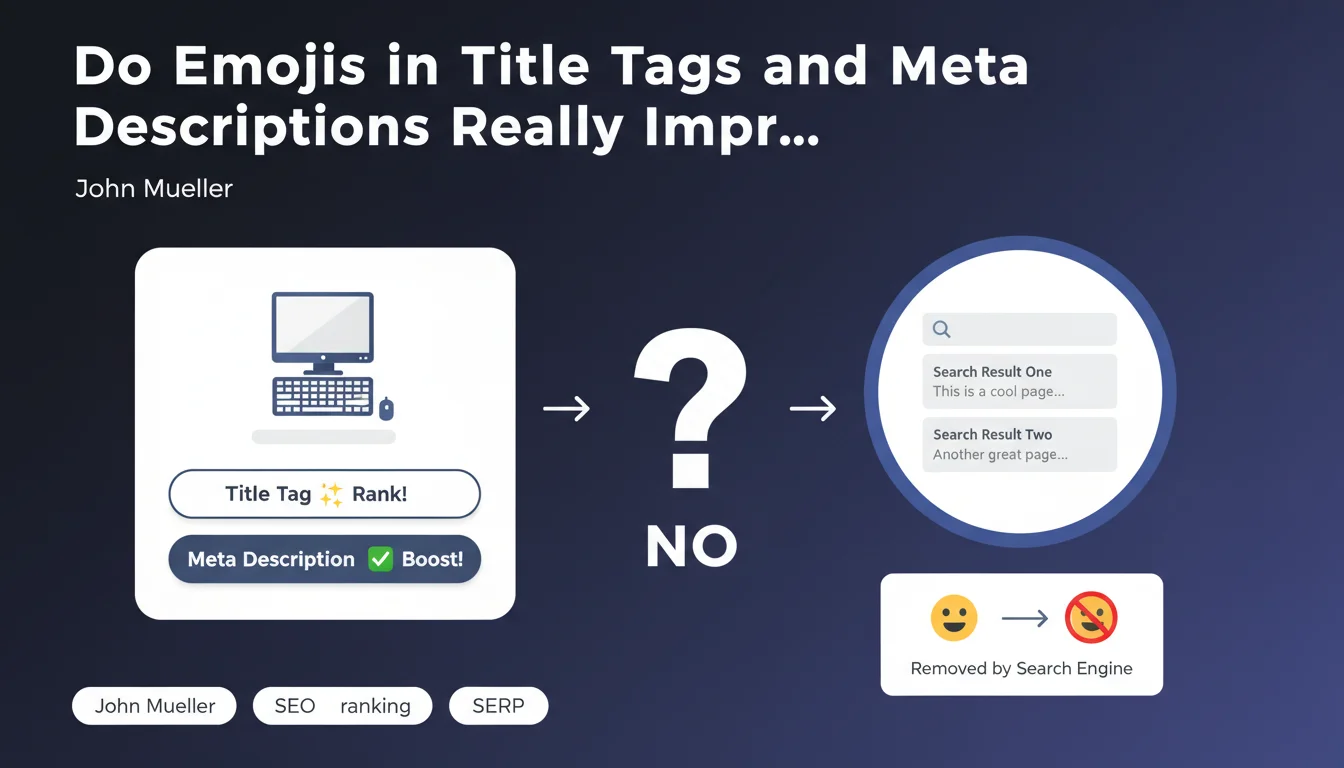
Google has officially clarified its position regarding the use of emojis in Title tags and meta descriptions. Contrary to a widespread belief, these special characters provide no advantage in terms of ranking in search results.
The search engine actually applies an automatic filtering system that removes the majority of these emojis before displaying them in the SERPs. This practice aims to maintain visual consistency and avoid overly aggressive manipulation of snippets.
Although some emojis still occasionally manage to pass through Google's filters, their appearance remains unpredictable and not guaranteed. This volatility makes their strategic use particularly risky for sustainable optimization.
- No positive impact on ranking: emojis are not a ranking factor
- Automatic filtering: Google removes most emojis before display
- Random appearance: even when used, they are not guaranteed to appear in the SERPs
- Risk of negative perception: the effect can appear cheap or unprofessional depending on the sector
SEO Expert opinion
Analysis of thousands of SERPs indeed confirms this official position. Emojis that still appear in results today are increasingly rare and unstable, as Google has progressively strengthened its filters over the years.
However, there is an important nuance concerning click-through rate. In certain very specific sectors (lifestyle, food, events), a well-chosen emoji that passes the filters could theoretically improve CTR. Nevertheless, this hypothetical benefit is largely offset by the risk of negative brand perception.
From a technical standpoint, relying on elements that Google actively filters represents a counterproductive time investment. Resources devoted to this optimization would be much better spent on factors that have a real and measurable impact.
Practical impact and recommendations
- Audit your existing tags: identify and remove all emojis present in your Title tags and meta descriptions
- Write optimized titles: favor impactful formulations with your main keywords at the beginning of the tag
- Work on your meta descriptions: create persuasive descriptions including a clear call to action without resorting to emojis
- Test power words: use words with strong emotional impact (free, exclusive, guaranteed, revealed) rather than emojis
- Leverage textual symbols: prefer standard characters (★, •, ✓, →) that pass filters better if necessary
- Segment by sector: adapt your approach according to the expected formality in your industry
- Measure actual CTR: analyze in Search Console the impact of your modifications on effective click-through rate
- Prioritize added value: focus on the value proposition rather than visual gimmicks
Optimizing Title tags and meta descriptions represents complex strategic work that goes far beyond the simple question of emojis. It requires a fine understanding of search intent, user psychology, and the specificities of your sector.
For companies managing large-scale sites or operating in competitive sectors, implementing a coherent and high-performing optimization strategy can quickly become time-consuming. Support from a specialized SEO agency provides access to in-depth expertise and proven methodology, while freeing your teams to focus on your core business.
💬 Comments (0)
Be the first to comment.