
Official statement
What you need to understand
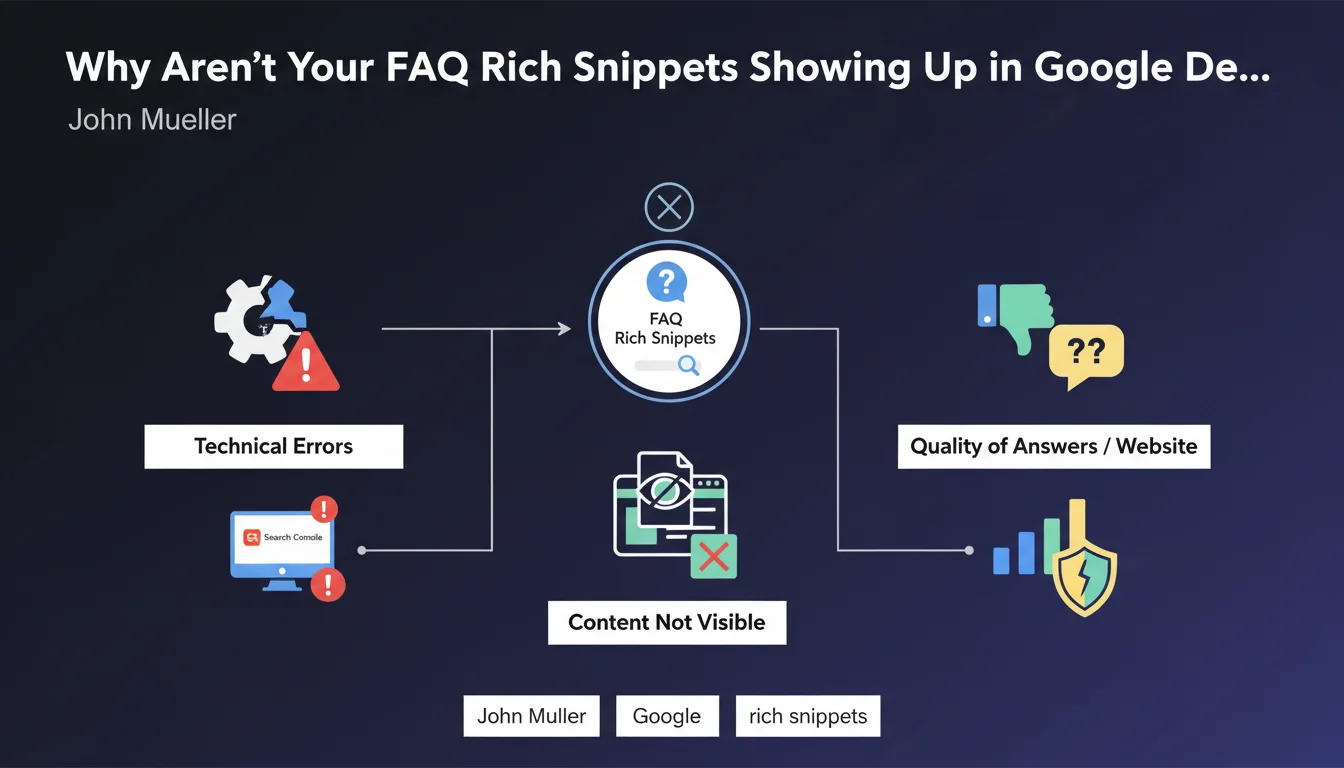
Google has clarified the three main reasons why FAQPage markup may be ignored in search results, even when it appears correctly implemented.
The first reason concerns technical implementation errors. These errors are generally detectable via Search Console, which will alert you to syntax or structural problems in the JSON-LD or Microdata code.
The second reason relates to compliance with content recommendations. Google particularly insists that all marked-up questions and answers must be visible to the user on the page. Hidden content or content accessible only after interaction will be considered non-compliant.
The third reason, more subjective, concerns the quality and reliability of the source. Google evaluates whether the site and the answers provided deserve sufficient trust to be displayed in an enhanced position in the SERPs.
- Technical validation: mandatory verification via Search Console
- Content visibility: questions and answers directly accessible to the user
- Site E-E-A-T: evaluation of the source's credibility and authority
- Additional factors: other undisclosed criteria influence display
SEO Expert opinion
This explanation from Google is consistent with field observations, but it only tells part of the story. Indeed, many sites that scrupulously respect these three criteria never see their FAQ markup displayed in the SERPs.
Based on my experience, several undocumented additional factors come into play. Competition for the query, the type of search intent, the presence of other priority rich snippets, and even the thematic category of the site can influence display. Google also seems to apply implicit quotas per domain or per content type.
It is also important to note that Google regularly modifies its display policies for rich snippets according to verticals. Some sectors have seen their FAQs disappear massively following algorithmic updates, regardless of technical compliance.
Practical impact and recommendations
- Systematically validate your FAQ markup via Search Console and Google's Rich Results Test tool
- Immediately correct all reported technical errors, even minor ones
- Ensure that 100% of marked-up content is visible directly on the page, without clicking or excessive scrolling
- Avoid generic FAQs: favor specific, detailed questions that provide real added value
- Write complete answers (minimum 200-300 characters) that demonstrate real expertise
- Don't over-markup: limit to 5-10 genuinely relevant questions per page maximum
- Strengthen E-E-A-T signals: expert author mentions, cited sources, regular content updates
- Monitor display in SERPs with rank tracking tools that include SERP features
- Test different question formulations to match actual user queries
- Don't rely solely on FAQs: diversify structured data types (HowTo, Article, etc.)
The optimal implementation of structured data requires sharp technical expertise combined with a fine understanding of Google's algorithms. Between code validation, semantic content auditing, domain authority building, and performance monitoring, the process can prove time-consuming and complex.
For businesses wishing to maximize their chances of obtaining rich results without mobilizing significant internal resources, support from an SEO agency specialized in structured data enables faster compliance and avoids costly mistakes. External expert insight also provides strategic vision on the most relevant rich snippet opportunities according to your industry sector.
💬 Comments (0)
Be the first to comment.