
Official statement
Other statements from this video 13 ▾
- □ Should you really master technical SEO before producing content?
- □ Is Google Search Console really enough to catch all your technical SEO problems?
- □ Why should e-commerce product titles absolutely contain the brand name and color?
- □ Are structured data really essential for Google to properly understand your pages?
- □ Should you really keep out-of-stock product pages indexed?
- □ Should you really create specific content for every step of the buyer's journey?
- □ Should you really create a unique URL for every product variant?
- □ Should you really describe every product variant in your canonical page?
- □ Is user experience really a decisive ranking factor at Google?
- □ Why does PageSpeed Insights combine real-world data with lab testing to measure performance?
- □ Why does SEO really take several months to deliver measurable results?
- □ Is buying backlinks really destroying your SEO, or is Google's stance on paid links more nuanced than we think?
- □ Is 'the best possible content' really Google's strategic compass, or just clever marketing spin?
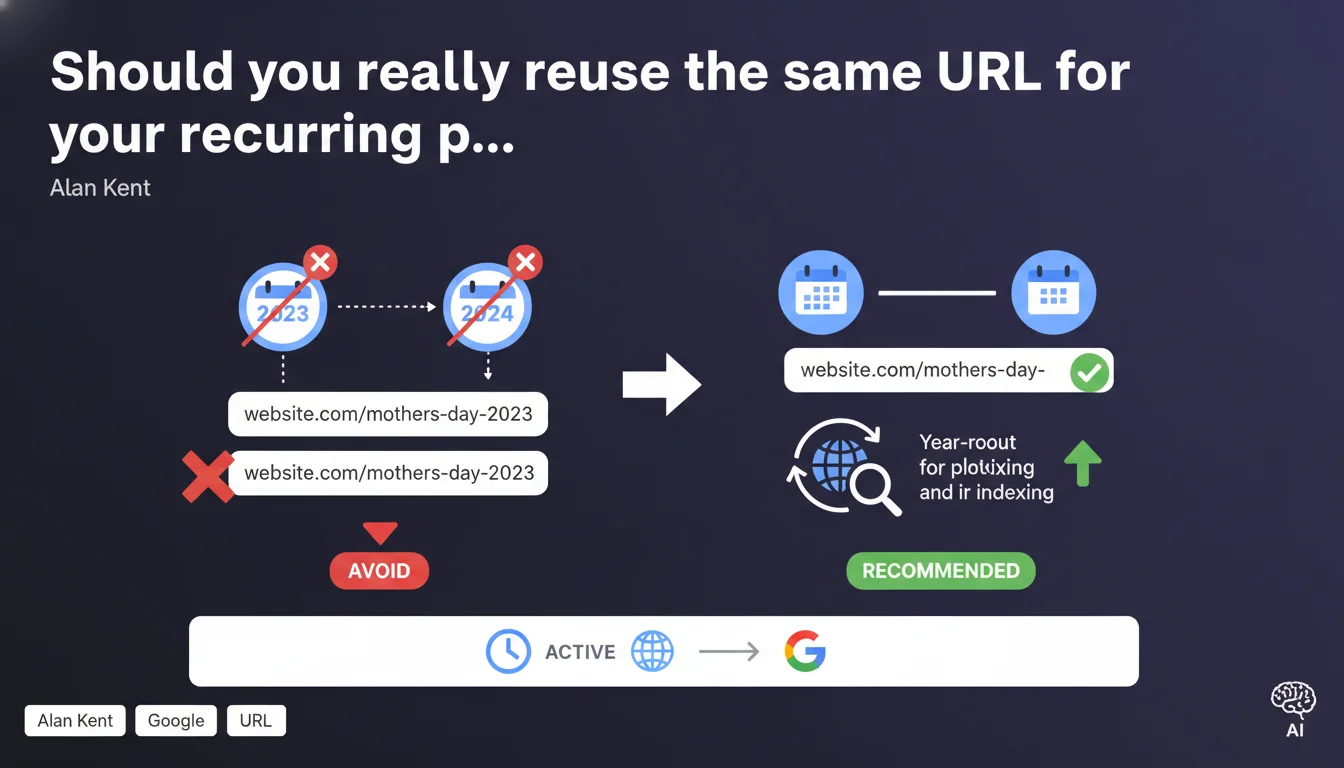
Google recommends keeping the same URL for promotional events that return each year (Mother's Day, Black Friday, sales). No year in the path, page stays active permanently, even outside promotional periods. The goal: capitalize on SEO history rather than starting from scratch with each edition.
What you need to understand
Why does Google insist on reusing URLs for recurring events?
The logic is straightforward: each new URL starts from zero in Google's index. No signal history, no inherited authority, no accumulated backlinks. For an event that returns every year, that's wasteful.
By keeping the same URL year after year, you capitalize on accumulated SEO signals: inbound links, content age, click history, engagement rates. Google doesn't have to relearn that this page exists and deserves to rank.
What does it concretely mean to "keep the page active year-round"?
Alan Kent clarifies that you shouldn't disable or return a 404 for the page between editions. Even outside the promotional period, the page must remain accessible and indexable.
This doesn't mean displaying an outdated offer. You can adapt the content — announce the next edition, offer a countdown, redirect to a newsletter. The key is that the URL remains live and crawlable.
Is the year in the URL really problematic?
Yes, and it's the classic pitfall. A URL like /black-friday-2023/ becomes outdated by January. If you then create /black-friday-2024/, you start over from zero on the SEO front.
Google has to rediscover the page, re-evaluate its relevance, rebuild signals. Meanwhile, your competitors who kept /black-friday/ already have an advantage.
- Reuse the same URL for each edition of a recurring event (Mother's Day, sales, Black Friday)
- Exclude the year from the URL path to avoid programmed obsolescence
- Keep the page active year-round, even outside promotional periods, to preserve indexation and accumulated SEO signals
- Capitalize on history: backlinks, age, user signals accumulated year after year
SEO Expert opinion
Is this recommendation consistent with observed practices?
In practice, sites that apply this principle actually see a measurable SEO advantage. A stable URL for a recurring event ranks more easily, faster, and maintains its positions from year to year.
The classic pitfall remains rigid e-commerce architectures that automatically generate year-stamped URLs. Many platforms do this by default — and you often need to manually intervene to break this pattern.
What nuances should be applied to this rule?
Caution: this logic applies to strictly recurring promotional events. If your event changes dramatically in nature, target audience, or products from year to year, the rule may not hold.
Concrete example: a music festival that keeps the same name but completely changes its lineup each year could justify distinct URLs — especially if users search for information specific to a past edition.
Another nuance: how to manage content outside season? Google provides no specific directive. Should you leave the old offer visible with a "previous edition" mention? Display a teaser for next year? Offer newsletter signup? [To verify]: no official data on the SEO impact of these different strategies.
In what cases does this rule not apply?
If you offer retrospective content with documentary value — for example, an annual review or year-specific ranking — it's legitimate to create a new URL each year. The year then becomes part of the topic, not just the promotional cycle.
Same for unique events disguised as recurring ones. If you launch "back-to-school week" for the first time and aren't certain you'll repeat it, a neutral URL you can recycle if needed is better than a year-stamped one.
Practical impact and recommendations
What should you do concretely if you already have year-stamped URLs?
First step: audit your existing event URLs. Identify those containing a year in the path that correspond to recurring events.
Second step: choose your reference URL. If you have /mothers-day-2022/, /mothers-day-2023/, /mothers-day-2024/, consolidate to /mothers-day/. Set up permanent 301 redirects from all old versions to the new canonical URL.
Third step: update internal links, sitemaps, canonical tags, hreflang if multilingual. Verify that backlinks point to the right URL — or are redirected properly.
What errors should you avoid during this consolidation?
Never abruptly remove old URLs without redirecting. You'd lose all accumulated signals and create unnecessary 404 errors.
Also avoid redirect chains. If /mothers-day-2022/ redirects to /mothers-day-2023/ which itself redirects to /mothers-day/, you dilute PageRank and slow down crawling. All old URLs should redirect directly to the final URL.
Another pitfall: leaving internal links pointing to old URLs. That's a waste of crawl budget and sends contradictory signals. Clean up your internal linking after the migration.
How should you manage page content outside the promotional season?
Several strategies are possible. You can display a countdown to the next edition, offer signup to be alerted, or temporarily redirect to a relevant product category.
The key: never return a 404 or deindex the page. Google must be able to crawl the URL permanently, even if content changes seasonally.
- Audit all event URLs containing a year in the path
- Choose a canonical URL without year-stamp (ex:
/black-friday/) - Set up permanent 301 redirects from old versions
- Clean up internal linking to point to the new URL
- Keep the page active year-round, even outside promotional periods
- Verify backlinks are redirected properly
- Update sitemaps, canonical tags, hreflang if applicable
- Avoid redirect chains — always redirect directly to the final URL
❓ Frequently Asked Questions
Que faire si mon CMS génère automatiquement des URLs avec l'année ?
Puis-je garder les anciennes URLs millésimées en ligne avec des redirections temporaires 302 ?
Faut-il mettre à jour le contenu de la page entre deux éditions de l'événement ?
Cette règle s'applique-t-elle aussi aux landing pages PPC pour événements récurrents ?
Comment gérer les backlinks pointant vers les anciennes URLs millésimées ?
🎥 From the same video 13
Other SEO insights extracted from this same Google Search Central video · published on 29/06/2022
🎥 Watch the full video on YouTube →
💬 Comments (0)
Be the first to comment.