
Official statement
Other statements from this video 13 ▾
- □ Faut-il vraiment maîtriser la technique SEO avant de produire du contenu ?
- □ La Search Console suffit-elle vraiment pour détecter tous les problèmes techniques SEO ?
- □ Pourquoi les titres de produits e-commerce doivent-ils impérativement contenir la marque et la couleur ?
- □ Les données structurées sont-elles vraiment indispensables pour que Google comprenne vos pages ?
- □ Faut-il vraiment garder les pages de produits en rupture de stock indexées ?
- □ Faut-il vraiment créer du contenu spécifique pour chaque étape du parcours d'achat ?
- □ Faut-il vraiment décrire toutes les variantes produit dans la page canonique ?
- □ Faut-il vraiment réutiliser la même URL pour vos événements promotionnels récurrents ?
- □ L'expérience utilisateur est-elle vraiment un facteur de classement déterminant chez Google ?
- □ Pourquoi PageSpeed Insights combine-t-il données terrain et tests en laboratoire ?
- □ Pourquoi le SEO met-il vraiment plusieurs mois à produire des résultats ?
- □ Pourquoi Google considère-t-il tous les liens payants comme artificiels et dangereux pour votre SEO ?
- □ Le « meilleur contenu possible » : vrai cap stratégique ou paravent marketing de Google ?
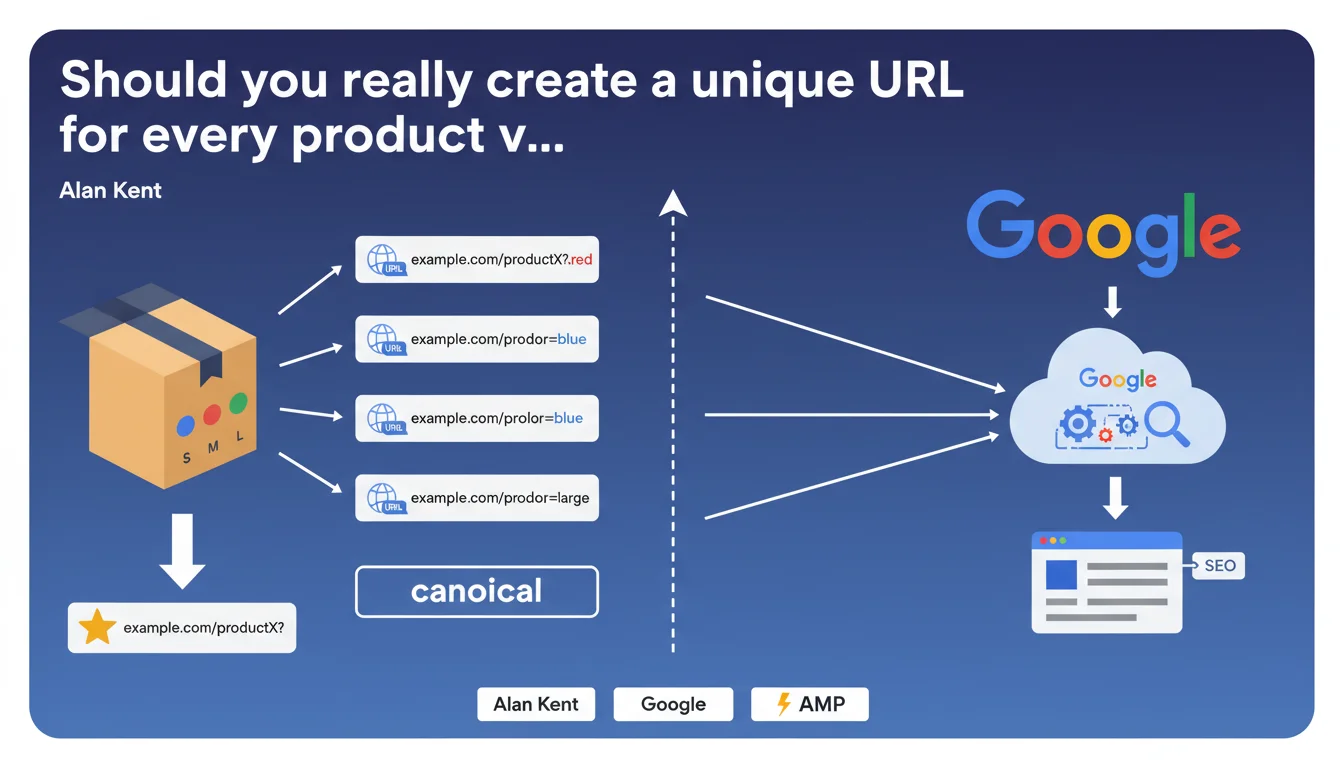
Google requires each product variant (color, size) to have a distinct URL, with query parameters if necessary. One variant should be designated as canonical, and all others should point to it via the canonical tag. This structure helps Google understand the relationships between variants without creating duplicate content.
What you need to understand
Why does Google require distinct URLs for each variant?
Google needs to crawl individual URLs to understand that multiple versions of the same product exist. Without a distinct URL, the search engine cannot index different options or properly associate search signals (user queries, backlinks) with the correct variant.
Concretely? If a user searches for "red t-shirt XL" and your site only offers a single URL for all variants, Google cannot determine which version to display. Distinct URLs also allow you to track the performance of each variant in Search Console.
How do you structure these URLs without creating duplicate content?
The classic pitfall: creating distinct URLs mechanically generates similar content. The solution relies on the canonical tag. You designate one variant as primary (often the best-seller or most generic) as canonical, and all others point to it.
This approach tells Google: "These pages exist and are crawlable, but consolidate SEO signals on the canonical version." Result — you avoid dilution while maintaining the necessary granularity.
What's the difference between query parameters and standard URLs?
Alan Kent explicitly mentions query parameters (e.g., ?color=red&size=xl). This is the simplest technical method: a single page with JavaScript that adapts content based on parameters.
The alternative — URLs like /red-t-shirt-xl — also works, but complicates management (explosive page growth, catalog maintenance). Parameters remain more flexible for sites with numerous combinations.
- Each variant must have a distinct and crawlable URL
- One variant is designated as canonical (primary reference)
- All non-canonical variants include a
rel="canonical"tag pointing to the canonical - Query parameters are a valid and recommended method
- This structure helps Google understand variant relationships without duplicating SEO signals
SEO Expert opinion
Is this recommendation consistent with real-world practices?
Yes, but with a significant nuance: many high-performing e-commerce sites use a JavaScript approach without distinct URLs — and perform very well. Amazon, for example, doesn't systematically create one URL per color variant.
The reality? Google is increasingly better at interpreting variant selectors in JS, especially with well-structured Product data. Alan Kent's recommendation remains valid for ensuring optimal understanding, but it's not the only viable path. [To verify] depending on your variant volume and technical architecture.
What are the risks of not following this recommendation strictly?
The main danger — Google might not correctly associate long-tail queries ("blue running shoe size 42") with your products if everything is handled in JavaScript without distinct URLs. You also lose granularity in Search Console: impossible to know which variant performs.
But let's be honest: if your structured data is solid and your JS is crawlable, the impact remains moderate for many catalogs. It's especially critical for sites with highly differentiated variants (technical products, high-end fashion) where each variation has its own audience.
When can you deviate from this rule?
If you have a catalog with tens of thousands of possible combinations (size × color × material × cut), creating one URL per variant becomes unmanageable. In this case, a hybrid approach works better: distinct URLs for main variants (popular colors), JS management for secondary variations.
Another exception — ultra-customizable products (car configurators, custom furniture). There, pre-generating everything is impossible. The key is ensuring the main page is well-indexed with comprehensive structured data.
Practical impact and recommendations
What do you need to do concretely on your e-commerce site?
First, audit your current architecture. Do your variants have distinct URLs? If yes, are they crawlable (no robots.txt blocking, no noindex)? Next, verify that each non-canonical variant points to the correct canonical.
If you're starting fresh or redesigning your site, prioritize query parameters for their flexibility. Example: /product-123?color=red&size=m. Configure your CMS so the default variant (often the first color, size M) is canonical, and all others point to it.
How do you manage canonicals without creating chaos?
The rule — one canonical tag per page, always as <link rel="canonical"> in the <head>. Never both in HTTP header AND HTML tag simultaneously, that creates conflicts. If you use query parameters, the canonical should be the URL without parameters or with default parameters.
Test with Google Search Console: submit a few variant URLs and check the "URL Inspection" tab to verify Google recognizes the declared canonical correctly. If Google chooses a different one, there's a consistency problem (contradictory tags, redirects, mixed signals).
What mistakes must you absolutely avoid?
Don't create circular canonicals (variant A points to B which points to A). Don't make all variants point to a category page — the canonical must be a variant of the same product.
Another common trap: generating variant URLs without unique content. If all your variants display exactly the same text (description, identical images), Google might consider it spam. At minimum, vary the images, page titles, and structured data to reflect each variation's specificity.
- Create distinct URLs for each variant (query parameters recommended)
- Designate a canonical variant (the best-seller or most generic)
- Implement the
rel="canonical"tag on all non-canonical variants - Verify that variant URLs are crawlable (no noindex, no robots.txt blocking)
- Fill in Product structured data with specific attributes of each variant
- Test in Search Console that Google recognizes the declared canonical correctly
- Avoid circular canonicals or those pointing to category pages
- Vary content (images, titles) between variants to avoid pure duplication
❓ Frequently Asked Questions
Peut-on utiliser des URLs en #ancre pour les variantes au lieu de paramètres de requête ?
Faut-il créer une sitemap XML pour toutes les URLs de variantes ?
Que se passe-t-il si Google choisit une canonique différente de celle déclarée ?
Les données structurées Product doivent-elles être dupliquées sur chaque variante ?
Comment gérer les variantes en rupture de stock dans cette architecture ?
🎥 From the same video 13
Other SEO insights extracted from this same Google Search Central video · published on 29/06/2022
🎥 Watch the full video on YouTube →
💬 Comments (0)
Be the first to comment.