
Official statement
Other statements from this video 13 ▾
- □ Is Google Search Console really enough to catch all your technical SEO problems?
- □ Why should e-commerce product titles absolutely contain the brand name and color?
- □ Are structured data really essential for Google to properly understand your pages?
- □ Should you really keep out-of-stock product pages indexed?
- □ Should you really create specific content for every step of the buyer's journey?
- □ Should you really create a unique URL for every product variant?
- □ Should you really describe every product variant in your canonical page?
- □ Should you really reuse the same URL for your recurring promotional events?
- □ Is user experience really a decisive ranking factor at Google?
- □ Why does PageSpeed Insights combine real-world data with lab testing to measure performance?
- □ Why does SEO really take several months to deliver measurable results?
- □ Is buying backlinks really destroying your SEO, or is Google's stance on paid links more nuanced than we think?
- □ Is 'the best possible content' really Google's strategic compass, or just clever marketing spin?
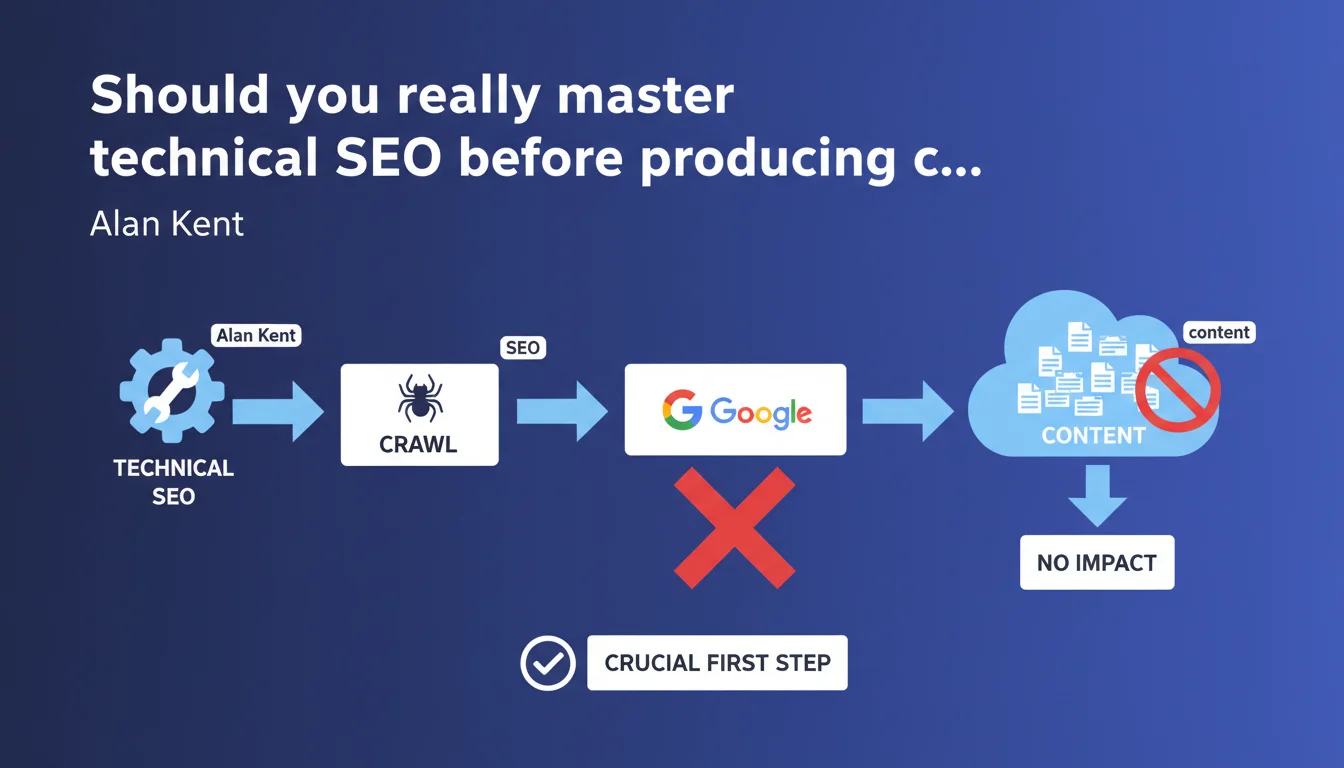
Google, via Alan Kent, hammers home that technical foundations must be solid before any investment in content. An uncrawlable site renders your best articles invisible — and this editorial investment becomes a money pit.
What you need to understand
Why does Google insist on technical priority?
The logic is straightforward: content that is unexplorable by Googlebot is content that does not exist in the index. No matter how well-written it is, how semantically deep it goes, or how relevant it may be — if the bot cannot read it, the site remains invisible.
This statement reframes priorities. Too many SEO strategies start with massive content production without verifying that the technical infrastructure allows it to be indexed. The result? Wasted editorial budgets, missed deadlines, and disastrous ROI.
Which technical aspects are considered "essential"?
Google does not explicitly detail all the levers, but we can reasonably include: crawl budget, URL accessibility (absence of redirect chains, 3xx/4xx loops), mobile compatibility, robots.txt structure, and XML sitemap management.
Site architecture also plays a decisive role: excessive click depth or chaotic internal linking slows down or blocks the discovery of new pages.
Is this stance new from Google?
No, it is a reminder. Google has repeated this hierarchy for years, but the proliferation of headless CMS platforms, client-side JavaScript architectures, and hybrid websites makes the subject more critical than before.
What is changing is the emphasis on frustration: too many teams invest in content without prior technical audit, then blame Google for "not indexing correctly." The message is clear — the problem is rarely on the search engine side.
- Crawl is a limited resource: Google will not indefinitely explore a poorly configured site.
- Indexation is conditioned by accessibility: robots.txt, redirects, server errors block everything.
- Technical SEO is a prerequisite, not an option: no content strategy compensates for an uncrawlable site.
- Teams must audit before producing: the sequence "technical audit → production" must be respected.
SEO Expert opinion
Is this statement consistent with field observations?
Yes, absolutely. Technically deficient sites accumulate orphaned pages, indexed duplicate content, and a plummeting crawl rate. We regularly observe situations where 50 to 70% of produced content is never indexed due to lack of accessibility.
However, Google remains vague about the definition of "mastering technical aspects." What makes a site "technically ready"? At what performance threshold (Core Web Vitals) becomes blocking? [To be verified] — no precise metric is provided here.
What nuances should be added to this assertion?
Beware of falling into paralyzing technical perfectionism. A 100% "perfect" site technically but without relevant content will not rank either. Balance is key: aim for a solid technical foundation, not a utopia of 100/100 on all tools.
Furthermore, not all sites are equal. A small WordPress blog with 50 pages does not face the same crawl budget challenges as a marketplace with 500,000 URLs. Technical priority varies depending on site size, vertical, and competition.
In which cases does this rule not apply strictly?
In closed environments (intranets, membership sites) where Google indexing is not an objective. Or in content marketing strategies outside search engines — social networks, newsletters, third-party platforms.
But as soon as you play on the organic SEO field, the rule applies without exception. Let us be honest: an uncrawlable site is an invisible site. No editorial strategy will save a rotten technical foundation.
Practical impact and recommendations
What should you do concretely before launching a content strategy?
Start with a complete technical audit: site crawl (Screaming Frog, OnCrawl, Botify), analysis of server logs to identify pages visited by Googlebot, verification of robots.txt and XML sitemap.
Next, fix critical blockers: 4xx/5xx errors on strategic pages, redirect chains, orphaned pages not linked from internal linking, excessive click depth (beyond 3-4 clicks from the homepage).
What mistakes must you absolutely avoid?
Do not launch a campaign to produce 100 articles without first validating that current URLs are properly crawled and indexed. That is pure waste.
Also avoid multiplying technical A/B tests (structure changes, migrations) while in the middle of editorial production. This creates noise in the signals sent to Google and delays indexation.
How do you verify that your site is ready for a content strategy?
Ask yourself these questions: Does Googlebot explore my new pages within 48-72 hours? Does my indexation rate (indexed pages / published pages) exceed 80%? Is my crawl budget being wasted on unnecessary URLs (facets, sessions, parameters)?
If the answers are unclear or negative, stop production and return to basics. A healthy site indexes quickly and broadly — everything else is a symptom of an underlying technical problem.
- Perform a complete site crawl with a specialized tool
- Analyze server logs to track Googlebot behavior
- Fix 4xx/5xx errors blocking strategic pages
- Optimize internal linking to reduce click depth
- Clean up robots.txt and XML sitemap (remove unnecessary URLs)
- Check indexation rate via Google Search Console
- Eliminate redirect chains and 3xx loops
- Test the speed of discovery for new URLs (crawl/indexation delay)
❓ Frequently Asked Questions
Peut-on quand même publier du contenu si le site a des problèmes techniques mineurs ?
Quels sont les indicateurs clés pour savoir si mon site est techniquement prêt ?
Un site WordPress bien configuré évite-t-il automatiquement ces problèmes ?
Combien de temps faut-il pour corriger les problèmes techniques avant de produire du contenu ?
Cette règle s'applique-t-elle aussi aux sites en JavaScript (React, Vue, Angular) ?
🎥 From the same video 13
Other SEO insights extracted from this same Google Search Central video · published on 29/06/2022
🎥 Watch the full video on YouTube →
💬 Comments (0)
Be the first to comment.