
Official statement
Other statements from this video 13 ▾
- □ Should you really master technical SEO before producing content?
- □ Is Google Search Console really enough to catch all your technical SEO problems?
- □ Why should e-commerce product titles absolutely contain the brand name and color?
- □ Are structured data really essential for Google to properly understand your pages?
- □ Should you really keep out-of-stock product pages indexed?
- □ Should you really create specific content for every step of the buyer's journey?
- □ Should you really create a unique URL for every product variant?
- □ Should you really describe every product variant in your canonical page?
- □ Should you really reuse the same URL for your recurring promotional events?
- □ Is user experience really a decisive ranking factor at Google?
- □ Why does PageSpeed Insights combine real-world data with lab testing to measure performance?
- □ Why does SEO really take several months to deliver measurable results?
- □ Is buying backlinks really destroying your SEO, or is Google's stance on paid links more nuanced than we think?
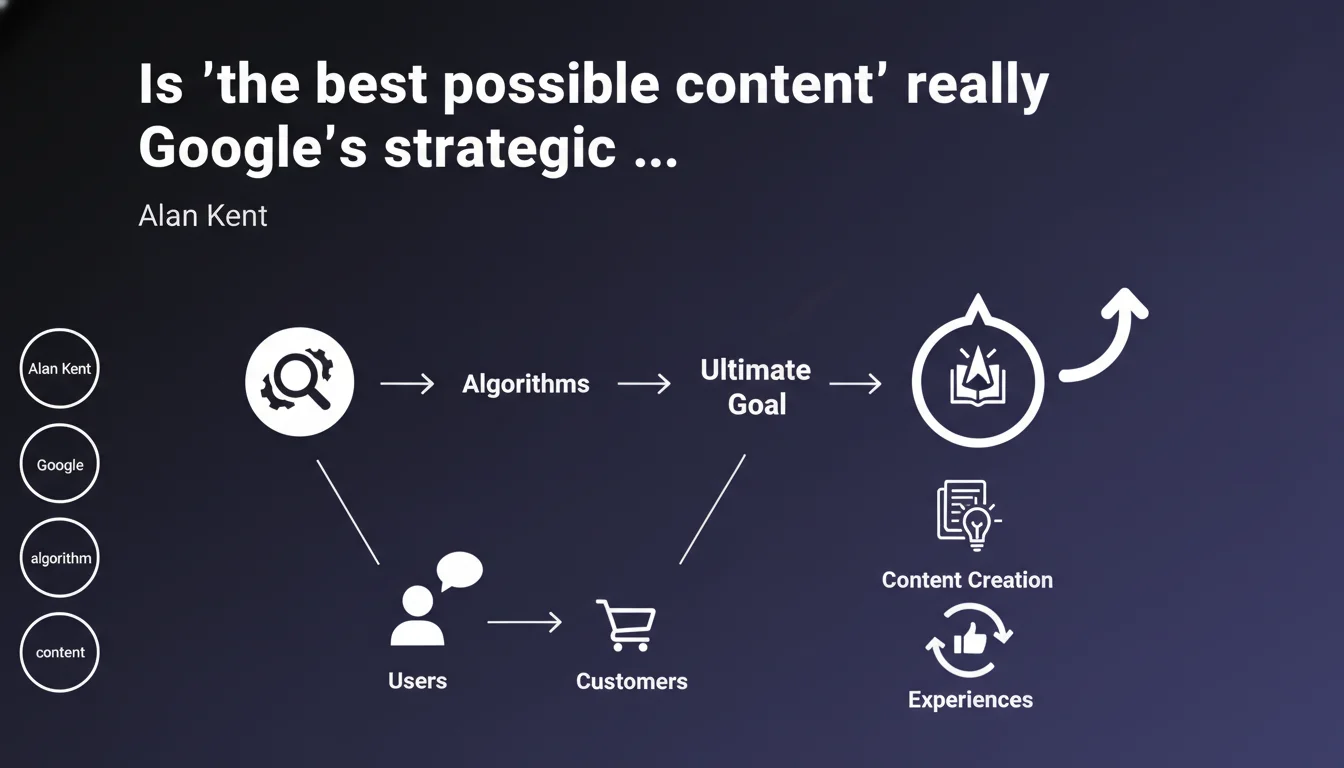
Google claims its ultimate goal is to present the best possible content, regardless of algorithm changes. Translation: focus on quality for your users rather than chasing every update. The catch? Defining what 'best' actually means in a given context remains vague.
What you need to understand
Why does Google keep pushing this 'best content' promise so hard?
This statement is nothing new. Google has been repeating it for years, in different forms. The objective is twofold: reassure content creators by telling them that algorithms evolve but the compass stays the same, and defuse the SEO hack race by claiming that short-term tactics won't hold up against quality.
In practice, this means Google wants you to stop obsessing over isolated technical signals and instead prioritize a holistic user-centered vision. Easy to say when you have billions of pages to sort through.
What does Google really mean by 'best content'?
The problem is that Google never precisely defines this term. 'Best' according to which criteria? Depth? Freshness? Author authority? User engagement? Post-click satisfaction rate?
The reality is that Google measures hundreds of signals and the notion of 'best' varies based on the query, user intent, geographic context, and search history. This vagueness leaves enormous room for interpretation — and that's probably intentional.
Is this philosophy compatible with what SEOs actually do in the field?
On paper, yes. In practice, it's more complicated. SEOs know that the best content isn't always enough: an excellent article on a site without authority, poorly structured technically or slow to load, will be crushed by a mediocre but better-optimized competitor.
Google implies that if you do good work, the rest will follow. Except it won't: technical optimization, internal linking strategy, backlinks, and page speed remain essential. Content is just one piece of the puzzle.
- Google wants to direct efforts toward user quality, not algorithmic hacks.
- The term 'best content' remains intentionally vague and heavily depends on search context.
- Content quality and technical optimization are not opposing forces — they must coexist.
- This statement is consistent with Google's communication strategy over the years.
SEO Expert opinion
Does this statement actually reflect the reality of rankings we observe?
Only partially. We do see quality content rising in visibility — but we also see mediocre sites, bloated with ads or filled with auto-generated content, squatting positions 1-3 on lucrative queries. Why? Because they have massive domain authority, a solid backlink profile, or age that compensates.
Saying that Google ranks 'the best content' implies the algorithm is infallible. Yet we know biases exist: preference for large established sites, over-weighting of certain signals (backlinks, brand), difficulty evaluating pure editorial quality. [To verify]: Does Google really measure intrinsic quality or proxies for quality?
What nuances should we add to this claim?
First, 'best' is relative. Content can be excellent for one audience but unsuitable for another. Google tries to personalize, but personalization introduces variance — which complicates the very notion of a universal 'best.'
Second, this statement ignores the commercial dimension. Google often favors e-commerce sites or transactional pages on informational queries if they generate more ad revenue or satisfy latent purchase intent. 'Best' from the user perspective and from the business perspective don't always align.
In what cases doesn't this rule apply?
On highly competitive queries, the best content often isn't enough. If you launch a health blog against WebMD, Mayo Clinic, or sites with millions of backlinks, you could produce flawless articles and still won't crack the top 10 without an aggressive authority-building strategy.
Another case: YMYL queries (Your Money Your Life). Google applies draconian trust filters. Perfect content published by an unknown will be systematically crushed by mediocre content signed by a recognized doctor or official institution. Here, perceived quality (credibility, authority) trumps actual quality.
Practical impact and recommendations
What should you concretely do to align your strategy with this objective?
Start by auditing your existing content. Ask yourself this for every page: does it answer the user's intent better than competitors? If not, enrich, restructure, or delete.
Next, analyze the SERPs for your target queries. Observe what Google ranks in positions 1-3. Identify patterns: length, structure, embedded media, freshness, author type. Adapt your approach accordingly — without blindly copying.
What mistakes should you avoid to stay on track?
Don't fall into the 'content for content's sake' trap. Producing 50 mediocre articles per month won't get you anywhere. Google increasingly values depth and expertise — one ultra-documented 3,000-word article beats 10 shallow pieces with no added value.
Also avoid neglecting user experience signals. Brilliant content buried in a slow page, poorly structured or stuffed with intrusive popups will never be ranked as 'the best.' The packaging matters as much as the substance.
- Regularly audit your content to identify weak or outdated pages.
- Analyze competitor SERPs to understand what Google actually ranks.
- Prioritize depth and expertise over publishing volume.
- Optimize user experience: speed, structure, accessibility, design.
- Invest in credible authors and reliable sources, especially for YMYL.
- Monitor engagement metrics: time on page, bounce rate, pages per session.
- Never sacrifice editorial quality for short-term SEO gains.
How can you verify that your site aligns with this vision?
Use tools like Search Console to identify pages with high impressions but low CTR — often a sign that content doesn't match intent. Test improvements and measure impact.
Conduct user testing or post-visit satisfaction surveys. If your visitors find what they're looking for and stay engaged, Google will eventually detect it through behavioral signals.
❓ Frequently Asked Questions
Google privilégie-t-il vraiment la qualité du contenu ou d'autres facteurs comme l'autorité de domaine ?
Comment Google mesure-t-il concrètement ce qui est « le meilleur contenu » ?
Cette déclaration implique-t-elle que les techniques SEO traditionnelles sont obsolètes ?
Un petit site peut-il concurrencer un gros acteur établi en misant uniquement sur la qualité ?
Comment savoir si mon contenu est perçu par Google comme « le meilleur » ?
🎥 From the same video 13
Other SEO insights extracted from this same Google Search Central video · published on 29/06/2022
🎥 Watch the full video on YouTube →
💬 Comments (0)
Be the first to comment.