
Official statement
Other statements from this video 13 ▾
- □ Should you really master technical SEO before producing content?
- □ Is Google Search Console really enough to catch all your technical SEO problems?
- □ Why should e-commerce product titles absolutely contain the brand name and color?
- □ Are structured data really essential for Google to properly understand your pages?
- □ Should you really keep out-of-stock product pages indexed?
- □ Should you really create specific content for every step of the buyer's journey?
- □ Should you really create a unique URL for every product variant?
- □ Should you really describe every product variant in your canonical page?
- □ Should you really reuse the same URL for your recurring promotional events?
- □ Is user experience really a decisive ranking factor at Google?
- □ Why does PageSpeed Insights combine real-world data with lab testing to measure performance?
- □ Why does SEO really take several months to deliver measurable results?
- □ Is 'the best possible content' really Google's strategic compass, or just clever marketing spin?
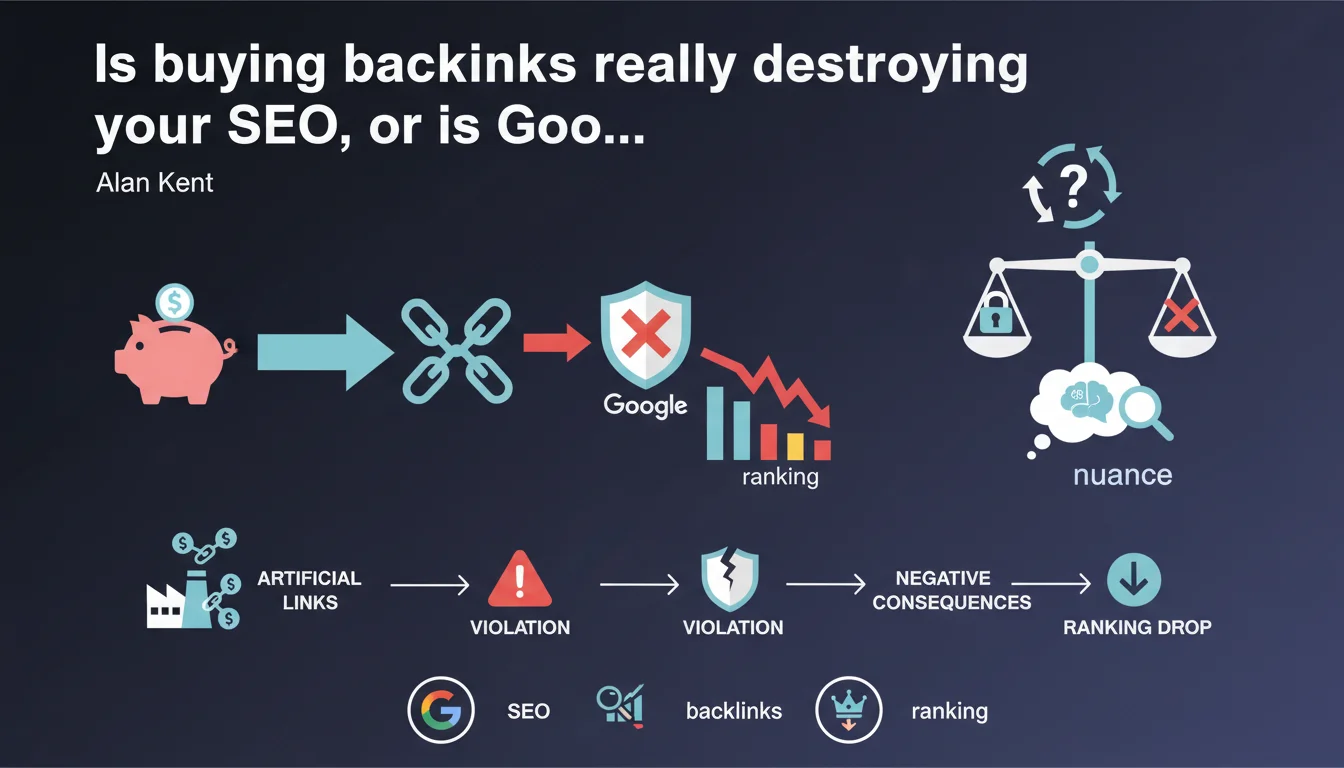
Google claims that paying to create links to your site violates its quality guidelines and can penalize your rankings. Alan Kent warns against agencies offering this type of service. The official position remains uncompromising: every paid link is considered artificial, with no apparent nuance regarding context or quality.
What you need to understand
What exactly does Google mean by "paid artificial link"?
Google classifies as artificial links all those obtained in exchange for payment, regardless of their form. This includes directly purchased links, monetary exchanges for mentions, or even poorly tagged sponsored collaborations.
The search engine believes these practices distort its relevance algorithm based on PageRank. A link should reflect a spontaneous editorial vote, not a commercial transaction. Any attempt at manipulation is theoretically sanctionable.
Does this directive really apply to all types of paid links?
Google's wording makes no distinction between a link from a low-quality directory and an editorial placement in a premium media outlet. Officially, any payment to obtain a link falls into the radar of forbidden practices.
Yet Google tolerates certain forms of sponsored links provided they carry the attributes rel="sponsored" or rel="nofollow". These tags tell the engine it should not pass SEO juice. Without them, you risk manual action.
What are the concrete risks for a site buying links?
Google can apply a manual penalty if its team detects a pattern of artificial links. This sanction results in a sharp drop in organic traffic and a message in Search Console. Recovery requires disavowing toxic links and submitting a reconsideration request.
Even without manual action, the algorithm can automatically devalue suspicious links. In this case, no alert — you simply notice that your backlinks no longer contribute anything, or even harm. Your invested budget goes up in smoke.
- Any paid link not tagged sponsored/nofollow officially violates guidelines
- Sanctions range from silent algorithmic devaluation to visible manual penalty
- Google makes no official distinction between editorial quality and pure spam in its communications
- Link disavowal and reconsideration requests are the only exit strategies after manual penalty
SEO Expert opinion
Does Google's radical stance truly reflect what happens on the ground?
Let's be honest: thousands of well-ranked sites have backlink profiles that wouldn't survive a strict audit under this definition. Media outlets sell sponsored articles, influencers monetize their recommendations, and many of these links carry no nofollow attribute.
Does Google systematically detect these practices? No. The algorithm focuses on obvious spam patterns — PBN networks, link farms, low-quality directories. A well-executed placement on an authority site generally flies under the radar. [To verify]: Google claims to detect "most" artificial links automatically, but no public data documents this detection rate.
Why does Google maintain such a binary stance on this topic?
Official discourse cannot nuance without shooting itself in the foot. If Google publicly admitted that a quality paid editorial link could be acceptable under certain conditions, it would open the door to all possible abuses.
The hard line serves as legal protection. However, in reality, the spam team concentrates its resources on industrial practices and massive networks. An isolated, well-integrated sponsored article will probably never trigger manual action — but nothing guarantees this.
Should you really abandon any paid link-building strategy?
It depends on your risk tolerance and time horizon. A site aiming for longevity should build its authority on clean levers: exceptional content, digital PR, natural partnerships.
That said, in ultra-competitive sectors, waiting for links to arrive organically amounts to accepting invisibility for years. Many practitioners adopt a hybrid approach: prioritize editorial merit investment, and occasionally supplement with strategic placements that are undetectable — which requires advanced expertise.
Practical impact and recommendations
How do you audit your existing link profile to spot risks?
Export your backlink profile via Search Console or a tool like Ahrefs/Semrush. Identify low-authority referring domains, sites with no organic traffic, and pages with link lists appearing from nowhere.
Look for suspicious patterns: same anchor text across dozens of different domains, links from footers or sidebars, sites in random languages unrelated to your topic. If you've purchased backlink packages in the past, assume they're probably toxic.
What should you do if you discover artificial links pointing to your site?
First contact the webmasters involved to request removal — keep records of these efforts. For links impossible to remove, compile them in a disavow file that you'll submit via Search Console.
Use disavowal carefully: don't throw the baby out with the bathwater. A mediocre but harmless link doesn't need disavowing — Google probably ignores it already. Focus on clearly spammy domains or identifiable networks.
What clean alternatives exist to develop your domain authority?
Invest in reference content: in-depth case studies, original data, ultra-comprehensive guides that naturally become cited resources. Backlinks earned through editorial merit are the only truly lasting ones.
Develop a digital PR strategy: identify journalists and bloggers in your sector, pitch them exclusive angles, comment on industry news with expertise. A link from real media is infinitely more solid than a purchased placement.
- Audit your backlink profile quarterly to detect new toxic links
- Never work with an agency promising X backlinks guaranteed in Y days — that's industrial spam
- Systematically use rel="sponsored" on your paid collaborations, even if the partner doesn't require it
- Build a premium content creation process that naturally attracts mentions
- Document all your cleanup efforts in case manual action occurs
- Prioritize quality over quantity: one link from real media > 50 directory links
❓ Frequently Asked Questions
Un lien d'un article sponsorisé avec rel="sponsored" transmet-il du PageRank ?
Google peut-il détecter qu'un lien a été payé même s'il semble naturel ?
Combien de temps après l'achat de liens risque-t-on une pénalité ?
Faut-il désavouer tous les liens de faible qualité pointant vers mon site ?
Les guest posts rémunérés sont-ils considérés comme des liens artificiels ?
🎥 From the same video 13
Other SEO insights extracted from this same Google Search Central video · published on 29/06/2022
🎥 Watch the full video on YouTube →
💬 Comments (0)
Be the first to comment.