
Official statement
Other statements from this video 13 ▾
- □ Faut-il vraiment maîtriser la technique SEO avant de produire du contenu ?
- □ La Search Console suffit-elle vraiment pour détecter tous les problèmes techniques SEO ?
- □ Pourquoi les titres de produits e-commerce doivent-ils impérativement contenir la marque et la couleur ?
- □ Les données structurées sont-elles vraiment indispensables pour que Google comprenne vos pages ?
- □ Faut-il vraiment garder les pages de produits en rupture de stock indexées ?
- □ Faut-il vraiment créer une URL unique pour chaque variante de produit ?
- □ Faut-il vraiment décrire toutes les variantes produit dans la page canonique ?
- □ Faut-il vraiment réutiliser la même URL pour vos événements promotionnels récurrents ?
- □ L'expérience utilisateur est-elle vraiment un facteur de classement déterminant chez Google ?
- □ Pourquoi PageSpeed Insights combine-t-il données terrain et tests en laboratoire ?
- □ Pourquoi le SEO met-il vraiment plusieurs mois à produire des résultats ?
- □ Pourquoi Google considère-t-il tous les liens payants comme artificiels et dangereux pour votre SEO ?
- □ Le « meilleur contenu possible » : vrai cap stratégique ou paravent marketing de Google ?
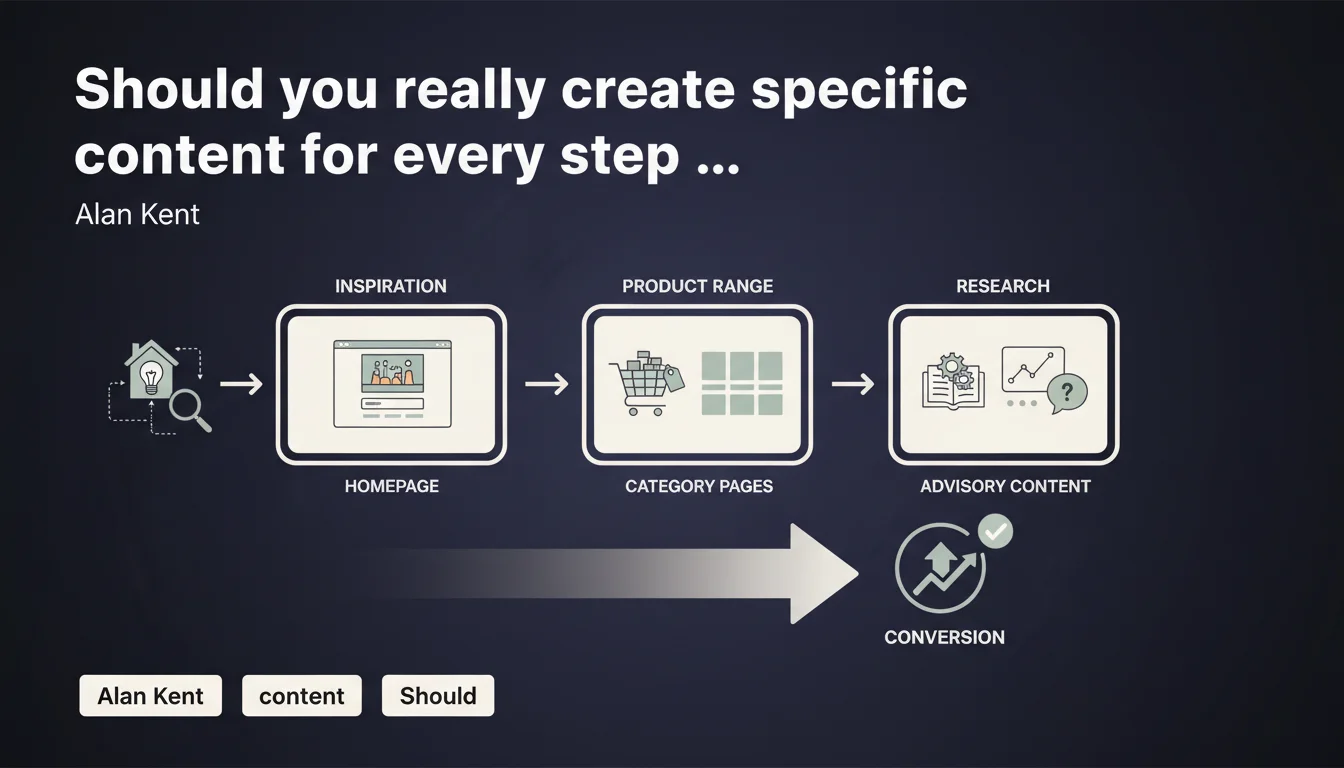
Google recommends structuring your content according to the customer journey: inspiration on the homepage, product discovery on category pages, and decision-making support through advisory content. The goal is to answer search intentions that evolve depending on whether the user is exploring, comparing, or about to purchase.
What you need to understand
Why does Google insist on aligning content with the customer journey?
Alan Kent's statement reflects a fundamental shift in how Google evaluates page relevance. The search engine no longer just matches keywords — it tries to understand what stage of the buying journey the user is at.
In concrete terms? A broad query like "bike" signals exploratory intent. A query like "carbon road bike 2000 euros" indicates an advanced comparison phase. If your content doesn't match this intent, your bounce rate skyrockets and Google adjusts its ranking accordingly.
What are the three key stages mentioned by Google?
Kent identifies three main touchpoints: the homepage (inspiration, brand discovery), category pages (exploring a range, product comparison), and editorial content (buying guides, comparisons, advice).
This segmentation isn't new in itself — but Google formalizes here its expectation that a mature e-commerce site has these three pillars. A site limited to product sheets without advisory content risks losing traffic on high-volume informational queries.
How does this principle apply beyond e-commerce?
Even though Kent clearly targets e-commerce, the concept translates to any sector with a conversion funnel. A SaaS site needs "problem" pages (awareness), "solution" pages (consideration), and "product" pages (decision).
The common mistake: creating only bottom-of-funnel content ("buy X") and neglecting top-of-funnel ("how to choose X"). Google values sites that guide users through their entire journey.
- Align each page type with a specific search intention
- Category pages should serve product discovery, not just list references
- Advisory content is not optional — it's a visibility lever for informational queries
- Structure your architecture to reflect these three levels (homepage > categories > guides + product sheets)
SEO Expert opinion
Is this recommendation really new?
Let's be honest: no. The idea of matching content to search intent has been at the heart of SEO since at least 2015. What's changing is that Google is formalizing this explicitly and valuing this approach in its guidelines.
In the field, we do observe that sites segmenting their content by journey stage capture a broader spectrum of queries. But — and this is where it gets tricky — Google provides no metric to evaluate whether your content/journey balance is optimal. [To verify]
What nuances should be added to this statement?
First point: not all sectors have a linear buying journey. In some complex B2B niches, the user may consult technical content (bottom-funnel) before even defining their need (top-funnel). Mechanically applying this schema can be counterproductive.
Second point: Kent mentions the homepage as a driver of inspiration — but in reality, most SEO traffic lands on deep pages, not the homepage. Optimizing the homepage for inspiration makes sense in UX, but its direct SEO impact is often marginal.
In what cases is this approach insufficient?
A site can check all the boxes (inspiring homepage, rich categories, advisory content) and remain invisible if technical fundamentals are failing. Loading speed, internal linking, backlink quality — none of this is solved by content segmentation.
Moreover, Google doesn't specify how to arbitrate between content depth and page volume. Should you create 10 ultra-detailed guides or 100 short articles? The statement remains vague. In practice, the answer depends on your domain authority and sector competitiveness.
Practical impact and recommendations
What should you audit first on your site?
Start by mapping your existing content across the three stages: inspiration, discovery, decision support. Identify gaps — for example, if you have 500 product sheets but zero buying guides, you're missing all top-of-funnel traffic.
Next, analyze your Search Console data: what informational queries generate impressions but not clicks? This often signals that competitors have advisory content you don't.
How do you concretely structure this content by stage?
For the homepage: prioritize inspiring visuals, featured collections, brand storytelling. Don't overload with SEO — that's not its primary function.
For category pages: enrich with editorial introductions (200-300 words), relevant filters, cross-suggestions. A category shouldn't be just a product list.
For advisory content: comparison guides, usage tutorials, detailed FAQs. This content should target informational queries with volume — not ultra-niche questions with no traffic.
- Map your existing content by stage of the customer journey
- Identify informational queries where you have no presence
- Create an editorial calendar prioritizing gaps with highest traffic potential
- Enrich your category pages with editorial content (not just product listing)
- Install tracking to measure each content type's impact on conversion
- Test different formats (long guides vs short articles) and observe performance
❓ Frequently Asked Questions
Un site e-commerce doit-il vraiment avoir une homepage "inspirante" pour bien ranker ?
Le contenu conseil doit-il être hébergé sur le site principal ou sur un blog séparé ?
Comment mesurer si mon contenu matche bien les différentes étapes du parcours ?
Faut-il créer du contenu pour chaque étape même dans une niche très spécialisée ?
Les pages catégories peuvent-elles ranker sur des requêtes informationnelles ?
🎥 From the same video 13
Other SEO insights extracted from this same Google Search Central video · published on 29/06/2022
🎥 Watch the full video on YouTube →
💬 Comments (0)
Be the first to comment.