
Official statement
Other statements from this video 13 ▾
- □ Faut-il vraiment maîtriser la technique SEO avant de produire du contenu ?
- □ La Search Console suffit-elle vraiment pour détecter tous les problèmes techniques SEO ?
- □ Pourquoi les titres de produits e-commerce doivent-ils impérativement contenir la marque et la couleur ?
- □ Les données structurées sont-elles vraiment indispensables pour que Google comprenne vos pages ?
- □ Faut-il vraiment garder les pages de produits en rupture de stock indexées ?
- □ Faut-il vraiment créer du contenu spécifique pour chaque étape du parcours d'achat ?
- □ Faut-il vraiment créer une URL unique pour chaque variante de produit ?
- □ Faut-il vraiment décrire toutes les variantes produit dans la page canonique ?
- □ Faut-il vraiment réutiliser la même URL pour vos événements promotionnels récurrents ?
- □ L'expérience utilisateur est-elle vraiment un facteur de classement déterminant chez Google ?
- □ Pourquoi PageSpeed Insights combine-t-il données terrain et tests en laboratoire ?
- □ Pourquoi Google considère-t-il tous les liens payants comme artificiels et dangereux pour votre SEO ?
- □ Le « meilleur contenu possible » : vrai cap stratégique ou paravent marketing de Google ?
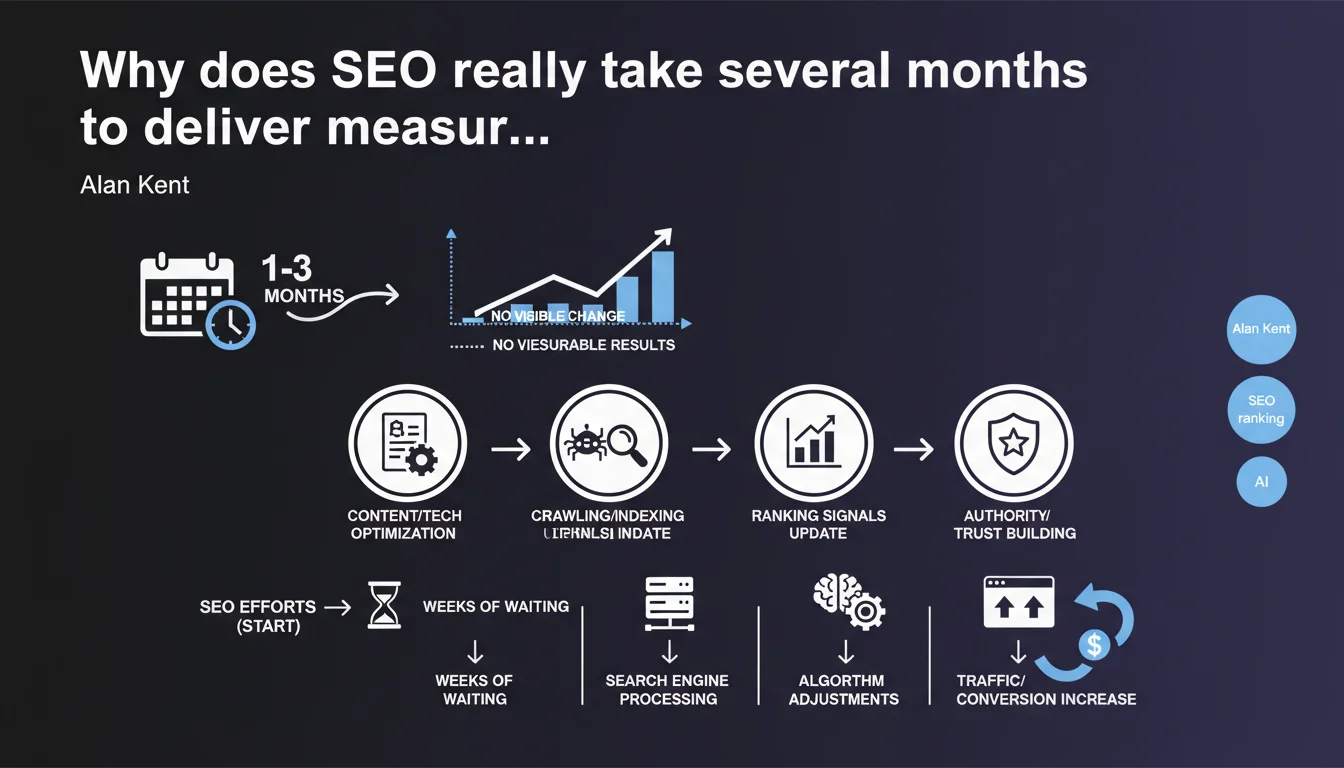
Google officially confirms that SEO is a marathon, not a sprint. Certain ranking signals require several months to update, and there's no guaranteed success despite your best efforts. Patience is your best ally, with a minimum timeline of several weeks before you'll observe even the slightest impact.
What you need to understand
Alan Kent — former Google engineer, now at Shopify — reminds us of a truth that many clients are reluctant to hear: SEO doesn't deliver instant results. This statement may seem obvious, but it crystallizes a recurring problem in the industry.
The message is less about technical details and more about managing expectations. Too many decision-makers still imagine that a technical overhaul or content optimization will trigger mechanical growth in the SERPs within days.
Which ranking signals actually take several months to update?
Kent remains vague on this point — and that's precisely where things get tricky. We know from field experience that certain authority signals (progressively acquired backlinks, brand mentions) take time to propagate through the index. Core Updates can also reshuffle the deck every 3-4 months.
Other factors — freshly published content, technical fixes — can have an impact within days or weeks. But Google never quantifies these timelines in granular detail, which complicates our forecasting work.
Why does Google emphasize the lack of guarantee?
Because SEO remains a probabilistic discipline, not a deterministic one. You can check every box — flawless content, impeccable technical setup, perfect internal linking — and still fail to rank if competitors perform better or search intent evolves.
This precision from Kent protects Google against accusations of « unfulfilled promises », but it also reflects a deeper reality: there is no fixed algorithm that we can reverse-engineer in absolute terms. Models change, weightings fluctuate.
- SEO takes several months before producing measurable effects, especially for authority and trust signals.
- No guaranteed success even with flawless execution — competition and the algorithm evolve in parallel.
- Patience and iteration remain the guiding principles: test, measure, adjust, repeat.
- Timelines vary depending on the nature of optimizations (technical, content, link-building) and industry sector.
SEO Expert opinion
Is this statement consistent with real-world observations?
Yes and no. In ultra-competitive sectors (finance, health, insurance), several months are indeed necessary to build authority and climb the SERPs. But in niche markets or long-tail queries, we sometimes observe positive movement 2-3 weeks after a technical optimization or new content addition.
The problem is that Google generalizes without nuance. Kent could have distinguished between incremental improvements (which can be quick) and strategic repositioning (which takes months). This lack of granularity makes the statement true but hardly actionable. [To verify]: To what extent do timelines differ based on domain age, history, and sector?
Why this insistence on the absence of guarantee?
Because Google fears lawsuits or accusations of broken promises. But let's be honest: no serious agency guarantees a top 3 position for an ultra-competitive keyword. What is guaranteed is a rigorous methodology, optimizations aligned with guidelines, and indicator tracking.
However, this formulation can serve as a convenient excuse for Google to avoid explaining why a well-optimized site stagnates while a mediocre competitor advances. Once again, the lack of transparency complicates our diagnostic work.
In what cases doesn't this rule fully apply?
On young sites with little competition, we can see rapid growth after publishing targeted content. Featured snippets can also shift within days if the content better answers the intent.
Similarly, a lifted penalty (manual or algorithmic) can trigger near-immediate recovery. The same goes for a fixed technical bug (accidental noindex tags, 302 redirect changed to 301). So no, everything doesn't take « several months » — Kent oversimplifies.
Practical impact and recommendations
What should you concretely do with this information?
Reset client expectations from the start. If you promise results in 1 month, you're setting up inevitable disappointment. Explain that SEO works in stages: some optimizations deliver quick signals (indexation, speed), others need 3-6 months to mature (backlinks, evergreen content).
Implement intermediate KPIs: crawl rate, indexed pages, average positions across a basket of keywords, etc. This shows progress even if organic traffic hasn't exploded yet.
What mistakes should you avoid given this long timeline?
Don't change everything at once. If you overhaul structure, add 50 articles, and launch a link-building campaign simultaneously, you'll never isolate what works. Proceed in iterations: one optimization, measurement, adjustment.
Also avoid the « it's not working after 3 weeks, let's quit » syndrome. Google can take time to re-evaluate your site, especially if it was previously inactive. Consistency beats impatience.
How do you effectively manage a long-term SEO project?
Structure your actions in monthly or quarterly sprints. Each sprint targets one lever (technical, content, authority) with clear deliverables and associated metrics. This maintains momentum without mixing everything together.
Rigorously document every change (via Git, a logbook, or tools like Screaming Frog). When results arrive — and they will — you can retroactively analyze what worked and build on it.
- Set a realistic timeline: 3-6 months for significant results, 12 months for strategic repositioning.
- Segment actions by lever (technical, content, authority) to measure each one's impact.
- Track intermediate KPIs (crawl, indexation, positions) to validate progress before traffic gains.
- Educate stakeholders: SEO isn't a Google Ads campaign with immediate ROI.
- Don't multiply simultaneous changes — test, measure, adjust.
- Maintain regular content production to signal to Google that the site is active.
SEO demands rigor, patience, and long-term vision. No single lever works in isolation, and ranking signals feed each other. If orchestrating this complexity alone seems difficult — especially alongside your core business — partnering with a specialized SEO agency can help you avoid costly mistakes and accelerate your learning curve. Personalized support lets you structure priorities, avoid dead ends, and pilot optimizations methodically.
❓ Frequently Asked Questions
Combien de temps faut-il attendre avant de juger qu'une optimisation SEO ne fonctionne pas ?
Tous les signaux de classement mettent-ils vraiment plusieurs mois à s'actualiser ?
Comment expliquer à un client que le SEO prend du temps sans passer pour inefficace ?
Est-il possible d'accélérer les résultats SEO sans enfreindre les guidelines Google ?
Faut-il arrêter toute action SEO si on ne voit rien bouger après 3 mois ?
🎥 From the same video 13
Other SEO insights extracted from this same Google Search Central video · published on 29/06/2022
🎥 Watch the full video on YouTube →
💬 Comments (0)
Be the first to comment.