
Official statement
Other statements from this video 13 ▾
- □ Faut-il vraiment maîtriser la technique SEO avant de produire du contenu ?
- □ La Search Console suffit-elle vraiment pour détecter tous les problèmes techniques SEO ?
- □ Pourquoi les titres de produits e-commerce doivent-ils impérativement contenir la marque et la couleur ?
- □ Les données structurées sont-elles vraiment indispensables pour que Google comprenne vos pages ?
- □ Faut-il vraiment créer du contenu spécifique pour chaque étape du parcours d'achat ?
- □ Faut-il vraiment créer une URL unique pour chaque variante de produit ?
- □ Faut-il vraiment décrire toutes les variantes produit dans la page canonique ?
- □ Faut-il vraiment réutiliser la même URL pour vos événements promotionnels récurrents ?
- □ L'expérience utilisateur est-elle vraiment un facteur de classement déterminant chez Google ?
- □ Pourquoi PageSpeed Insights combine-t-il données terrain et tests en laboratoire ?
- □ Pourquoi le SEO met-il vraiment plusieurs mois à produire des résultats ?
- □ Pourquoi Google considère-t-il tous les liens payants comme artificiels et dangereux pour votre SEO ?
- □ Le « meilleur contenu possible » : vrai cap stratégique ou paravent marketing de Google ?
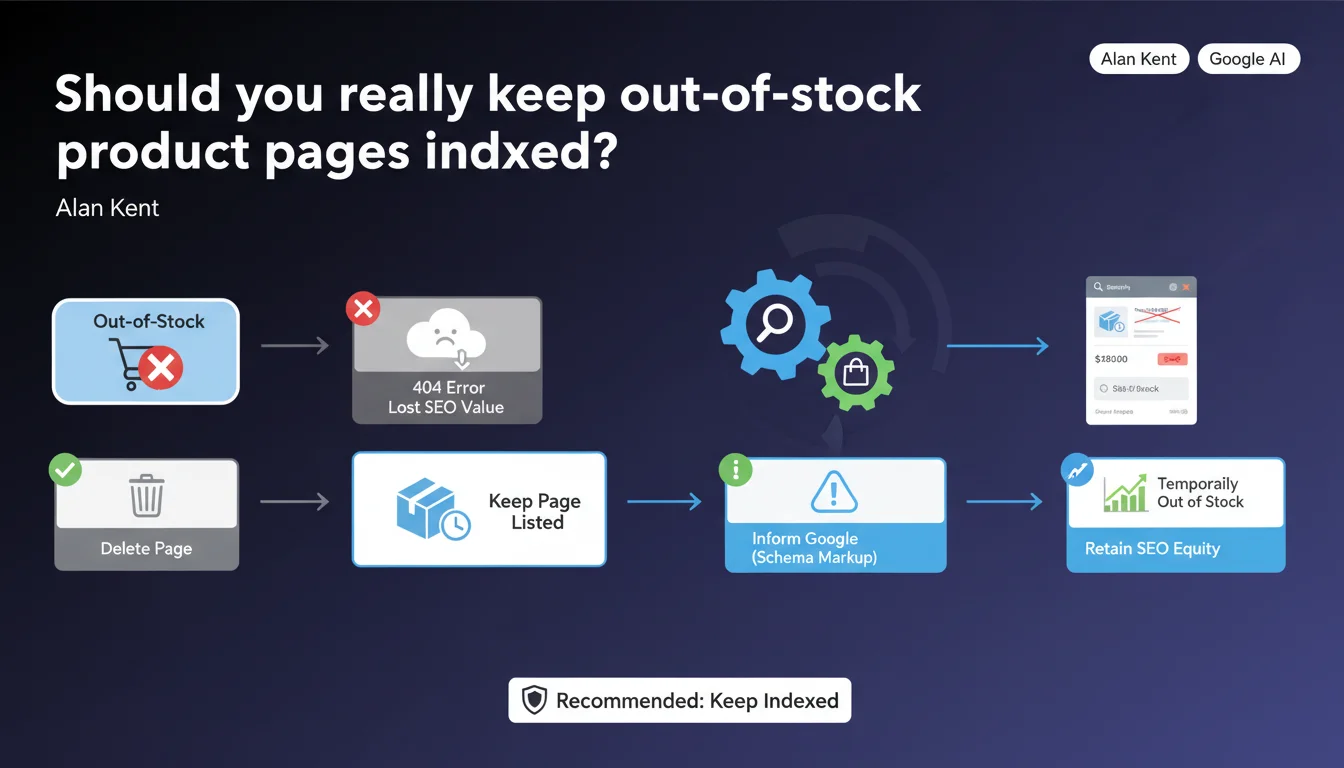
Google recommends keeping out-of-stock product pages on your site and indicating their unavailability rather than deleting them. This approach preserves SEO capital (backlinks, history, authority) and avoids 404 errors that degrade user experience and waste crawl budget.
What you need to understand
Why does Google prefer you to keep pages for sold-out products?
When a product is no longer available, the temptation is strong to delete the page to avoid offering "useless" content. Except Google doesn't see it that way.
A product page that has existed accumulates SEO signals: external backlinks, organic traffic, engagement signals. Deleting it brutally destroys this capital and creates 404 errors that frustrate users arriving via search or external links.
How do you inform Google that a product is unavailable?
Google expects you to use Schema.org Product markup with the availability property. Relevant values: OutOfStock, Discontinued, PreOrder, BackOrder.
This approach allows Google to understand the product status without interpreting the page as dead content. The search engine can then display this information in rich results and adjust its crawl accordingly.
What's the difference from a complete deletion?
Deleting a page = immediate loss of rankings and backlinks. Google has to relearn everything if the product comes back in stock, which takes time — sometimes weeks.
Keeping the page with an "out of stock" status preserves indexation, maintains history, and allows an almost instant comeback when the product is available again. Backlinks remain active, PageRank flows through.
- Preserve SEO capital: inbound links, page authority, ranking history
- Avoid 404 errors that degrade experience and waste crawl budget unnecessarily
- Use Schema.org with
availabilityproperties to signal product status - Facilitate restocking: the page remains indexed and can rank immediately again
- Improve UX: offer alternatives, availability alerts, similar products
SEO Expert opinion
Is this recommendation consistent with practices observed in the field?
Yes, and testing has confirmed it for years. E-commerce sites that delete out-of-stock product pages systematically see their rankings collapse — sometimes never returning to their original level, even after restocking.
What's less often mentioned: Google doesn't treat all out-of-stock situations the same way. A seasonal product that comes back each year? No problem. A product permanently discontinued with zero alternative? That's where it gets sticky. Alan Kent's statement lacks nuance on this point [To be verified].
What nuances should be applied depending on context?
Not all products deserve the same treatment. A high-ticket product with quality backlinks and recurring traffic justifies keeping it indexed indefinitely. A generic product with no inherent authority can sometimes be consolidated via a 301 redirect to a category or equivalent product.
The real problem is volume. A catalog of 50,000 items with 30% permanent stockouts becomes unmanageable — and Google will never crawl all of it effectively. Let's be honest: you need to balance SEO preservation with operational reality.
In what cases does this rule not apply?
When the product is permanently discontinued, with no equivalent, and the page has never generated significant organic traffic. There, a 301 redirect to a relevant category makes more sense than a ghost page.
Another edge case: ultra-fast-rotation products (fast-fashion, electronics). Keeping 10,000 out-of-stock product pages from 18 months ago dilutes crawl budget and sends a catastrophic freshness signal to Google. Sometimes you have to make the call.
Practical impact and recommendations
What should you actually do to manage out-of-stock situations?
First, implement Schema.org Product markup with the availability property. That's the technical foundation for Google to understand the product status. Values to use: OutOfStock, Discontinued, PreOrder, BackOrder.
Then, enrich the user experience on these pages. Offer similar products, email availability alerts, additional content (comparisons, customer reviews). An out-of-stock page that converts through alternatives remains performant in Google's eyes.
What mistakes must you absolutely avoid?
Never return a 404 or 410 HTTP code on a product page with authority. That's SEO suicide, especially if the stockout is temporary. The code should remain 200, with Schema.org markup indicating unavailability.
Also avoid the "noindex" trap on out-of-stock pages. That's basically telling Google to forget the page — exactly the opposite of what you want. If you must deindex, at least redirect properly.
How do you verify your implementation is correct?
Use Google's Rich Results Testing Tool to validate your Schema.org markup. Verify that the availability property appears correctly and its value is recognized.
Monitor Search Console: out-of-stock pages should not generate indexing errors or soft 404s. If they do, your technical implementation is flawed and Google doesn't understand your signals.
- Keep out-of-stock product pages (HTTP 200 code)
- Add Schema.org Product markup with
availability: OutOfStock - Enrich the page: alternatives, availability alerts, additional content
- Never return 404 or 410 on a page with SEO authority
- Avoid noindex on temporary stockouts
- Redirect via 301 only if the product is permanently discontinued and has no equivalent
- Monitor Search Console to detect unintended soft 404s
- Balance volume considerations: a catalog with 30% permanent stockouts needs a consolidation strategy
❓ Frequently Asked Questions
Faut-il noindexer les pages de produits en rupture de stock ?
Quel code HTTP renvoyer pour une page produit épuisée ?
Peut-on rediriger une page en rupture vers une catégorie ?
Comment Google affiche-t-il les produits en rupture dans les résultats ?
Combien de temps peut-on garder une page en rupture de stock indexée ?
🎥 From the same video 13
Other SEO insights extracted from this same Google Search Central video · published on 29/06/2022
🎥 Watch the full video on YouTube →
💬 Comments (0)
Be the first to comment.