
Official statement
Other statements from this video 13 ▾
- □ Faut-il vraiment maîtriser la technique SEO avant de produire du contenu ?
- □ La Search Console suffit-elle vraiment pour détecter tous les problèmes techniques SEO ?
- □ Pourquoi les titres de produits e-commerce doivent-ils impérativement contenir la marque et la couleur ?
- □ Faut-il vraiment garder les pages de produits en rupture de stock indexées ?
- □ Faut-il vraiment créer du contenu spécifique pour chaque étape du parcours d'achat ?
- □ Faut-il vraiment créer une URL unique pour chaque variante de produit ?
- □ Faut-il vraiment décrire toutes les variantes produit dans la page canonique ?
- □ Faut-il vraiment réutiliser la même URL pour vos événements promotionnels récurrents ?
- □ L'expérience utilisateur est-elle vraiment un facteur de classement déterminant chez Google ?
- □ Pourquoi PageSpeed Insights combine-t-il données terrain et tests en laboratoire ?
- □ Pourquoi le SEO met-il vraiment plusieurs mois à produire des résultats ?
- □ Pourquoi Google considère-t-il tous les liens payants comme artificiels et dangereux pour votre SEO ?
- □ Le « meilleur contenu possible » : vrai cap stratégique ou paravent marketing de Google ?
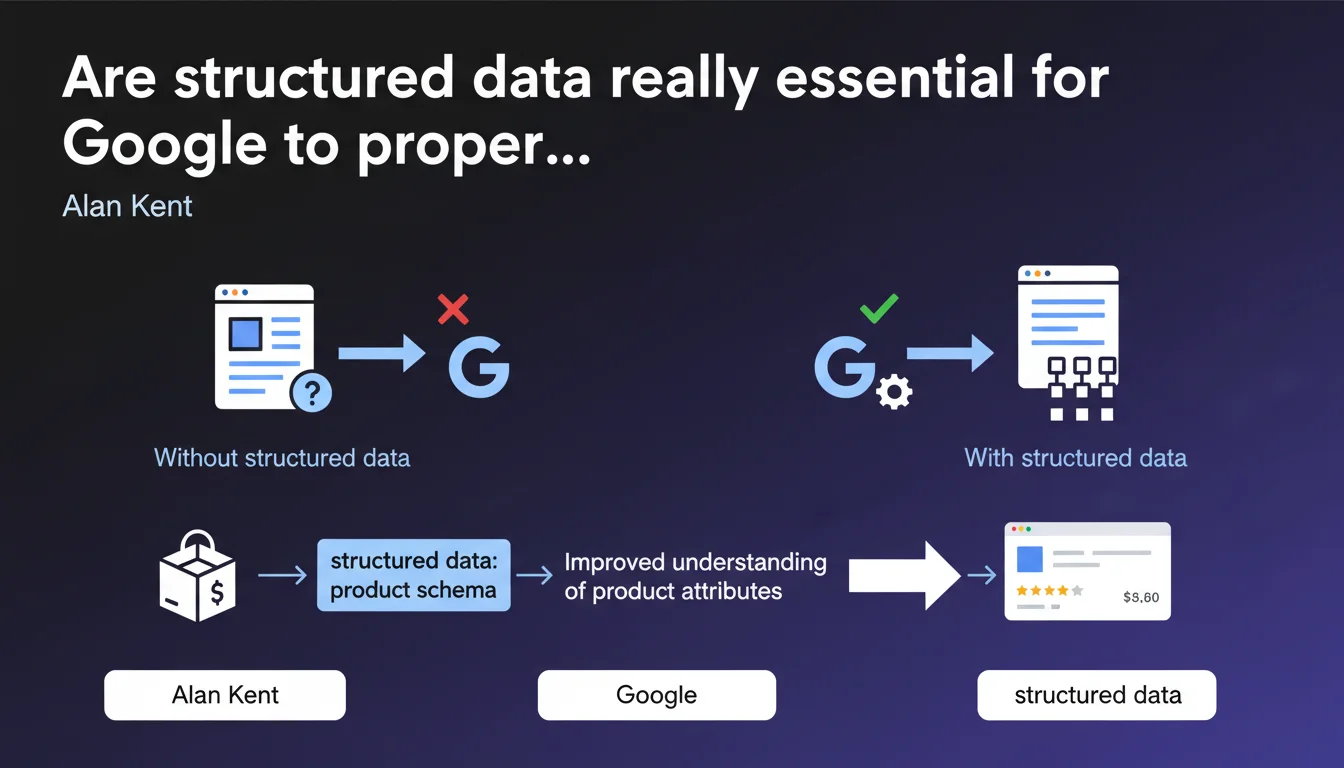
Google states that structured data helps it better understand the purpose of each page, particularly product attributes on e-commerce product sheets. It's not just about rich snippets — it's a semantic layer that makes content interpretation easier for algorithms.
What you need to understand
Why does Google insist so much on structured data?
Because natural language remains ambiguous for an algorithm. A page can talk about a product without Google clearly identifying the price, availability, or brand if this information is buried in standard HTML.
Schema.org structured data provides a standardized format that robots understand without interpretation. It's like giving an identifying sheet rather than a novel to decipher.
What does Google mean by "correctly understanding the purpose" of a page?
It's about identifying whether a page is a product sheet, blog article, FAQ, recipe, event, etc. Without explicit markup, Google must guess based on content and HTML structure — with a risk of error or imprecision.
On a product page, structured data allows you to properly surface the name, image, price, and reviews. Google can then reliably feed its rich surfaces (Google Shopping, rich results, Knowledge Graph) with accurate information.
Do all types of pages benefit equally from structured data?
No. Product pages, recipes, events, job postings, or FAQs have dedicated Schema.org types and directly benefit from rich displays in the SERP.
For other types of content (generic blog articles, institutional pages), the visible impact is less. Google will understand the structure better, but without immediate visibility gains.
- Structured data clarifies page intent for Google
- They are particularly effective on product pages, recipes, events
- Without them, Google must guess — with risks of interpretation errors
- They feed rich displays and improve SERP visibility
- Not all content benefits equally in terms of implementation ROI
SEO Expert opinion
Is this statement consistent with field observations?
Yes, broadly. E-commerce sites that correctly deploy Product Schema often see better visibility in Google Shopping and more frequent rich snippets. But nuance is needed: structured data is not a direct ranking factor.
They facilitate understanding, so indirectly improve perceived relevance by Google. But tagging a mediocre page won't make it rank miraculously. It's an accelerator, not an autonomous lever.
What gray areas remain in this statement?
Google remains vague about the actual scope of impact. Does it help "better" understand, or is it essential for certain features? [To verify] — the wording suggests it can do without it, but at what cost for the site?
Another point: not all product attributes are exploited the same way. Google may ignore certain Schema.org fields if the visible content differs, or if other signals (price in Merchant Center feed, for example) take precedence. Consistency between markup and visible content remains crucial.
In what cases do structured data provide little value?
On very generic content without a suitable Schema.org type, or when Google already understands the intent perfectly through other signals (title, URL, meta tags, clear editorial content).
Also on pages where no rich SERP feature exists for that content type. In these cases, the gain remains theoretical and difficult to measure. Better to prioritize efforts elsewhere.
Practical impact and recommendations
What should you do concretely on an e-commerce site?
Deploy Product Schema on all product sheets with at minimum: name, image, description, offers (price, priceCurrency, availability), aggregateRating if relevant. Use JSON-LD rather than microdata for maintainability.
Verify strict consistency between structured data and visible content. If the displayed price differs from the markup, Google may ignore it or penalize. Test with Google's Rich Results Test.
What errors should you absolutely avoid?
Never tag invisible or misleading content (fake reviews, fictitious prices). Google detects these manipulations and may deindex the enrichments or even manually penalize the site.
Also avoid markup duplicates (JSON-LD + microdata on the same page for the same element). This creates confusion and validation errors. One format, properly implemented, is enough.
How do you verify the implementation works correctly?
Use Google Search Console > Enhancements to monitor errors detected in structured data. Correct critical warnings as a priority.
Also monitor the appearance of rich results in the SERP using position tracking tools that capture features. If no change after several weeks, investigate logs to verify that Googlebot can access the markup properly.
- Implement Product Schema on all product sheets with required fields
- Guarantee absolute consistency between markup and visible content
- Test each page with the official Rich Results Test
- Avoid any invisible or misleading content in the markup
- Monitor errors in Google Search Console regularly
- Prioritize JSON-LD for ease of maintenance
- Track the appearance of rich snippets in SERPs after deployment
❓ Frequently Asked Questions
Les données structurées améliorent-elles directement le classement dans Google ?
Faut-il baliser toutes les pages d'un site avec des données structurées ?
Quel format privilégier : JSON-LD, microdata ou RDFa ?
Que se passe-t-il si les données structurées contiennent des erreurs ?
Les données structurées garantissent-elles l'affichage d'extraits enrichis ?
🎥 From the same video 13
Other SEO insights extracted from this same Google Search Central video · published on 29/06/2022
🎥 Watch the full video on YouTube →
💬 Comments (0)
Be the first to comment.