
Official statement
Other statements from this video 13 ▾
- □ Faut-il vraiment maîtriser la technique SEO avant de produire du contenu ?
- □ La Search Console suffit-elle vraiment pour détecter tous les problèmes techniques SEO ?
- □ Les données structurées sont-elles vraiment indispensables pour que Google comprenne vos pages ?
- □ Faut-il vraiment garder les pages de produits en rupture de stock indexées ?
- □ Faut-il vraiment créer du contenu spécifique pour chaque étape du parcours d'achat ?
- □ Faut-il vraiment créer une URL unique pour chaque variante de produit ?
- □ Faut-il vraiment décrire toutes les variantes produit dans la page canonique ?
- □ Faut-il vraiment réutiliser la même URL pour vos événements promotionnels récurrents ?
- □ L'expérience utilisateur est-elle vraiment un facteur de classement déterminant chez Google ?
- □ Pourquoi PageSpeed Insights combine-t-il données terrain et tests en laboratoire ?
- □ Pourquoi le SEO met-il vraiment plusieurs mois à produire des résultats ?
- □ Pourquoi Google considère-t-il tous les liens payants comme artificiels et dangereux pour votre SEO ?
- □ Le « meilleur contenu possible » : vrai cap stratégique ou paravent marketing de Google ?
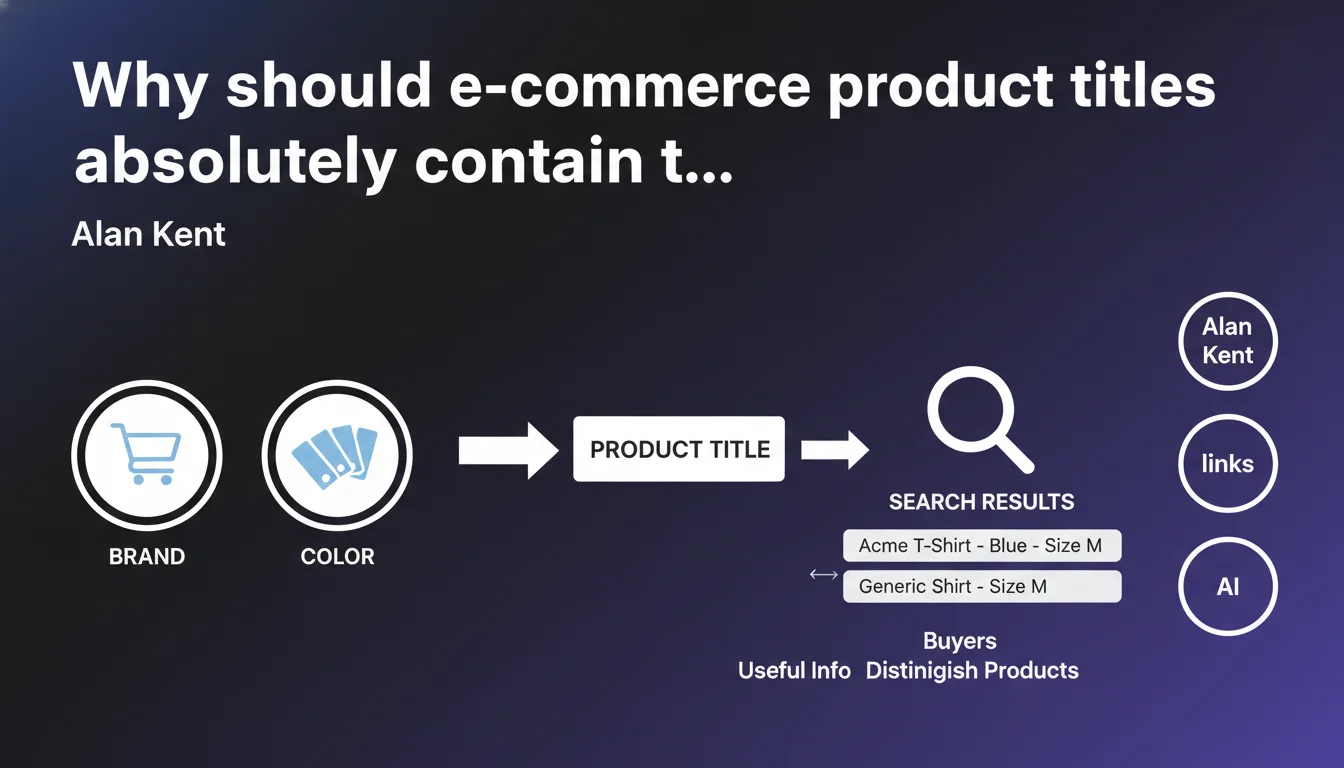
Google recommends integrating specific details such as brand name and color into page titles for product listings. These elements enable clear differentiation of variants and improve the relevance of snippets in SERPs. The title tag remains the primary basis for title links displayed in search results.
What you need to understand
Why does Google insist on product details in title tags?
Google seeks to maximize informational relevance from the moment results are displayed. A title containing "Nike Air Max 90 White" is infinitely more useful than a generic "Men's Sneakers". The search engine uses this information to build snippets that help users distinguish between multiple variants of the same product without having to click through.
Concretely, brand and color constitute critical differentiation signals in e-commerce. Two URLs selling the same model in black and white must be immediately distinguishable in the SERP — without these details, Google risks rewriting your titles or deeming them poorly relevant.
Are these titles systematically used exactly as written in the SERP?
No. Google clarifies that these titles serve as a foundation, but it reserves the right to rewrite them. If your title lacks clarity or doesn't match the user's search query, the algorithm will draw from your H1, content, or internal link anchors to rebuild a title link that's more appropriate.
That's where it gets tricky: even a well-optimized title can be ignored if Google believes a different phrasing will perform better. Alan Kent's recommendation therefore aims to reduce this rewriting risk by providing the most complete information upfront.
What product details must be absolutely included?
Alan Kent explicitly mentions brand and color. But the logic extends to any discriminating attribute: size, material, version (Pro/Standard), vintage for wine, storage capacity for electronics, etc.
- Brand: differentiates between competitors and enhances navigational searches
- Color: prevents confusion between variants of the same SKU
- Model/Reference: specifies the exact product identity
- Key attributes: anything that changes the product's nature or use (size, capacity, version)
- Site name: often added at the end of the title to reinforce the brand
SEO Expert opinion
Is this recommendation consistent with real-world practices observed?
Yes, and it aligns with established e-commerce SEO best practices that have been proven effective for years. The top-performing sites in transactional queries structure their titles according to a proven pattern: [Brand] [Model] [Differentiating Attribute] | [Site Name].
Where it becomes interesting: Google doesn't specify character limits or information priority. It doesn't say whether the brand should be at the beginning or end of the title, or how to handle generic products without a brand. The statement remains deliberately descriptive rather than prescriptive.
What critical nuances must be considered?
First point: not all products have a brand or color. Custom furniture, service offerings, artisanal products — how do you apply this advice? Google remains silent on this. [To be verified] through A/B testing whether the absence of these attributes truly penalizes CTR or ranking.
Second point: title length. Stacking brand + model + color + size + material can quickly exceed the 60 characters displayed in desktop SERPs. Google will truncate, potentially cutting off the most important information. You must therefore prioritize — and this prioritization depends on the sector, competition, and search volume by attribute.
Third point: the keyword stuffing risk. Some e-commerce merchants try to cram their titles with every possible synonym and variation. Google won't stand for it — it wants clarity, not spam. A natural and readable title outweighs one stuffed with secondary keywords.
In what cases does this rule not fully apply?
On category pages or thematic landing pages, this ultra-descriptive title logic no longer holds. A page titled "Women's Running Shoes" doesn't have a single brand or color to highlight — it must target an informational or comparative intent, not a specific transactional one.
Similarly, for products with very low differentiation (screws, bolts, standard industrial components), the brand may be secondary to technical specifications. Context matters — and Google doesn't provide a clear decision matrix.
Practical impact and recommendations
What should you do concretely on your product pages?
Audit your current titles and identify generic patterns: "Buy cheap product", "Online product sales", "Product - Fast delivery". These formulations add nothing for the user and are candidates for Google rewrites.
Replace them with an informative and structured format: [Brand] [Exact Model] [Color/Size/Version] | [Site Name]. Example: "Nike Air Max 90 White Men's Size 42 | RunShop" rather than "Cheap Nike Sneakers | RunShop".
Automate this logic in your CMS or PIM. If you manage thousands of SKUs, manually building each title isn't feasible. Define a dynamic template that pulls from your product attributes: {brand} {model} {color} {size} | {site_name}. Then test that the order and presence of each variable maximizes CTR.
What mistakes must you absolutely avoid?
Don't duplicate titles across variants. If you sell a t-shirt in 5 colors with 5 distinct URLs, each title must mention the specific color — otherwise Google sees 5 near-identical pages with the same title, synonymous with soft duplicate content.
Don't sacrifice readability for keyword stuffing. "Nike Air Max 90 White Men's Cheap Sale Discount 2023 Free Shipping" serves no purpose. Google and users prioritize semantic clarity over keyword density.
Don't forget that the title is just one signal among many. A perfect title on a product page with thin content, no reviews, unoptimized images, without structured data — won't make up for an overall quality deficit.
How can you verify that your titles are compliant and performing well?
- Crawl your site and extract all product page titles
- Verify that each title contains at least the brand and model
- Identify variants (color, size) and ensure they're differentiated in the titles
- Check length: aim for 50-60 characters to avoid truncation, maximum 70
- Test actual display in SERPs using a tool like SERPsim or by directly searching your URLs
- Analyze the rewrite rate by Google via Search Console (compare crawled vs displayed titles)
- Measure CTR by page and identify underperforming titles to iterate
❓ Frequently Asked Questions
Faut-il inclure le prix dans le title de la fiche produit ?
Que faire si mon produit n'a pas de marque (produit artisanal, marque blanche) ?
Google réécrit-il moins souvent les titles qui suivent cette recommandation ?
Doit-on répéter la marque dans le H1 si elle est déjà dans le title ?
Comment gérer les produits avec plusieurs couleurs sur une seule URL ?
🎥 From the same video 13
Other SEO insights extracted from this same Google Search Central video · published on 29/06/2022
🎥 Watch the full video on YouTube →
💬 Comments (0)
Be the first to comment.