
Official statement
Other statements from this video 13 ▾
- □ Should you really master technical SEO before producing content?
- □ Is Google Search Console really enough to catch all your technical SEO problems?
- □ Why should e-commerce product titles absolutely contain the brand name and color?
- □ Are structured data really essential for Google to properly understand your pages?
- □ Should you really keep out-of-stock product pages indexed?
- □ Should you really create specific content for every step of the buyer's journey?
- □ Should you really create a unique URL for every product variant?
- □ Should you really describe every product variant in your canonical page?
- □ Should you really reuse the same URL for your recurring promotional events?
- □ Why does PageSpeed Insights combine real-world data with lab testing to measure performance?
- □ Why does SEO really take several months to deliver measurable results?
- □ Is buying backlinks really destroying your SEO, or is Google's stance on paid links more nuanced than we think?
- □ Is 'the best possible content' really Google's strategic compass, or just clever marketing spin?
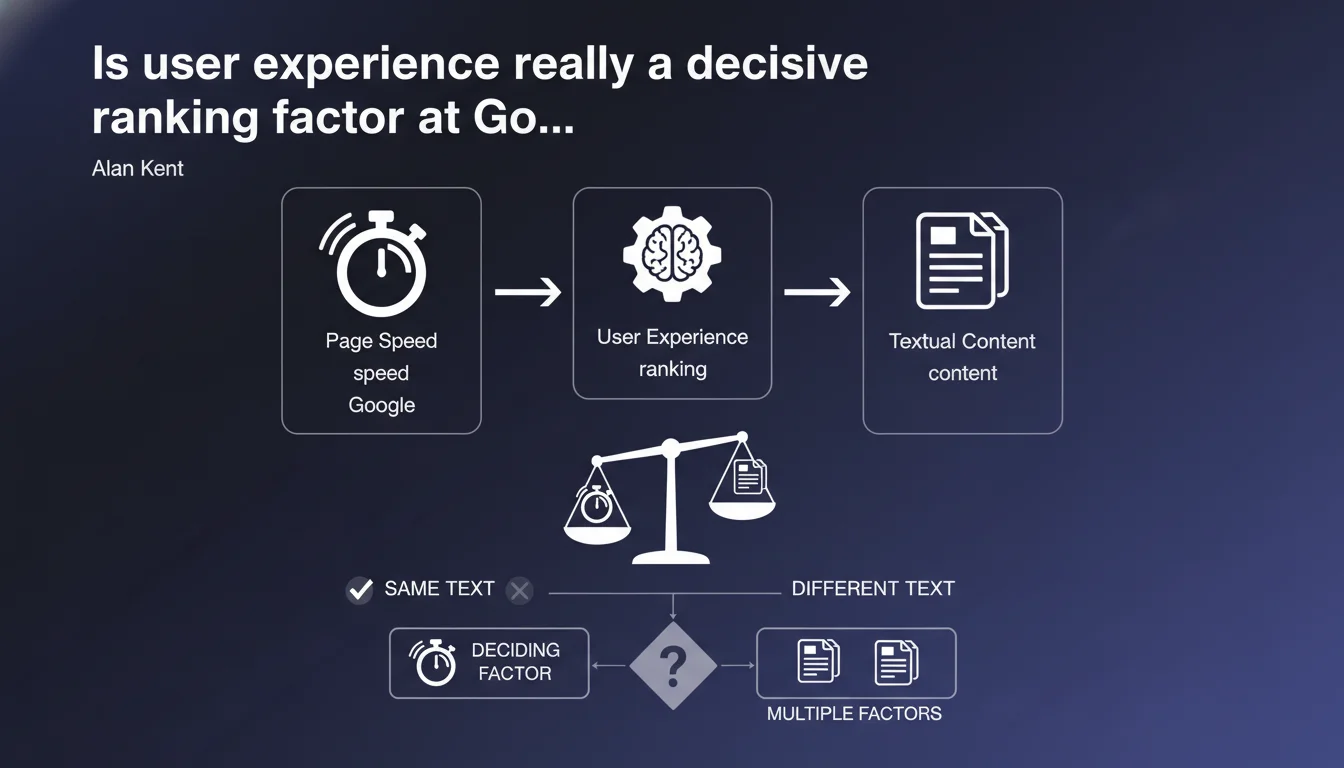
Google confirms that user experience constitutes an official ranking signal. Between two pages with equivalent textual content, page loading speed can make the difference in positioning. This statement validates the growing importance of Core Web Vitals and technical performance.
What you need to understand
What does this formalization of UX as a ranking signal really mean in practice?
Google is formalizing what many have already observed in the field: user experience carries weight in the algorithm. The nuance here lies in the case of a tie — if two pages offer the same textual content, technical performance becomes the discriminating criterion.
This statement is part of the ongoing rollout of Core Web Vitals as ranking factors. It clarifies that page speed is no longer just an ergonomics recommendation, but a measurable SEO lever.
What is the actual scope of this user experience signal?
The wording remains intentionally broad. Google speaks of "user experience" without precisely detailing which metrics are included. We can reasonably assume LCP, FID, CLS (the three pillars of Core Web Vitals), but also mobile compatibility, the absence of intrusive pop-ups, and HTTPS usage.
The textbook scenario mentioned — two pages with identical content — raises a question: in real life, do two pages ever have exactly the same textual content? This theoretical situation mainly allows Google to affirm a principle without quantifying its real weight.
How does this statement fit with the rest of the algorithm?
Alan Kent makes it clear that speed acts as a deciding factor in case of a tie. In other words, textual content remains the priority. UX acts as an arbitrator when everything else is comparable.
This implicit hierarchy confirms that Google maintains a multi-criteria approach: semantic relevance first, then authority signals, and finally user experience to break ties. Performance doesn't compensate for weak content, but it can tip the scales between two equivalent pieces of content.
- UX is an official ranking signal, not just a best practice
- Page speed becomes decisive in case of equal textual content
- Core Web Vitals represent the operational manifestation of this signal
- Content remains the primary criterion, UX acts as a secondary arbitrator
- This statement validates a trend observed since the rollout of Core Web Vitals
SEO Expert opinion
Does this statement match what we observe in the field?
Yes and no. On competitive queries where multiple sites offer comparable content levels, we indeed observe that faster sites tend to rank better. But quantifying this "better" remains difficult — are we talking about gaining 2 positions, 5, 10?
The problem is that Google provides no weighting scale. Saying that UX "can be the deciding factor" in case of a tie is vague. [To be verified] How often do site A and site B actually offer the same textual content with the same domain authority? This theoretical situation may mask a more nuanced reality.
What is the true reach of this announcement compared to other signals?
Let's be honest: user experience remains one signal among hundreds of others. Backlinks, content freshness, domain authority, semantic relevance — all these factors continue to play a major role.
What changes with this announcement is Google's explicit recognition. Before, you could always doubt it. Now, it's confirmed. But be careful not to overestimate its impact: optimizing Core Web Vitals on a site with mediocre content won't work miracles.
And that's where it gets tricky — Google doesn't say what percentage UX weighs. 5%? 15%? Impossible to say. This opacity leaves SEO professionals in the dark about the real return on investment of heavy technical spending.
What limitations or edge cases should be considered?
Certain sectors or types of queries escape this logic. On low-competition informational queries, a slow site with excellent content will continue to rank. On YMYL queries, authority and trustworthiness will take precedence over speed.
Furthermore, does this statement apply uniformly across mobile and desktop? User tolerance thresholds aren't the same. An LCP of 3 seconds on mobile might be acceptable, while it would be prohibitive on desktop.
Practical impact and recommendations
What concrete actions should you take right now?
Start by auditing your Core Web Vitals via Google Search Console and PageSpeed Insights. Identify strategic pages showing red or orange metrics — these are your priorities.
Focus on the three key indicators: LCP (Largest Contentful Paint) must be under 2.5 seconds, FID (First Input Delay) under 100 milliseconds, and CLS (Cumulative Layout Shift) under 0.1.
To improve LCP, optimize image weight (WebP, lazy loading), reduce render-blocking CSS and JavaScript, and consider a high-performance CDN. For FID, limit heavy JavaScript execution on initial load. For CLS, set explicit dimensions for images and iframes.
What common mistakes are unnecessarily slowing down your pages?
Many sites embed dozens of third-party scripts (ads, analytics, chatbots) that drag down performance without real ROI. Clean house — every script must justify its presence.
Poorly loaded web fonts also cause slowdowns. Use font-display: swap and limit the number of variants. A site doesn't need 6 different weights of the same typeface.
Another classic pitfall: unoptimized images. A 3 MB visual displayed at 300x200 pixels is pure waste. Automate compression and generation of modern formats (WebP, AVIF).
How can you verify that your optimizations produce measurable results?
Don't rely solely on Google tools. Use WebPageTest for more granular testing, and monitor your metrics over time with tools like SpeedCurve or Calibre.
Correlate your technical improvements with your positions in Search Console. If you get your Core Web Vitals in the green and your positions don't move over 2-3 months, other factors are limiting your progress — likely content or backlinks.
- Audit Core Web Vitals for your strategic pages in Search Console
- Optimize images: compression, modern formats (WebP), lazy loading
- Reduce render-blocking CSS and JavaScript, defer non-critical scripts
- Implement a CDN to accelerate static resource delivery
- Set explicit dimensions for all visual elements (images, iframes)
- Audit third-party scripts and remove those that don't add value
- Test regularly with WebPageTest and PageSpeed Insights
- Monitor the evolution of your positions after each wave of optimizations
❓ Frequently Asked Questions
Les Core Web Vitals sont-ils les seuls critères d'expérience utilisateur pris en compte par Google ?
Un site lent mais avec un excellent contenu peut-il quand même bien se positionner ?
Quel délai faut-il pour voir l'impact d'une amélioration des Core Web Vitals sur le classement ?
Faut-il optimiser toutes les pages du site ou se concentrer sur certaines prioritaires ?
Les seuils des Core Web Vitals sont-ils les mêmes pour mobile et desktop ?
🎥 From the same video 13
Other SEO insights extracted from this same Google Search Central video · published on 29/06/2022
🎥 Watch the full video on YouTube →
💬 Comments (0)
Be the first to comment.